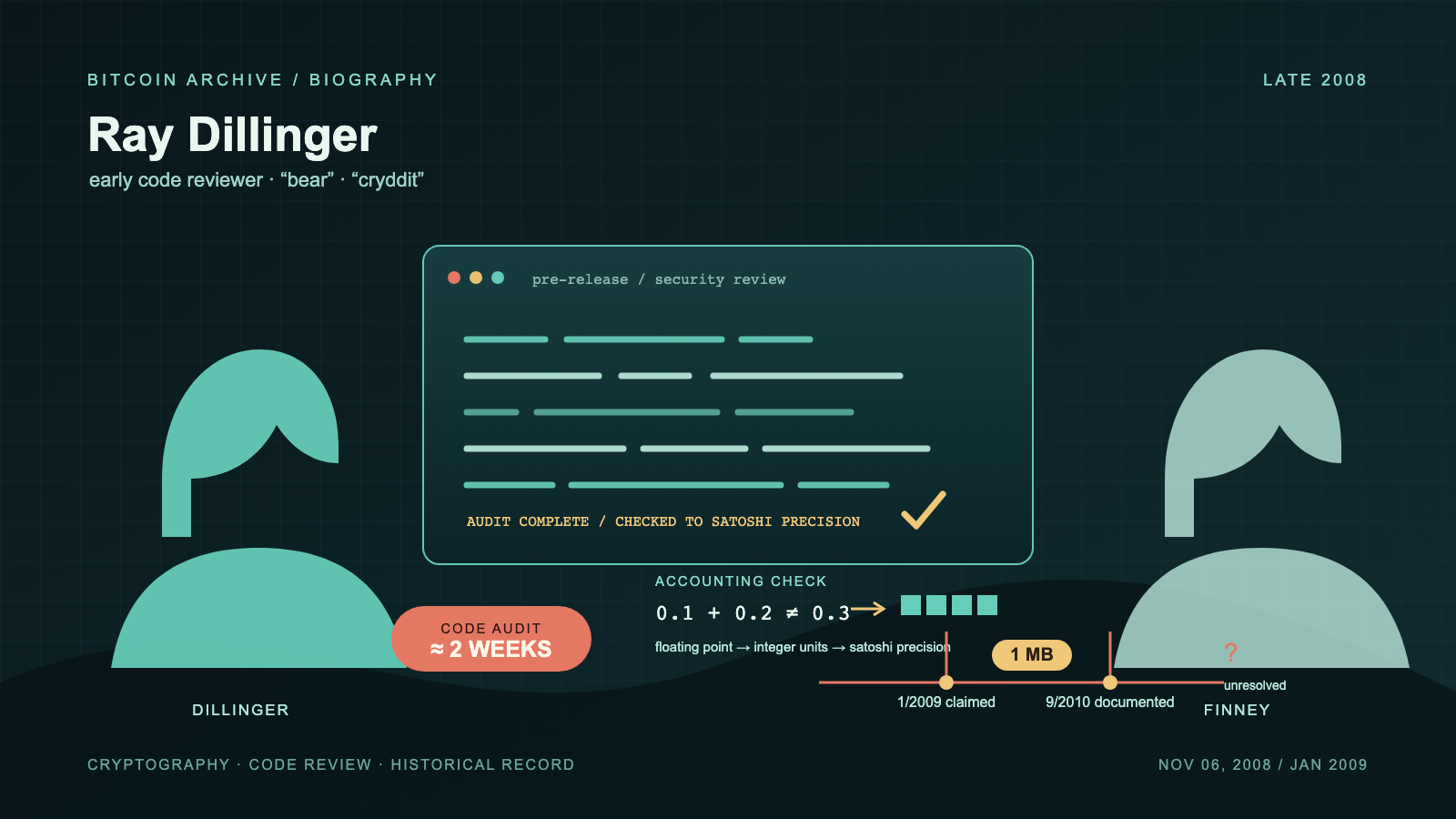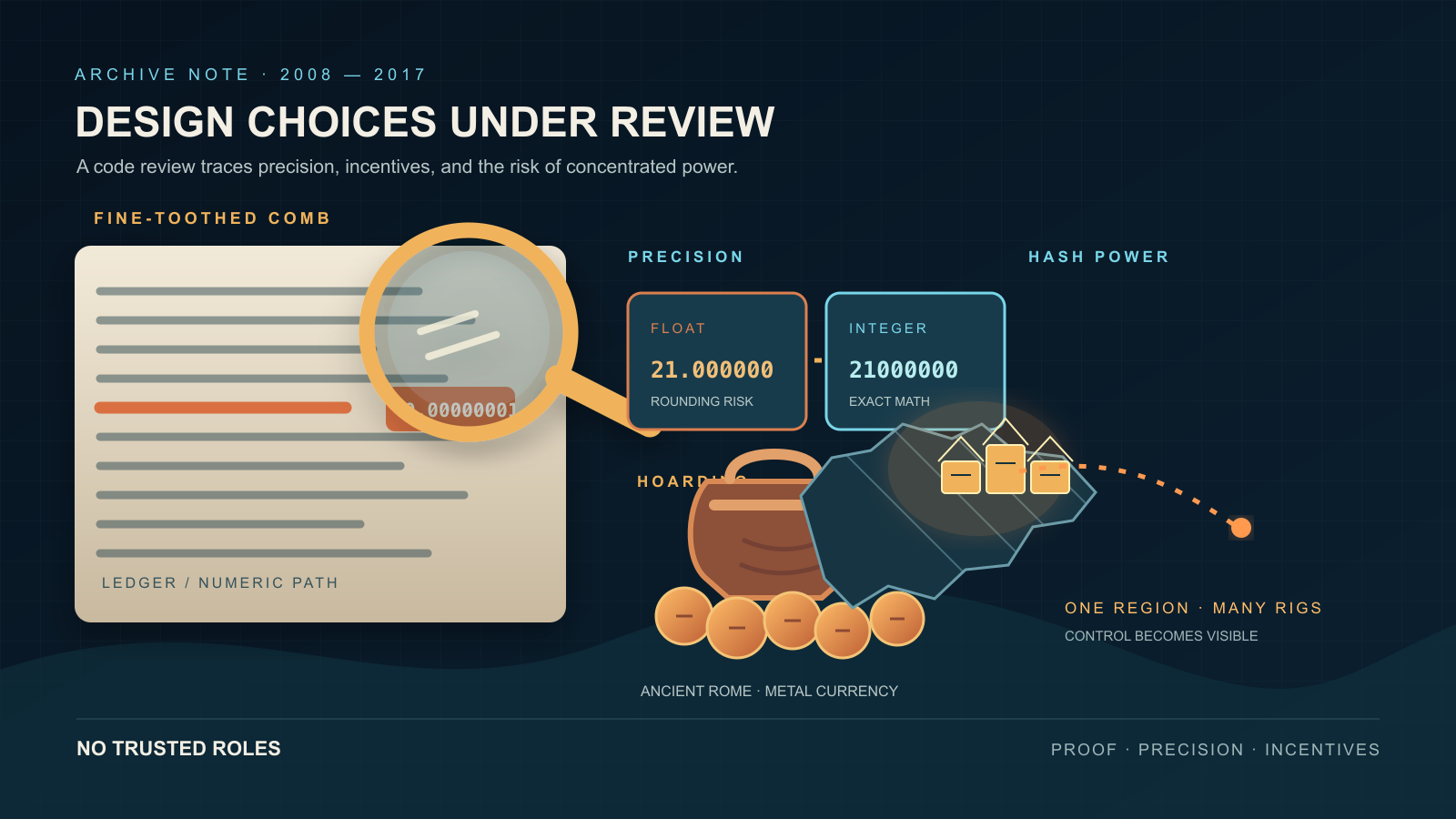
In November 2008, Ray Dillinger reviewed the blockchain portion of Bitcoin’s source code, splitting the pre-release audit with Hal Finney, who took the scripting language, while Satoshi fielded their questions and asked his own. He’d built something related himself thirteen years earlier — a block-chain-based digital-cash design in a 1995 graduate networking paper — and found Satoshi’s cryptographic code tight. His two objections were structural, not stylistic: powerful actors could attack the early network, and bandwidth would strain as it grew.
The full essay is here. After launch, Dillinger stepped back rather than mine, on the reasoning that proof-of-work hashes had no reason to acquire nonzero value and that the bandwidth requirements looked impractical at scale — a call that reads, from 2017, as the essay’s title implies: a plausible technical judgment that missed what was actually starting.
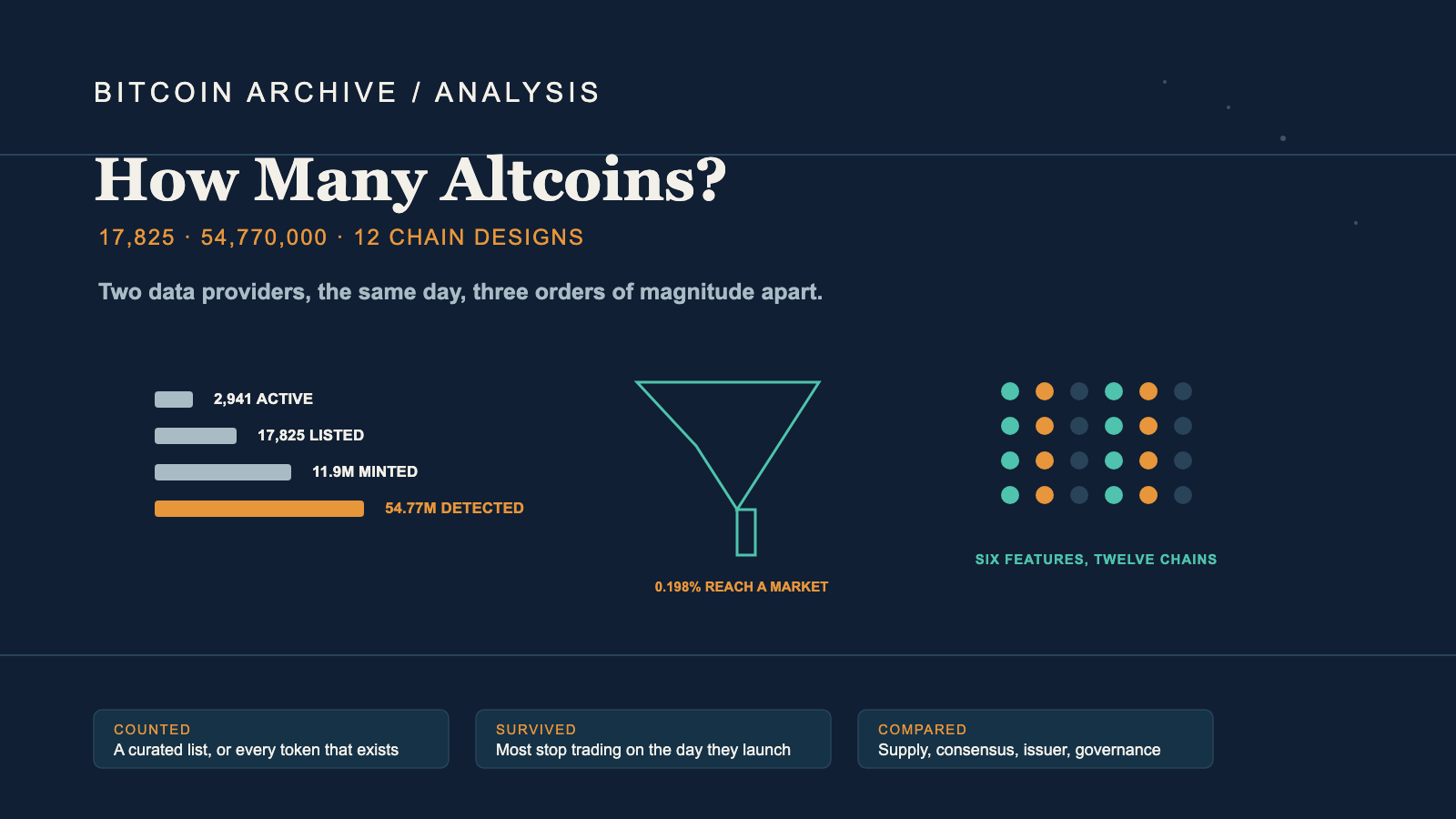
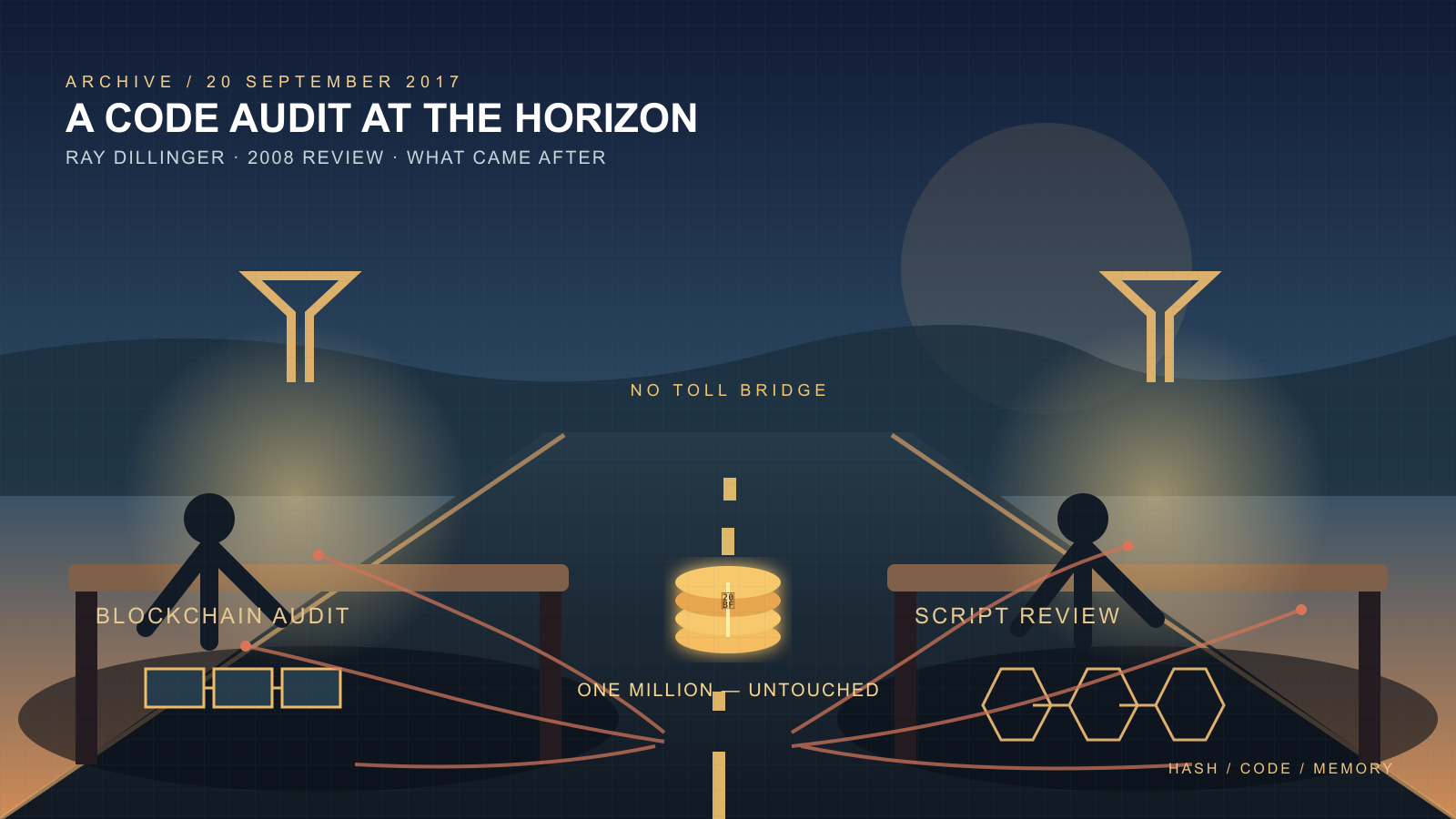
What convinced him Satoshi wasn’t running a con was mining behavior, not code: “Satoshi mined approximately one million bitcoins but never sold any.” Dillinger reads that restraint as the clearest evidence of genuine disinterest in personal enrichment, in explicit contrast to what came after — by his count, over 3,000 altcoins, at least three quarters of them, in his words, knowingly built to take money from people. The archive’s own altcoin and ICO-scam count backs the shape of that claim: the Satis Group found roughly 78% of 2017-era ICOs were identified scams. Dillinger singles those ICOs out for looking like “blatant stock price manipulation and insider trading,” a judgment that legitimate blockchain projects paid for by association.
Quote from: Ray Dillinger on September 20, 2017Satoshi built a highway with no toll bridge. He wasn’t selling coins, he was giving them away for solving hashes.
The line lands harder set against Dillinger’s own reasoning for stepping back: he judged the highway not worth building on, then watched everyone else build toll bridges on it anyway.
This piece was published on LinkedIn on September 20, 2017, and reached the front page of Hacker News on September 21, 2017, receiving 329 points and 86 comments.
Dillinger sketches the division of review labour with Hal Finney here; the deeper technical substance of that audit — the floating-point accounting discovery and the satoshi-precision design choice — is drawn out at length in his 2018 interview with Tim Swanson.
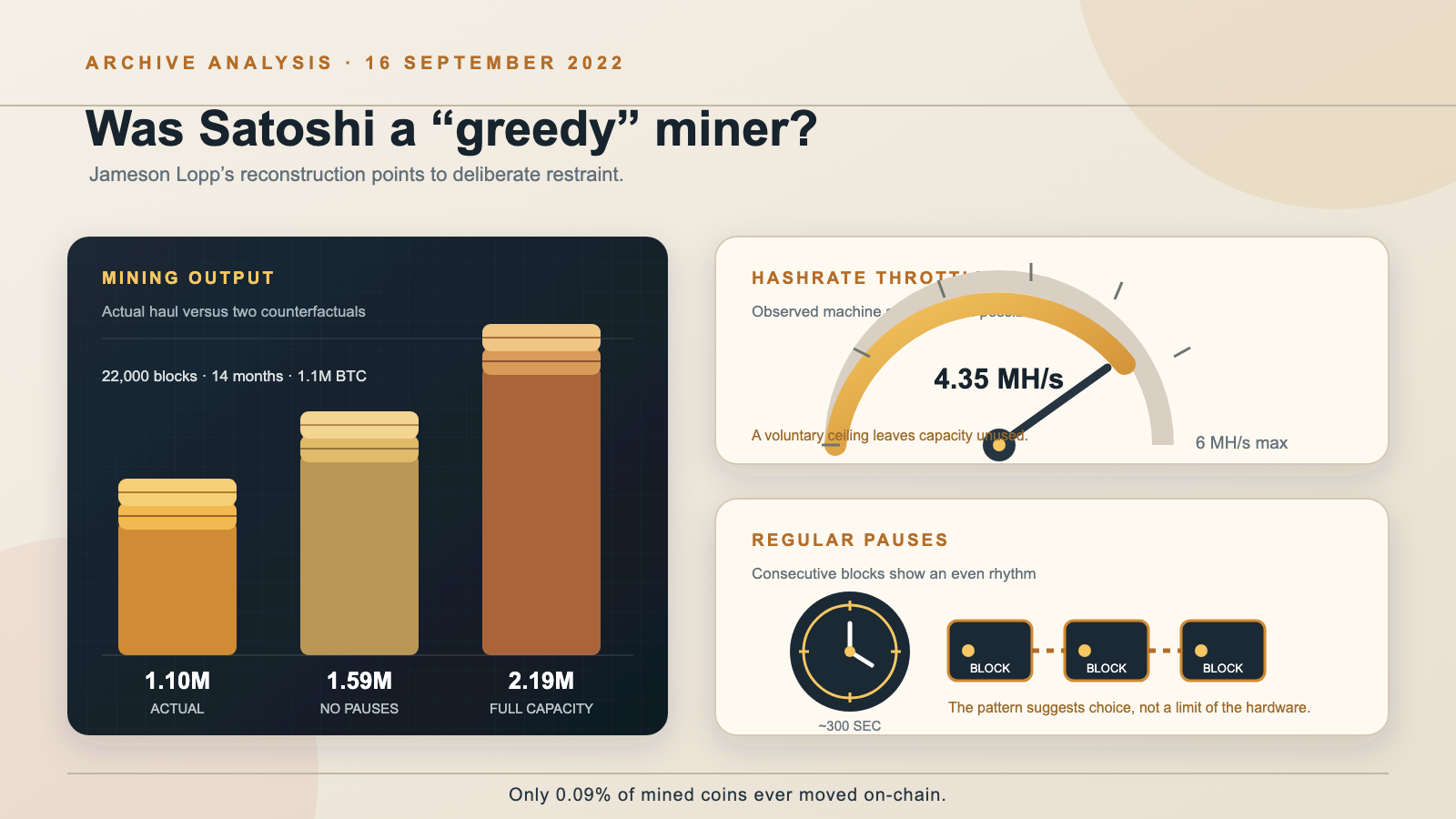
Dillinger’s claim here — that Satoshi mined roughly a million bitcoins and never sold any of them — is corroborated and quantified five years later by Jameson Lopp’s 2022 data analysis, which finds Satoshi’s actual mining output was only about half of what his hardware could have produced running at full capacity.