Will this coin buy more dollars next year than it does today? Every chain wrote part of the answer into its own rules, years before anyone bought anything — and the part it wrote is narrower than the question.
Why each design chose its issuance rule is a debate running from 1998; why Bitcoin has value at all is a structural argument; why its own scarcity wore down its use as cash is the tension every later design had to answer. All three sit above the plainer question a buyer actually asks.
1. What a design can and cannot do to the price
The unit price rises when demand grows faster than supply. An issuance rule fixes one of those two, years in advance, in code: how fast supply grows. It fixes nothing about the other. So the design decides the bar the buying has to clear, and never whether the buying arrives.
So the question a buyer is really asking splits in two: how high is the bar, and is the buying growing faster than that? Only the first has an answer written down. Throughout what follows, buying holds steady means the flow of money coming in stays at the rate it is at now — not that the total already invested is frozen.
That is a narrow power, and it is the whole of what a monetary design controls.
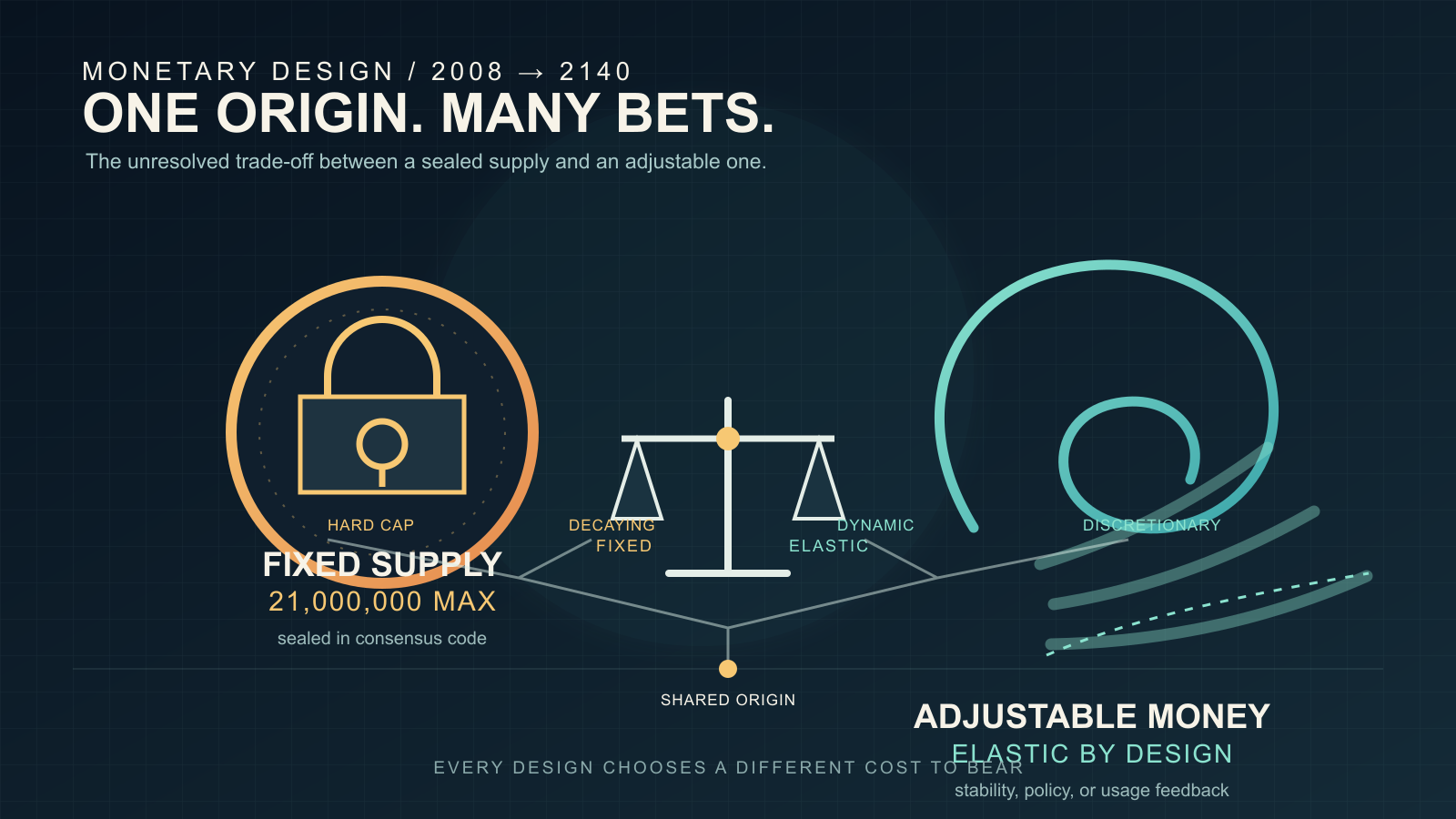
But the choice of rule is not narrow at all: it is a statement about what the currency thinks it is. A ceiling says the unit should not be diluted. A burn tied to usage says supply should answer to the network. A peg says the unit should not move. A fixed annual issuance says the thing is meant to be spent, not held.
Those positions sort into six, and each sets a different bar. The fixed-supply comparison traces which failure each project was trying to avoid when it picked its position, from b-money in 1998 through the Ethereum Merge.
| What the currency takes itself to be | How the rule says it | Chains | The bar: how fast supply grows | Where the price goes if buying holds steady |
|---|---|---|---|---|
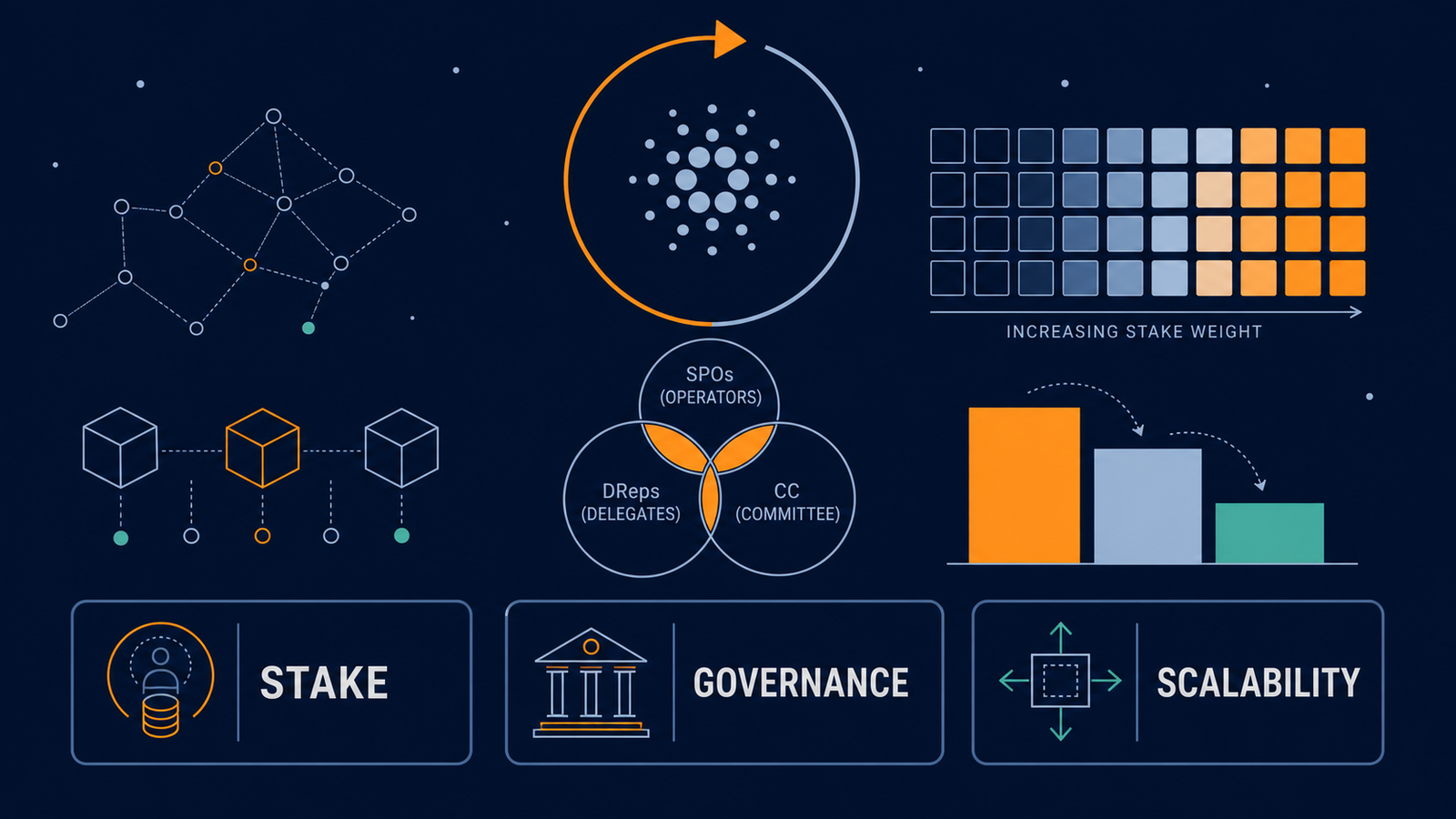
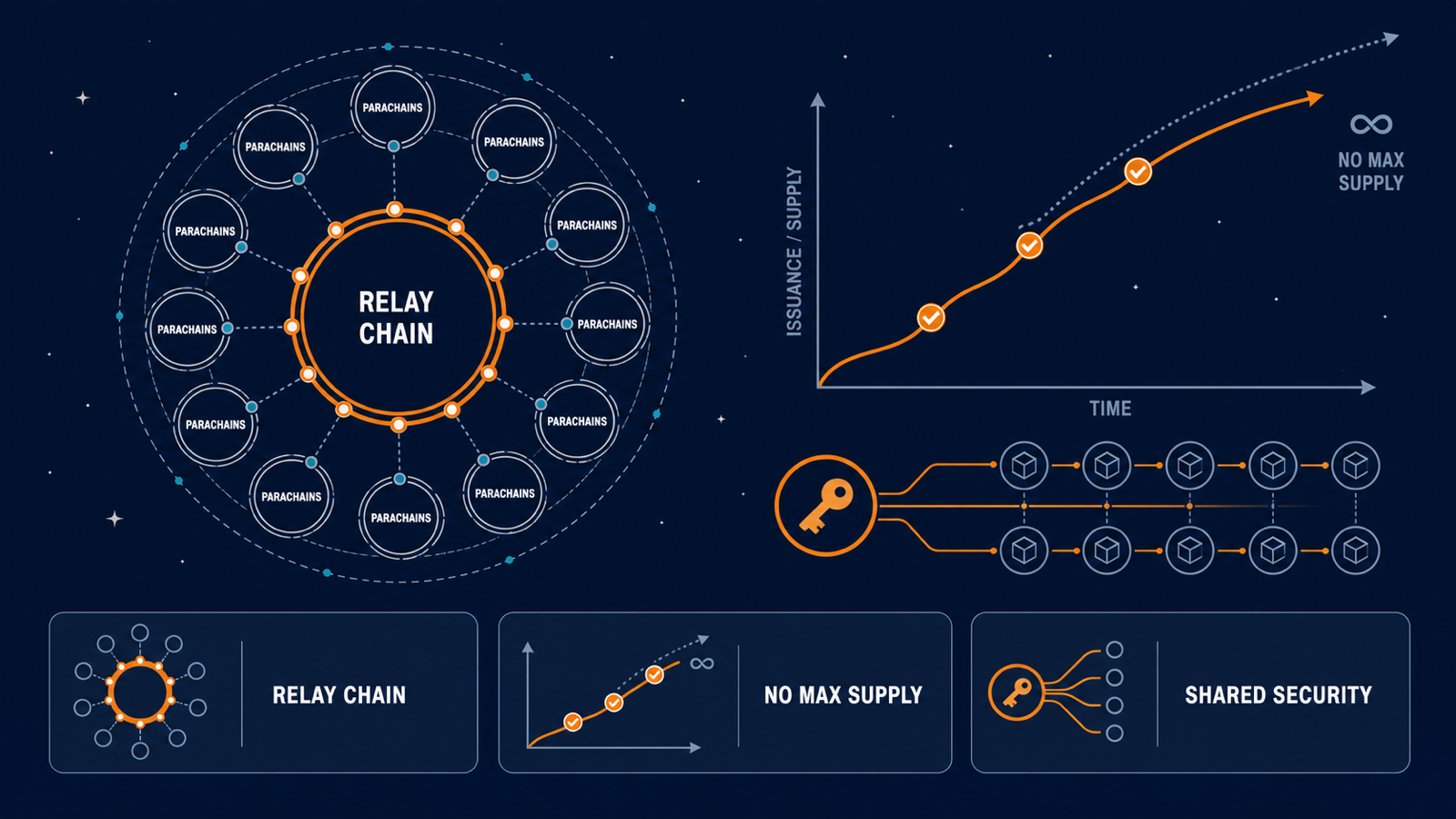
| Scarce — it must not be diluted | A ceiling, with issuance decaying toward it | Bitcoin, Litecoin, BCH, BSV, Cardano, Polkadot | Falling by steps toward the cap | Up, and by more each step as the bar drops |
| Scarce, and issued all at once | The whole supply generated at launch | XRP | Zero — the schedule has already run | Up, with no bar to clear at all |
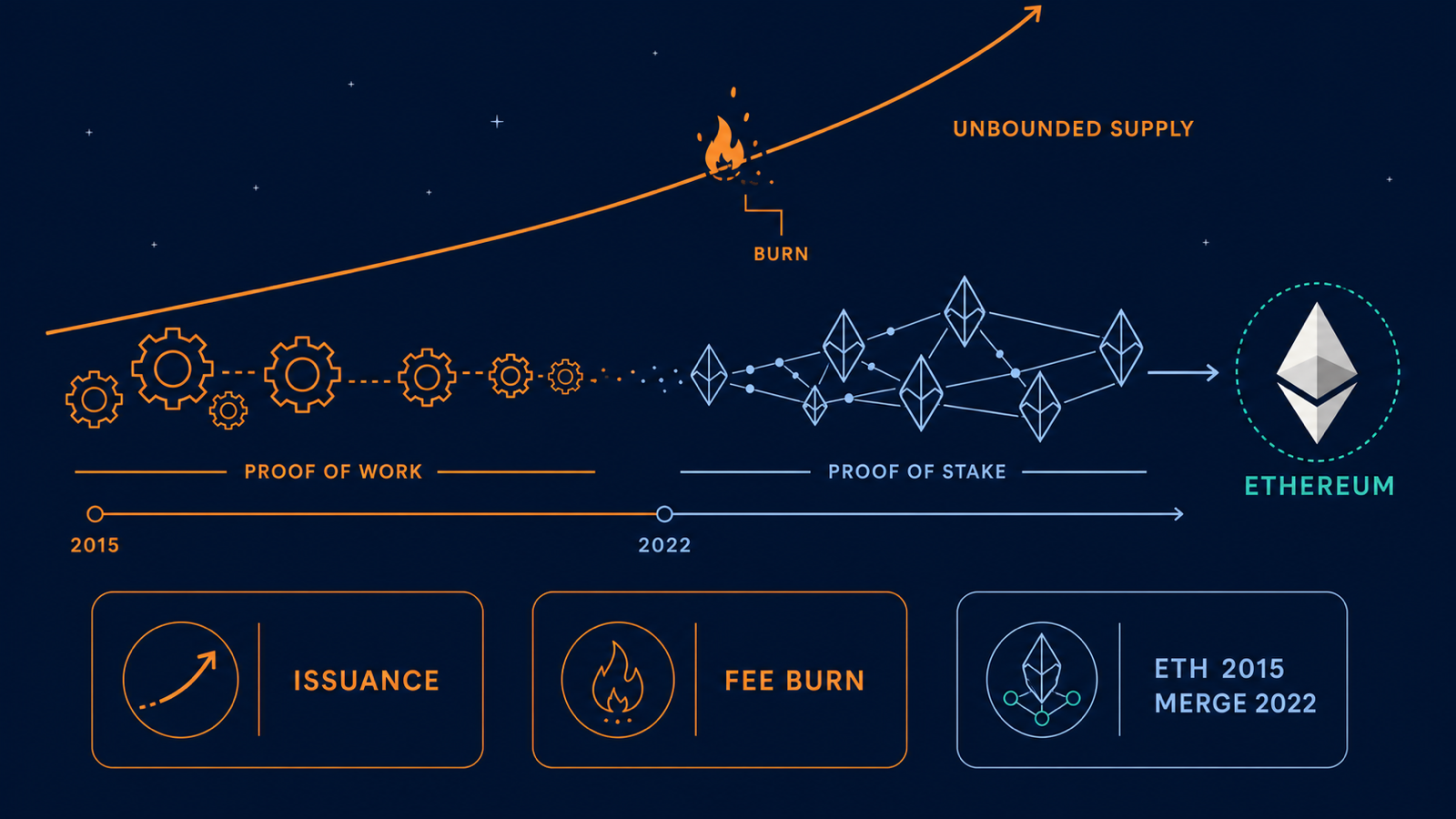
| Self-adjusting — supply answers to the network | Issuance plus a fee burn, so supply can shrink | Ethereum | Set by usage; negative when burn exceeds issuance | Either way, depending on how busy the chain is |
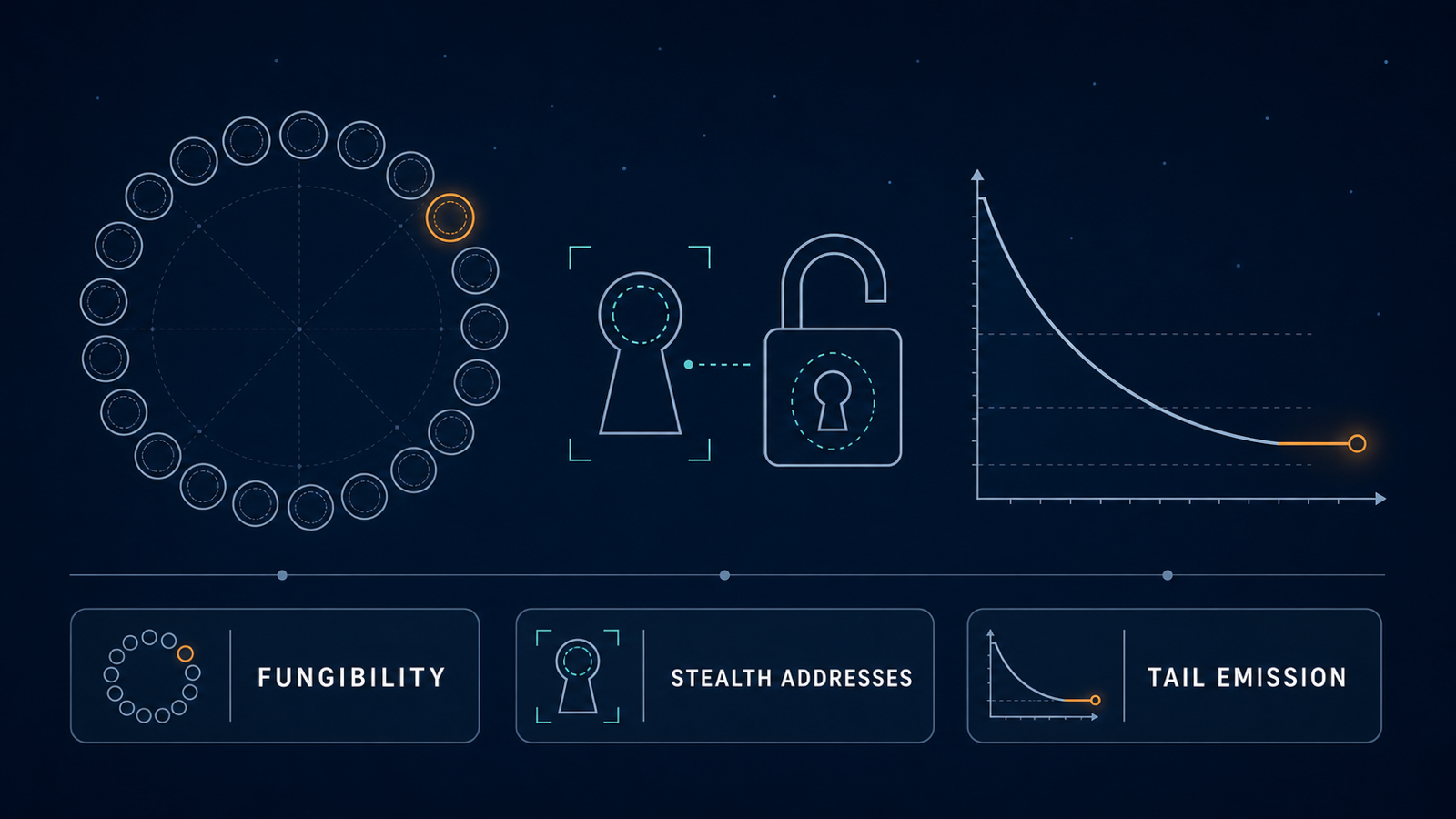
| Self-adjusting on a published curve | A declining rate, or a permanent tail that never reaches zero | Solana, Monero | Falling, but never to zero | Up, once buying clears a bar that keeps shrinking |
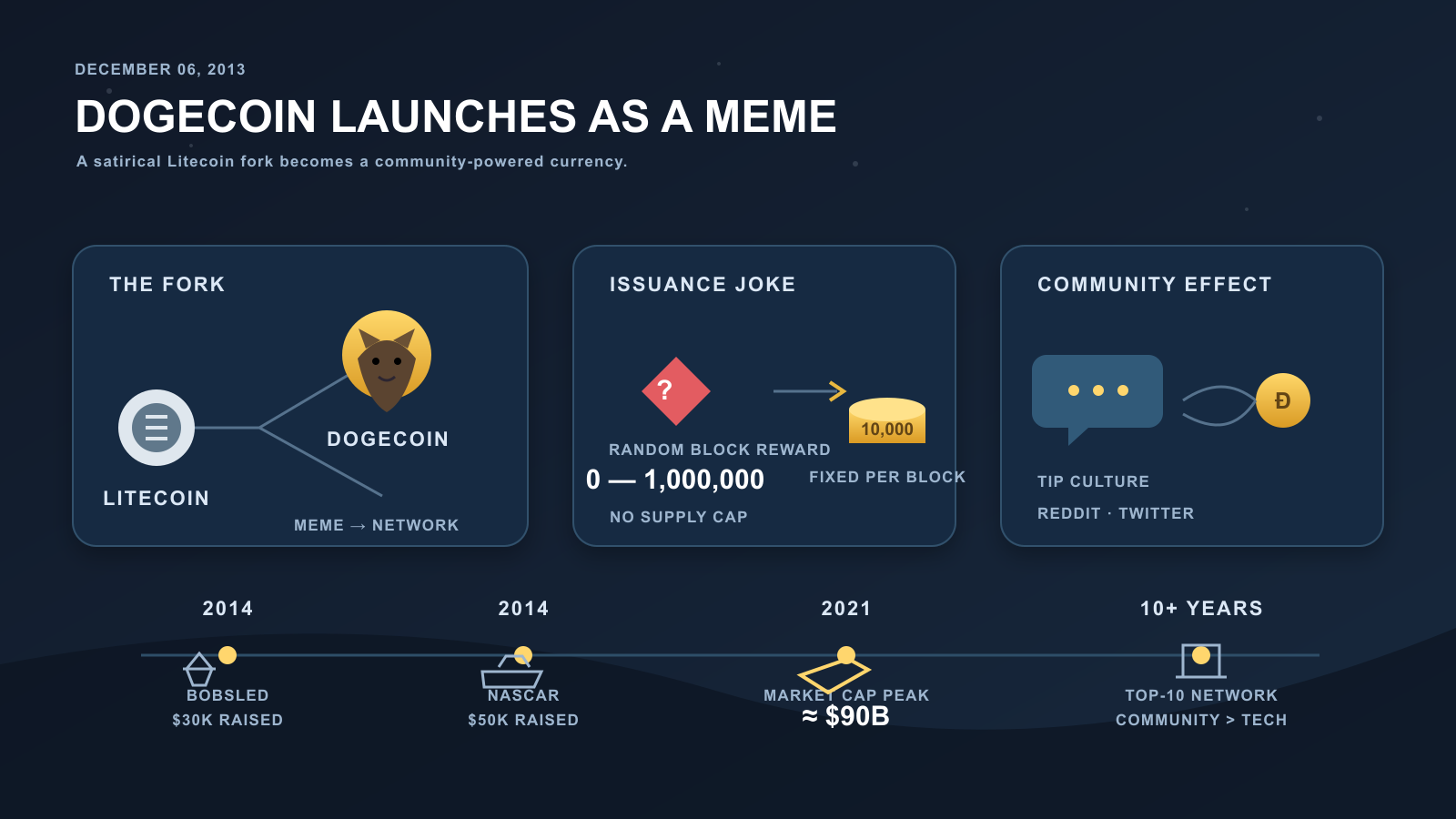
| A currency to spend, not an asset to hold | A fixed number of units, issued forever | Dogecoin | 5.256 billion a year against a base that grows, so about 3.5% and falling | Up, on a bar that falls without the rule ever changing |
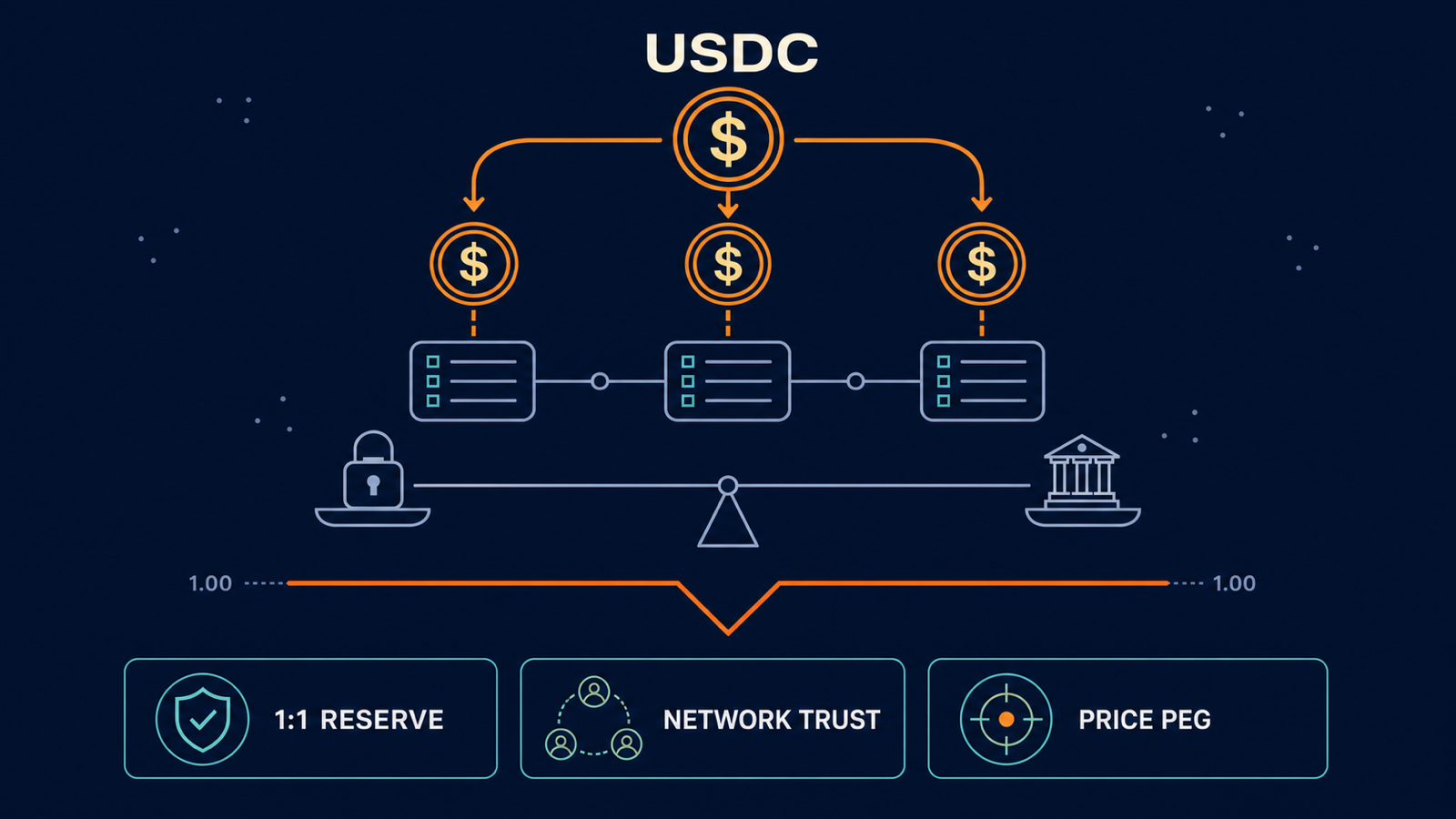
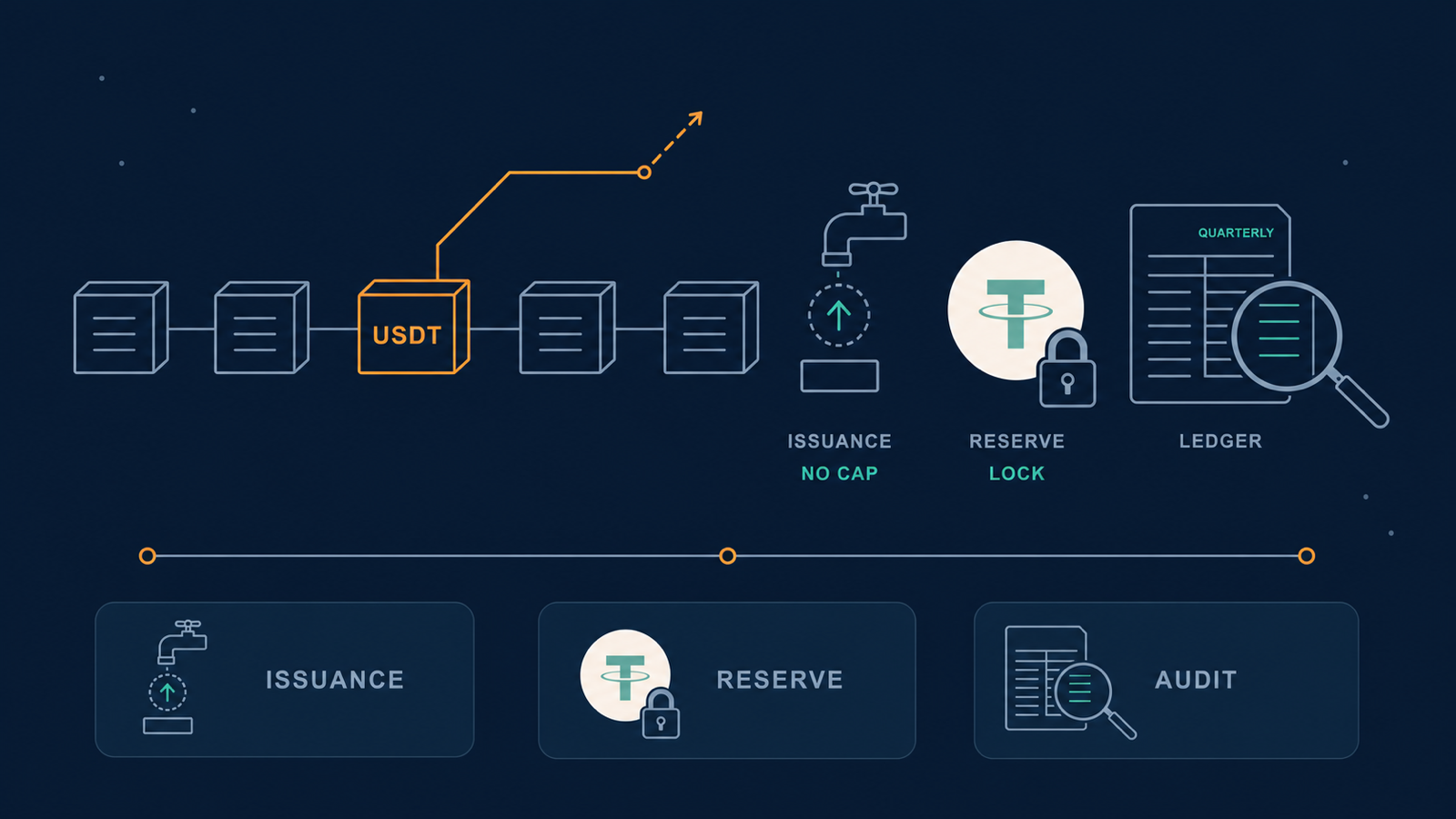
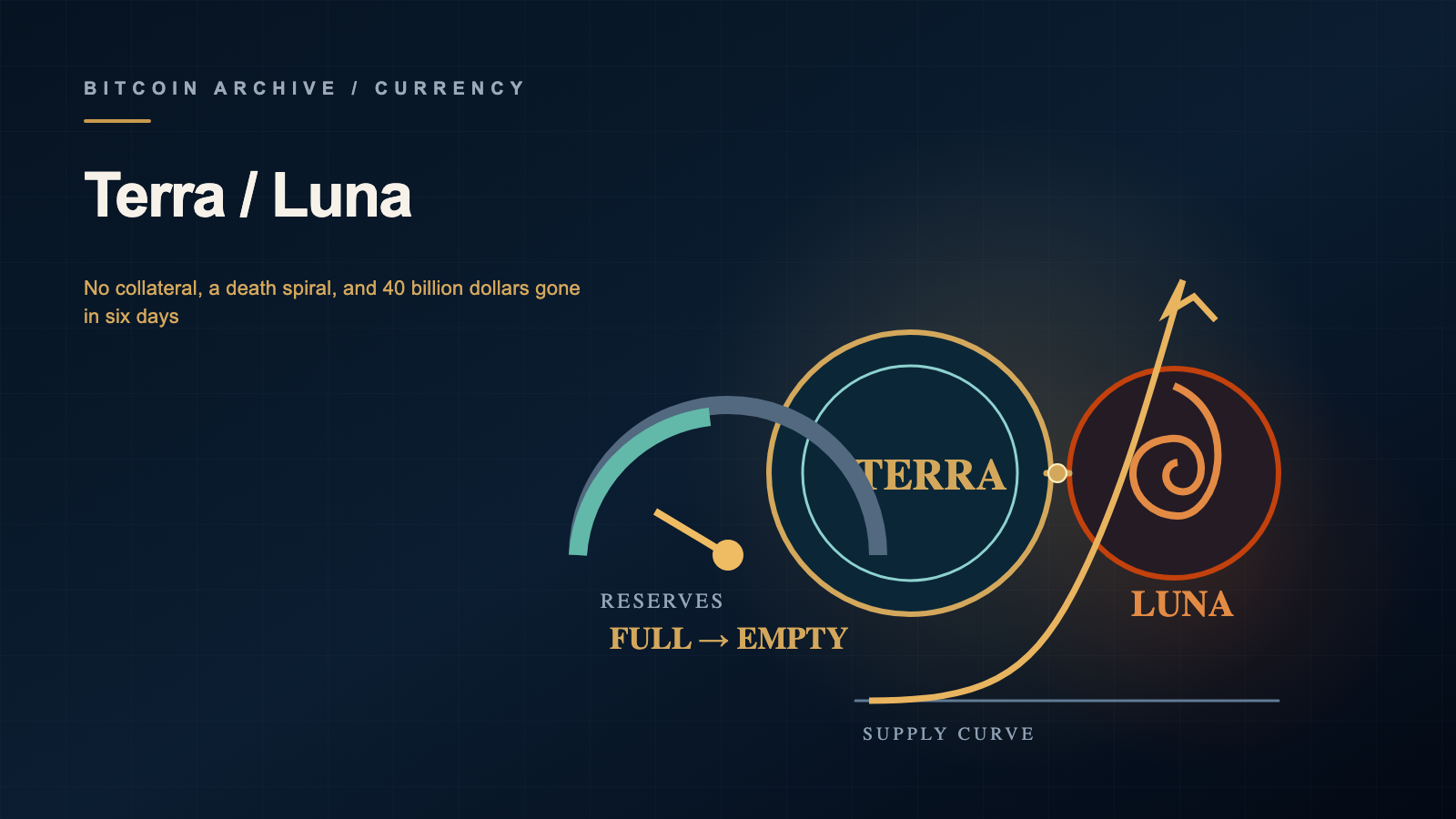
| Pegged — it must not move at all | Supply expands and contracts to hold one dollar | USDT, USDC | Whatever the issuer’s reserves do | Nowhere — new money reaching the issuer mints units rather than moving the price |
The first row and the fifth are the same observation taken from opposite ends. The electronic-cash reading traces how Bitcoin’s own scarcity wore down its use as cash: nobody pays for today’s lunch with something worth more tomorrow, so the property that made it gold is the property that took the spending away. Any design that puts use first has to answer that, and the answer is a supply that keeps moving. Dogecoin issues forever so holding is not the winning move; Ethereum ties issuance to usage so the network’s activity, rather than a schedule, sets the number. Self-adjusting and use-first are not two separate philosophies in the table above. They are one position, reached by taking the cash side of the trade the scarcity designs took the other side of.
Two things follow from those two columns.
The bar is the design’s entire contribution. It is a number, it is published, and it is settled years before anyone buys anything. Everything else about where the price goes sits on the other side of the comparison.
No design brings the buying. A halving does not add a buyer. A burn does not add one. A cap does not add one. Each lowers the bar; none supplies the thing that has to clear it. That is why the last column says if buying holds steady — the condition is carrying the weight, and no line of a supply schedule guarantees it.
The stablecoins show the seam by taking the price out of the comparison altogether. Buying USDC does not move its price; it mints another unit. The dollars deposited move constantly and the unit price does not, by design.
Two readings in wide circulation get this wrong.
“Inflationary forever” does not mean “diluting at a constant rate.” Dogecoin issues the same 5.256 billion units every year against a base that grows every year, so the percentage of the supply that is new falls each year without the rule ever changing. Holding a dilution rate steady takes a rule that targets the percentage rather than the number, and the chain that had one no longer does. Polkadot ran a ~10% annual target until its own token-holders voted it away: Referendum 1710 took effect in January 2026, capping supply at 2.1 billion DOT and replacing the target with a stepped schedule that mints 13.14% of the remaining supply every two years, the first step falling on March 14, 2026. It is the clearest case in this table of §2’s last column being used: the party who can change the rules changed the monetary rule.
A hard cap is a floor under the unit count, not a floor under the price. Bitcoin’s cap guarantees that the denominator stops growing; it guarantees nothing about the numerator. What the cap actually removes is one specific way of losing value — issuance decided by someone else.
In the other direction, coins that become permanently unspendable reduce the effective denominator without any rule change; the record of iconic losses collects the documented cases.
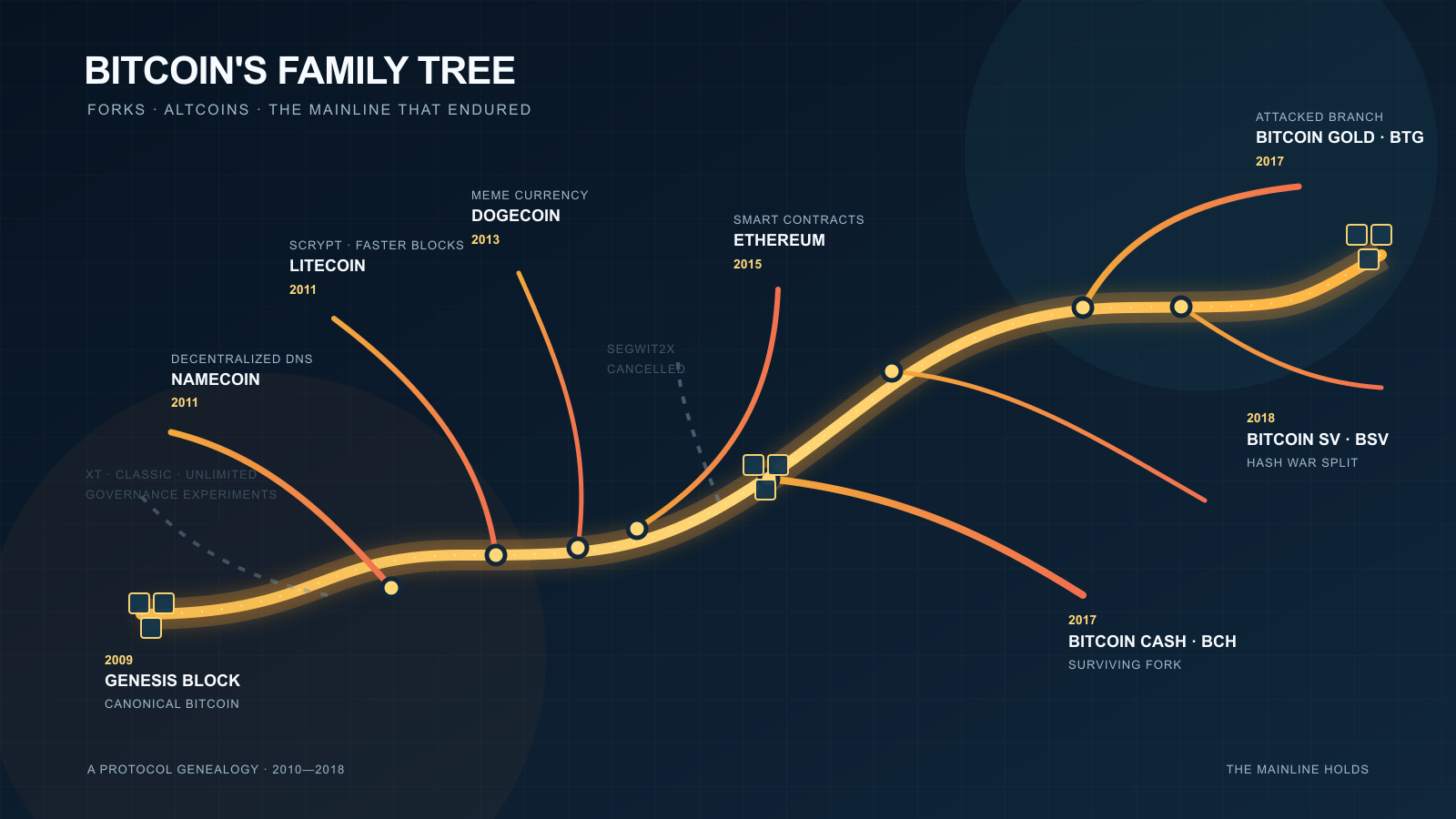
There is one thing the unit price will not do, and it is the thing it gets used for most: compare one coin against another. Bitcoin caps at 21 million units, XRP generated 100 billion at launch, and Dogecoin adds 5.256 billion a year, so a coin trading at $0.20 with a trillion units outstanding is a larger asset than one trading at $200 with a million. “Cheap, so there is room to grow” is the intuition the figure invites, and the arithmetic does not support it: the denominator it is divided by was chosen at launch and says nothing about demand. The market history of the closest thing to an overtake, Ethereum reaching about 85% of Bitcoin’s market capitalization in June 2017, is recorded with its dated snapshots in the fork-and-altcoin genealogy.
Was any of this meant to make a coin worth more?
What each design says it wants to happen to the value of a unit sorts into three groups: keep it from being diluted (the hard-cap chains), keep it from moving at all (the stablecoins), or treat value as somebody else’s department (the performance chains, and Dogecoin).
What is missing from the whole set is a fourth group. No design document among these twelve argues that its coin will become worth more. The hard-cap projects argue about who may issue, not about where the price goes. Ethereum’s whitepaper gives fairness to later arrivals as its reason for having no cap. The stablecoins promise the opposite of appreciation. And Dogecoin’s co-founder denies the link outright — the sharpest statement anyone in this record has made about supply and price:
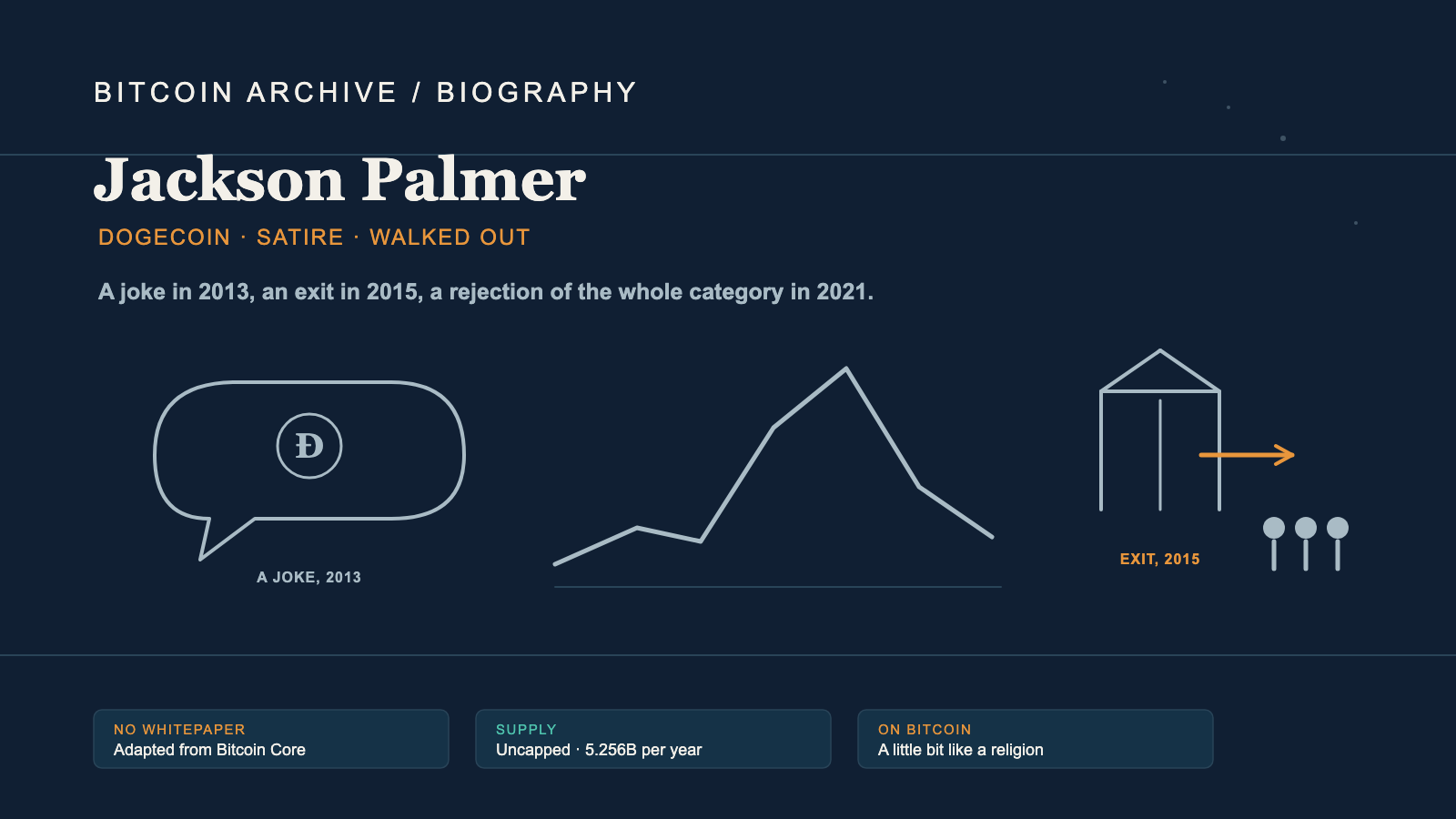
New coins come out every day, hour, minute, with various parameters and various random reason people can point to that make them superior or not. Those don’t matter for price. Only buying and selling does.
Jackson Palmer, asked what Dogecoin was for, gave the matching answer:
Is Dogecoin ever going to rock the foundations of the financial world? No, and that was never its intent.
The appreciation case, in other words, is made by holders and not by specifications. That is not an argument against it — a scarce, non-discretionary asset can be worth holding whether or not its designer said so, and the digital-gold reading sets out the structural version of that case, while Satoshi’s own production-cost argument is the one place in this history where a designer does reason about price directly. It is an argument for reading the two claims separately, because the projects themselves do.
The coins in §8 are the exception, and they invert the question. A coin whose supply is allocated to its issuer before launch, and whose fee revenue accrues to that issuer regardless of price, is a design with a very definite view about where value goes — it just is not a view about the unit price.
The bind, and the question underneath it
Put the two halves together and the taxonomy turns into a trap.
A design that protects the unit from dilution makes it worth holding, and a thing worth holding is not spent — that is the mechanism the electronic-cash reading traces through Bitcoin’s own history, from the pizza to the settlement layer.
But the reverse holds too. A design that keeps issuing so the unit stays spendable is a design that has removed the reason to accumulate it. Dogecoin is cheap, fast, and works; the record of its launch concludes that its lasting significance is sociological rather than technical — it held its position through community and brand, not because its monetary design made it good money. The stablecoins are the cleanest case: they are held in enormous quantity and by construction nobody holds them expecting more.
So each side of the table fails at what the other side is for. Neither is a flawed execution of a single goal; they are the two ends of a trade nobody has been able to avoid making.
Which raises the question the whole comparison sits on, and Bitcoin Institute cannot settle it: what is any of this for? If the need is a convenient way to pay, that need is already met. Card networks settle billions of payments a day, and almost nobody declines to use PayPal on the grounds that it is centralized. The honest description of the demand for non-sovereign money is not that people prefer it. It is that they do not need it until they are the ones who get cut off — and then they need it absolutely.
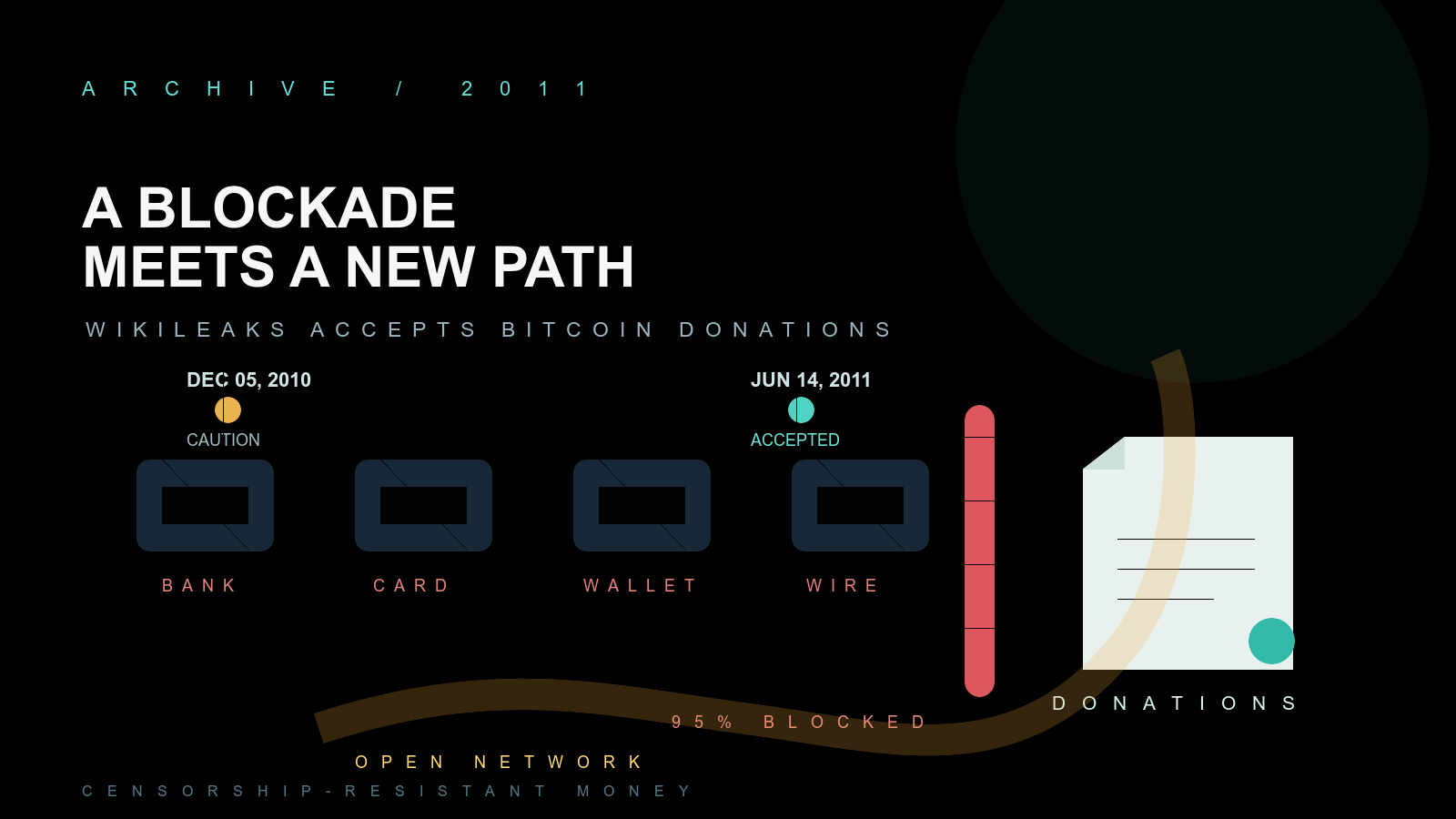
There is a documented instance. In November 2010, after CableGate, Bank of America, Visa, MasterCard, PayPal and Western Union all blocked donations to WikiLeaks, removing an estimated 95% of its revenue; in June 2011 it began accepting Bitcoin. Nothing about that case is convenience. The property being bought was the absence of a party who can decline, which is exactly what §3 tests for and exactly what no incumbent can offer. Jeremy Allaire — who sells the sovereign product — describes the same demand from the other side of the counter:
That’s the digital gold thesis, and I think a lot of both institutional accumulators of bitcoin, individuals, very specifically individuals in jurisdictions or environments where the intense concern about capital controls are there.
That is a narrower demand than “money for the internet,” and it is contingent: real, documented, and irrelevant to most people on most days.
Which leaves the uncomfortable reading, and the record leans toward it. What moves volume in this category is not the payment property. It is the price. The largest holder counts in this archive belong to coins with no payment use at all — roughly two million wallets bought a token announced on a social-media account three days before an inauguration, and Chainalysis found 764,000 of them underwater. Bitcoin’s own first purchase of a real good is now remembered not as the design working but as the trade someone should not have made. Dogecoin’s co-founder says supply parameters are irrelevant and only buying and selling sets the price. Wei Dai, whose b-money Bitcoin cited, said the volatility makes it a poor everyday currency.
And the same question can be asked of the builders, which is where it gets uncomfortable. Bitcoin Institute does not assert motive — what someone intended is not in the record. What is in the record is who held what before the philosophy was ever tested. Ripple’s founders and company held the bulk of a supply generated in full at launch. Cardano allocated 20% of the vouchers sold to IOHK, EMURGO and the Foundation, on its own published page. Ethereum ran a pre-launch sale with a founder and contributor allocation. Solana’s own disclosure states that it did not tell the public about an 11,365,067 SOL loan during the token auction. In each case the monetary argument and the allocation table are two documents from the same project, and only the first one is about what money should be.
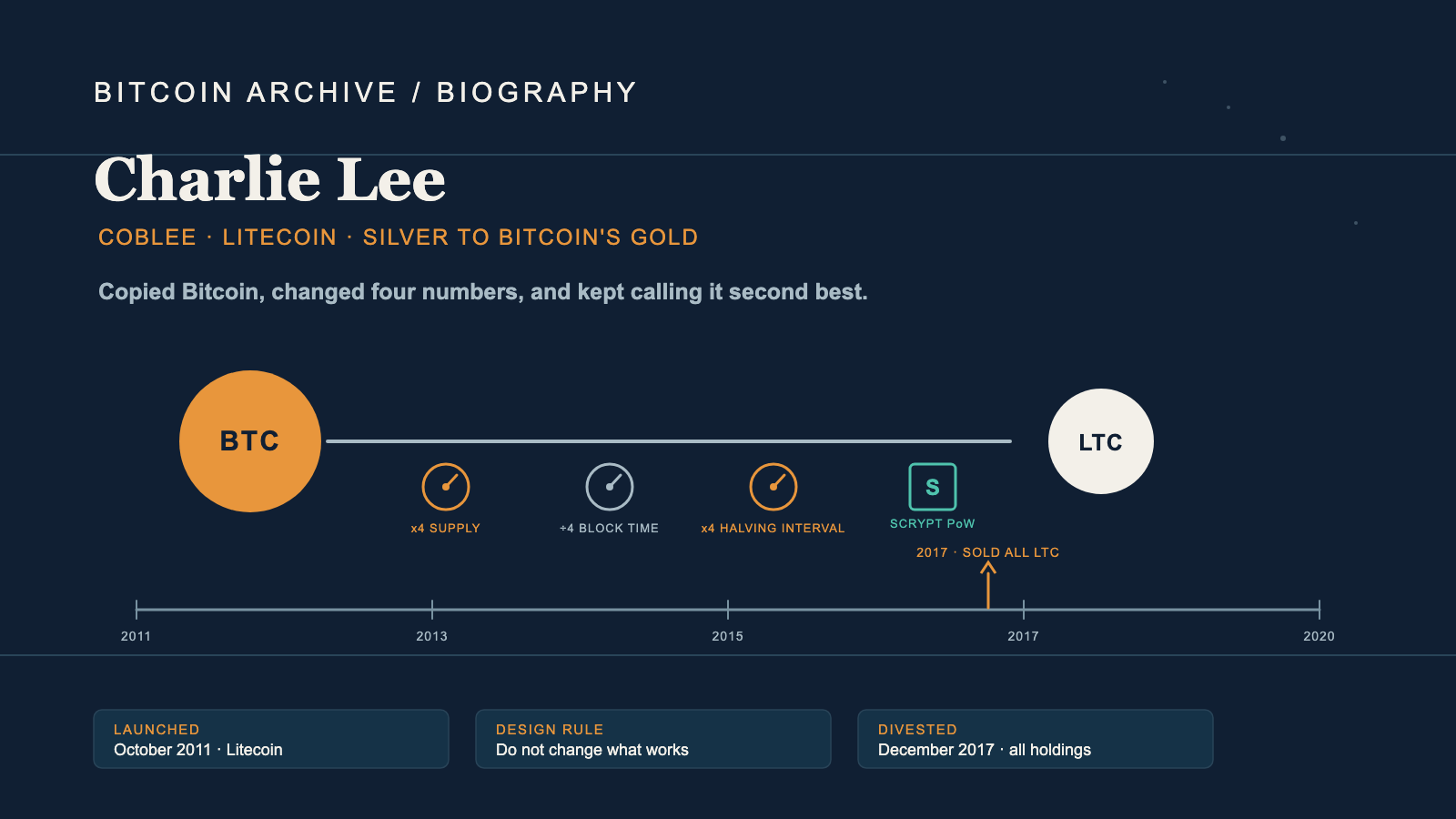
That is why §3’s fair-launch column is not a moral scorecard but a structural one: a founder holding a pre-launch allocation cannot separate the question “is this design right” from the question “does this design pay me,” because the answer to the second does not depend on the first. Exactly one founder in this record removed that entanglement deliberately. Charlie Lee sold or gave away his entire Litecoin position in December 2017 and named the reason: holding it while commenting on it was a conflict of interest, because he had too much influence over the price. That it happened once says more than the act itself does.
So the designs are conducting an argument about what money should be, and the market is largely not participating in it. That is not a reason to dismiss the argument: the WikiLeaks case is what the argument is for, and it does not stop being real because it is rare.
One more thing follows, and it cuts across the builder-and-buyer split. Demand for an asset nobody can seize is a function of how likely you think it is that someone will seize it. Where institutions work, the incumbent rails are enough and the property is abstract; where they do not (the blockade, the capital control, the currency that lost 99% of its purchasing power), the property is the only thing on offer. That is not a claim about human nature. It is the shape of the demand curve the record actually shows, and it explains why the same design reads as a portfolio curiosity in one jurisdiction and as an exit in another.
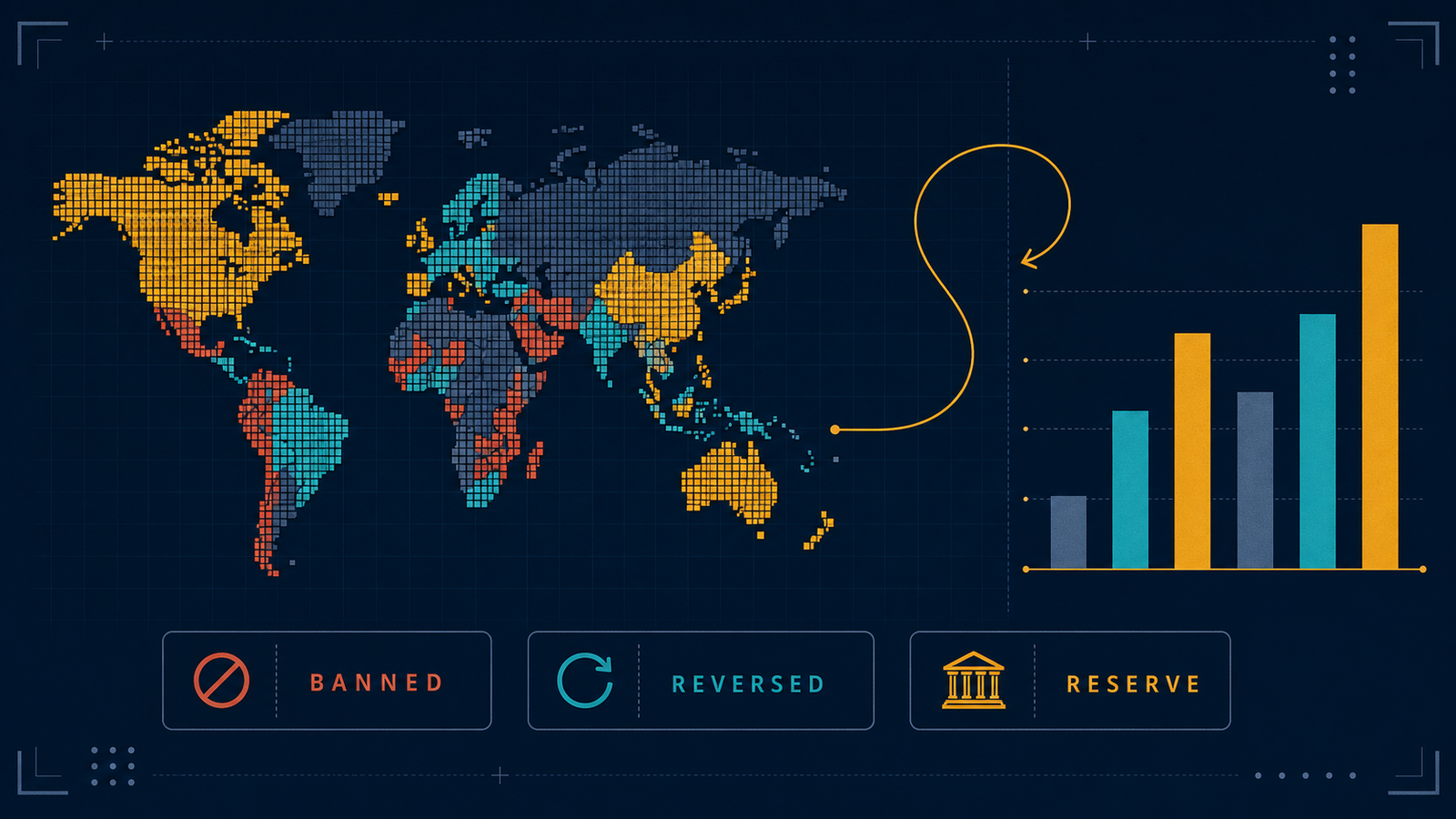
It also explains the strangest thing about the present. The holders are no longer only individuals hedging against institutions; they are institutions. Bitcoin’s ownership map records corporate treasuries, spot exchange-traded funds and sovereign reserves climbing the same table — and makes the point that holding coins confers none of the protocol authority the second layer of decentralization is about. A state can buy the asset. It cannot buy the property that made the asset worth holding. Whether that distinction survives contact with enough concentrated ownership is the open question underneath every row of §3.
It is a reason to keep the two apart when reading any comparison table: what a chain was built to be does not explain why anyone bought it.
2. What twelve chains actually differ on
Below are the twelve non-Bitcoin chains that recur in this archive, with Bitcoin as the reference row. Supply appears here as one axis among six; for issuance design on its own, across fifteen currencies, see the fixed-supply comparison.
| Chain | Supply | Consensus | Initial distribution | Ledger privacy | Who can change the rules |
|---|---|---|---|---|---|
| Bitcoin | 21 M cap | Proof-of-work | Mined from block 1, no premine | Transparent, pseudonymous | Rough consensus among node operators, miners, contributors; no entity |
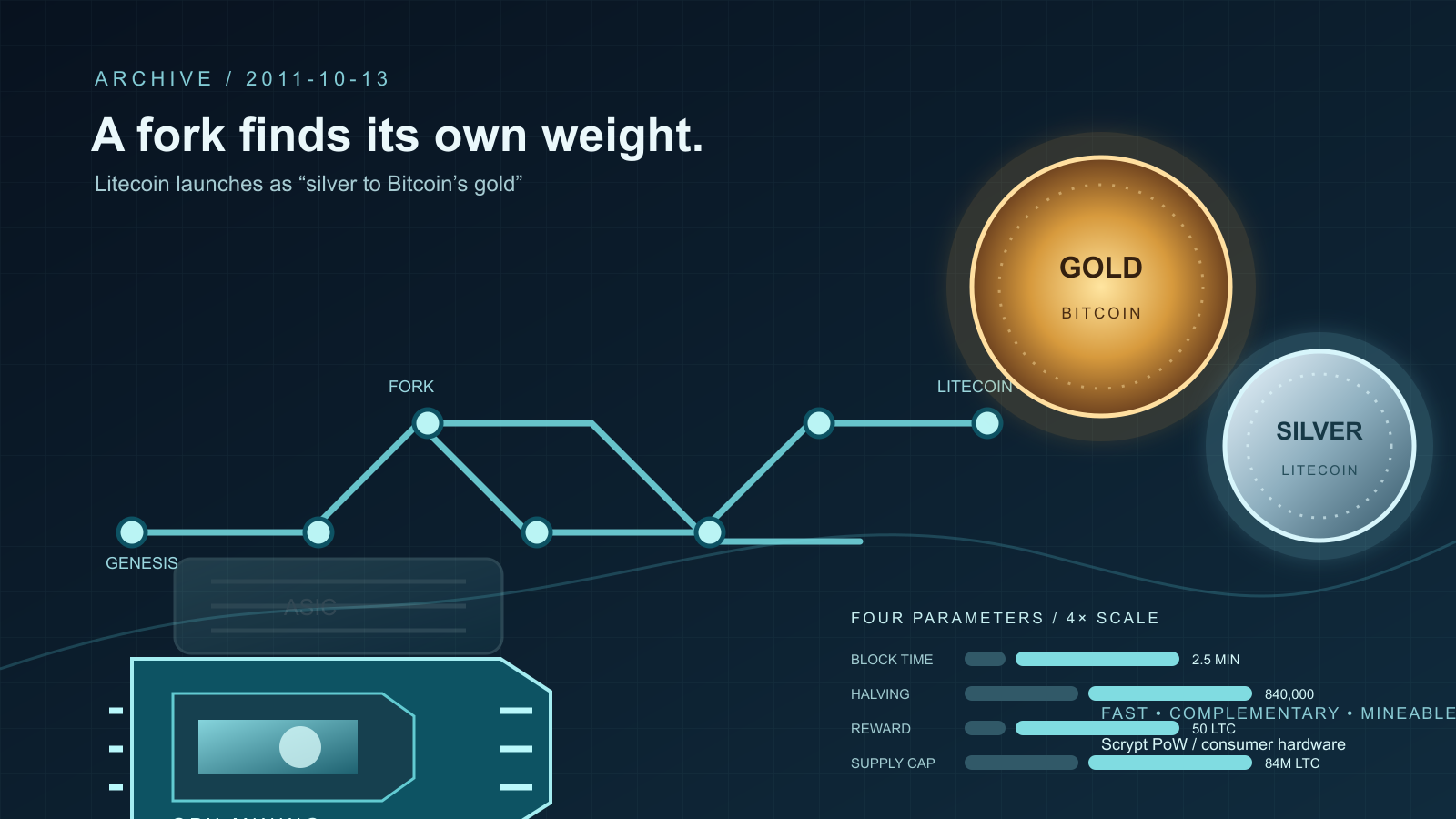
| Litecoin | 84 M cap | Proof-of-work (Scrypt) | Mined; negligible premine (150 coins) | Transparent | Contributors; founder publicly active |
| Dogecoin | None; 5.256 B/year forever | Proof-of-work, merge-mined with Litecoin | Mined | Transparent | Contributors; co-founders publicly active |
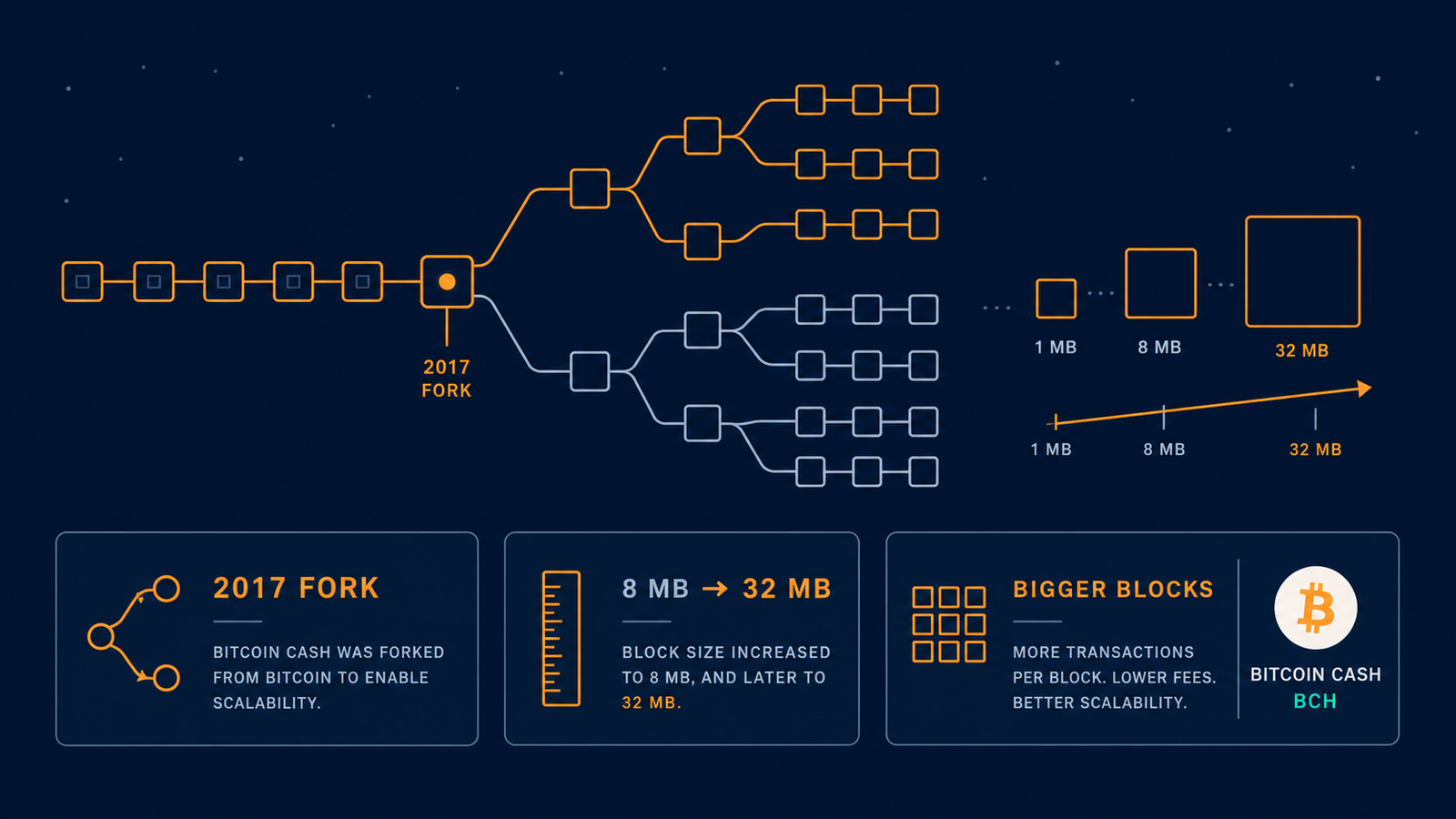
| Bitcoin Cash | 21 M cap | Proof-of-work | Inherited Bitcoin’s chain state at the 2017 fork | Transparent | Implementation teams; has split twice more |
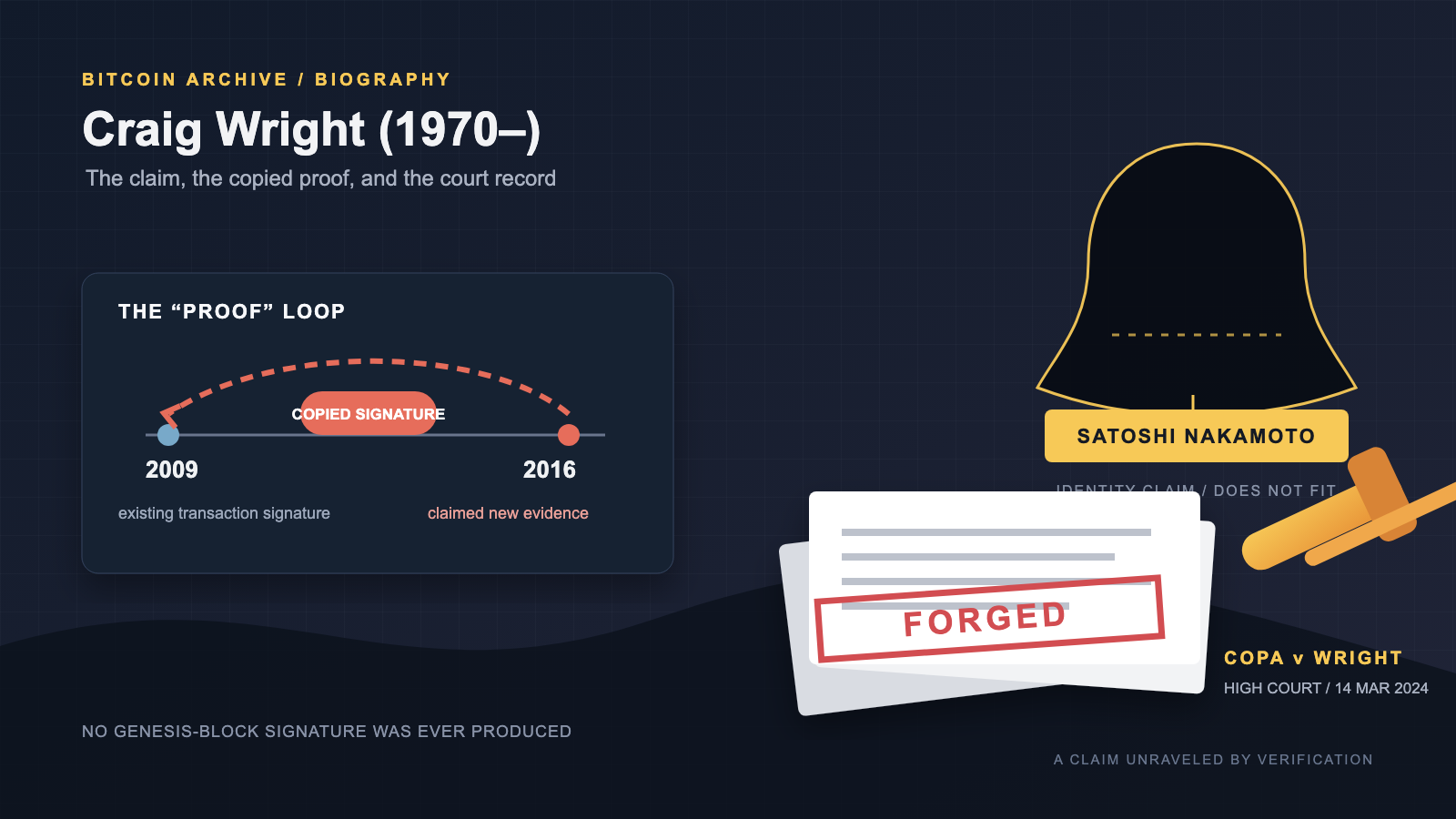
| Bitcoin SV | 21 M cap | Proof-of-work | Inherited BCH chain state at the 2018 fork | Transparent | Craig Wright’s nChain |
| Ethereum | None; issuance + fee burn | Proof-of-stake since 2022 | 2014 public sale + founder/contributor allocation | Transparent | Ethereum Foundation-coordinated EIP process |
| XRP | 100 B, generated in full at launch | Validator agreement (no mining) | Pre-generated; founders and Ripple held the bulk | Transparent | Ripple Labs plus the validator list |
| Cardano | 45 B cap | Proof-of-stake (Ouroboros) | 2015–17 voucher sale; 20% to IOHK, EMURGO, the Foundation | Transparent, with optional metadata | Three coordinating bodies plus on-chain governance |
| Solana | None; declining inflation | Proof-of-stake + Proof of History | Premine; foundation and investor allocation | Transparent | Solana Foundation and Labs |
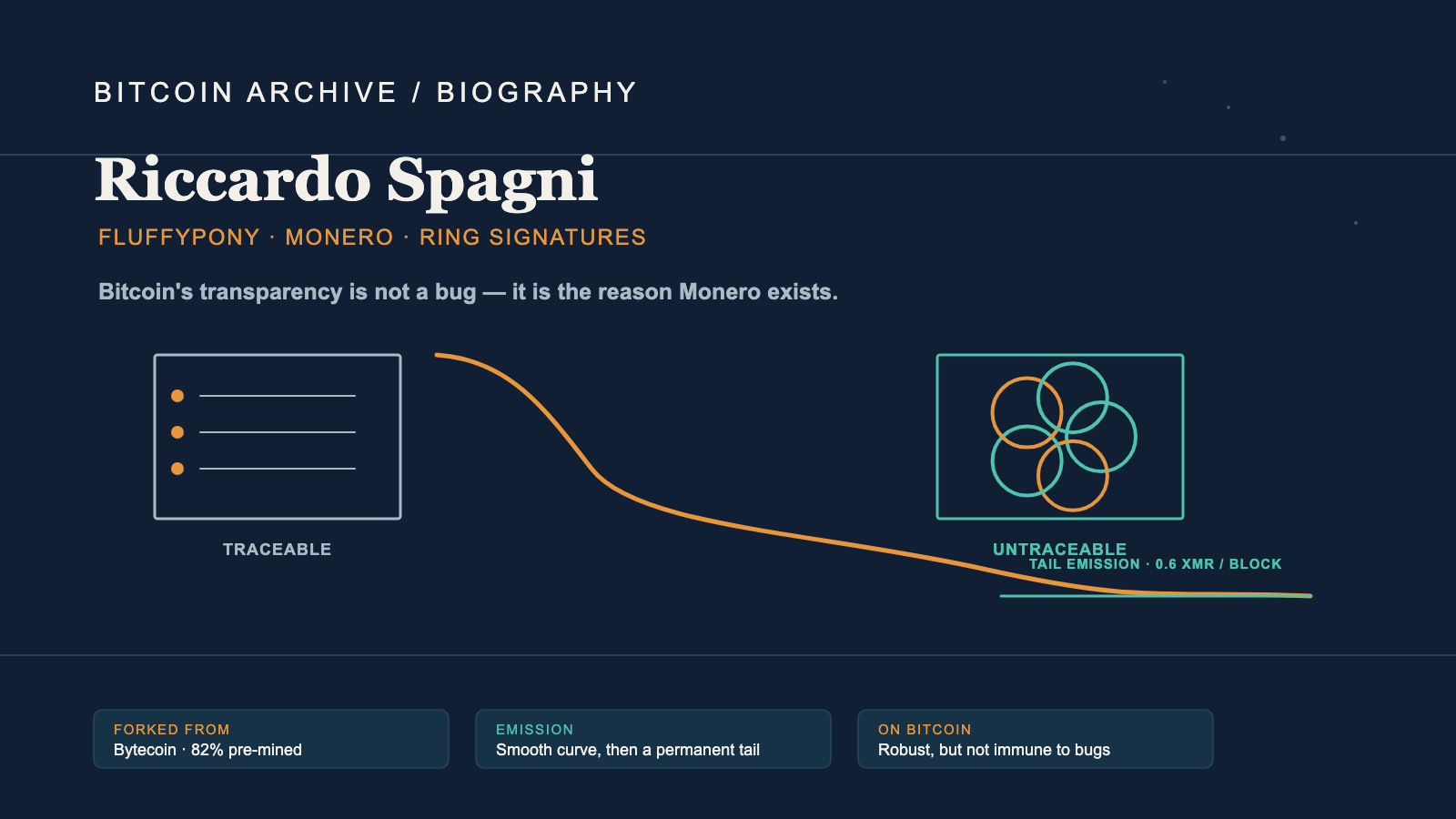
| Monero | 18.4 M + 0.6 XMR/block forever | Proof-of-work (RandomX) | Mined; no premine | Opaque by default (ring signatures, hidden amounts) | Contributors; no foundation with protocol authority |
| Polkadot | 2.1 B cap since January 2026 | Nominated proof-of-stake | 2017 sale + Web3 Foundation allocation | Transparent | On-chain governance by token vote |
| USDT (Tether) | Set by the issuer’s reserves | N/A — a token on other chains | Minted on demand against fiat | Transparent | Tether Ltd |
| USDC (Circle) | Set by the issuer’s reserves | N/A — a token on other chains | Minted on demand against fiat | Transparent | Circle |
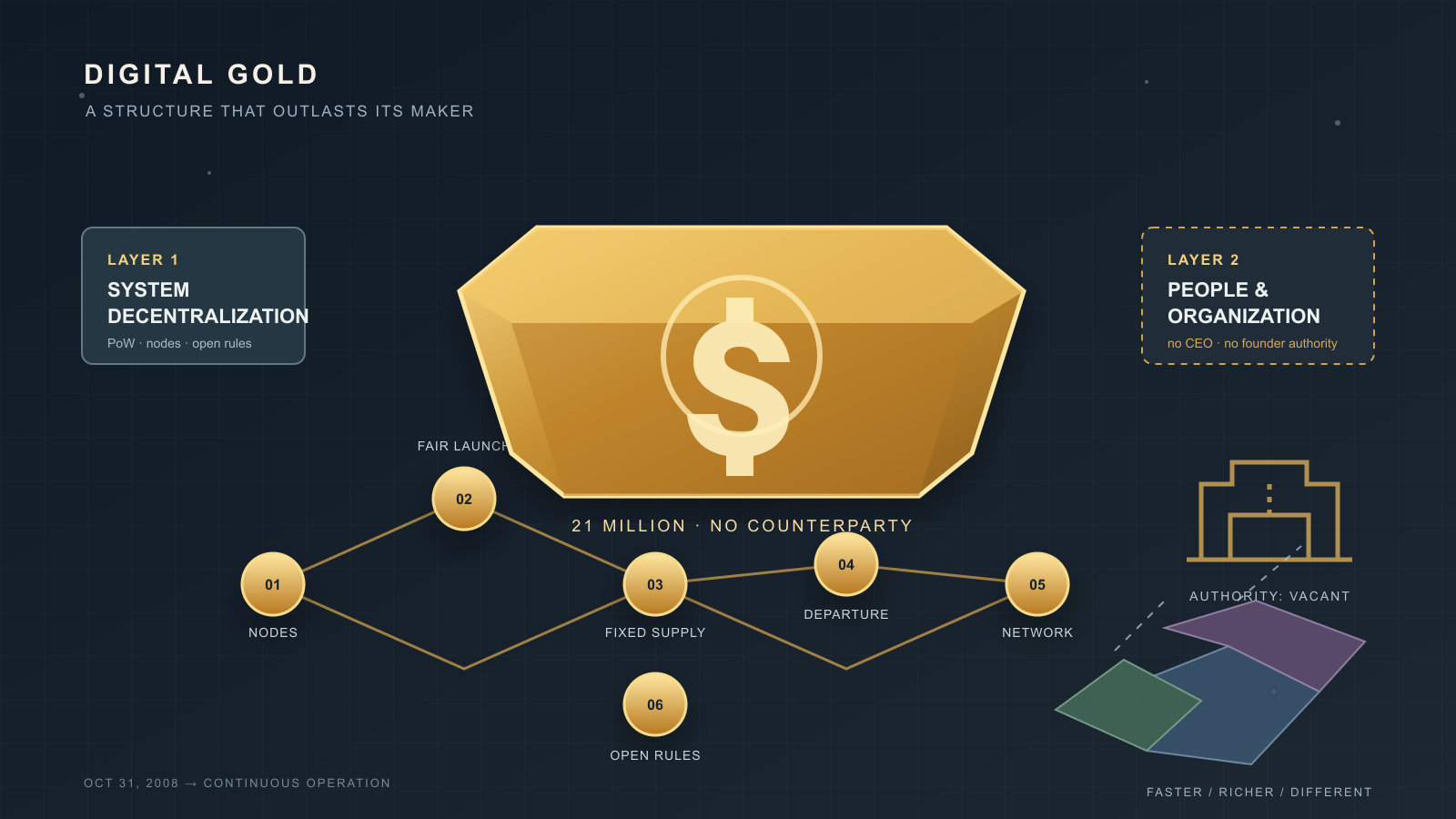
The column that separates the group is not supply and not consensus. It is the last one. Every row of this table except Bitcoin and — with qualifications — Monero has an identifiable party who can be persuaded, subpoenaed, acquired, or replaced. That is not a scandal; for most of the stated purposes in the table it is a requirement. It is simply the axis on which the category is least differentiated from the financial system it was built next to.
3. The six structural features, applied
The digital-gold analysis sets out six structural features and argues that Bitcoin’s position rests on holding all six at once. The definitions are there in full.
Legend — this table only. holds · partial, contested, or holds only under a qualification · does not hold. The symbols are not a score. Do not add up the greens. The features are not independent, not equally weighted, and several are in tension with each other — a chain that wants rapid iteration structurally cannot have feature 4, and that is a design decision, not a failure. Reading a row as a total misses the entire argument the six features are part of.
| Chain | 1 System decentralization | 2 People / org decentralization | 3 Fair launch | 4 Founder departed | 5 Fixed supply | 6 First-mover |
|---|---|---|---|---|---|---|
| Bitcoin | ||||||
| Litecoin | founder active, no protocol-controlling body | |||||
| Dogecoin | hashrate depends on merge-mining | co-founders active as commentators | both stepped back, both returned to comment | uncapped | ||
| Bitcoin Cash | implementation teams with named leads | inherited state, no new issuance | ||||
| Bitcoin SV | low hashrate, repeated reorgs | inherited state | ||||
| Ethereum | foundation, active founder | pre-launch sale | no cap | |||
| XRP | curated validator list | company-controlled | fully pre-generated | fixed total, issuer-held | ||
| Cardano | fully centralized until March 2021 | three bodies, active founder | sale plus 20% allocation | |||
| Solana | high hardware requirements for validators | foundation, active founder | premine | no cap | ||
| Monero | no foundation with protocol authority | no premine | pseudonymous originator gone; later leads public | bounded then permanent tail | ||
| Polkadot | foundation, active founder | sale plus allocation | capped in 2026, by a vote that can vote again | |||
| USDT / USDC | set by an issuer |
Monero is the interesting row. Of the twelve chains in this table it is the only one that matches Bitcoin on fair launch, on the absence of a controlling organization, and on system decentralization. Where it diverges is supply — it chose a permanent tail emission over a hard cap, deliberately, to keep paying for security after issuance would otherwise end. That is a different answer to the same question, chosen by people who understood exactly what they were giving up. Riccardo Spagni’s record sets out the reasoning.
4. Stablecoins are not in the same category
Every structural feature reads for USDT and USDC. This is not a criticism; it is a category error corrected. A fiat-pegged stablecoin is a dollar with a blockchain interface. Its supply follows the issuer’s reserves, its stability depends on a balance sheet, and its issuer can freeze a balance. The CENTRE whitepaper says so itself, in the sentence that should end most stablecoin arguments:
This approach is distributed, though it does not purport to be — or aim to be — entirely decentralized.
The peg is not one design, either, and the difference is in who guarantees it and under what obligation. USDC’s reserve composition was a matter of voluntary disclosure — it held commercial paper and corporate bonds in 2021 and moved to cash and cash equivalents afterwards, and its governance body was dissolved in 2023 with no reader’s consent required.
The alternative is a statutory one. Japan’s revised Payment Services Act put yen-denominated stablecoins under a registration regime, and JPYC Inc. registered as a funds-transfer provider on August 18, 2025 (Kanto Local Finance Bureau No. 00099), stating that “the backing assets are secured in Japanese yen (deposits and government bonds)”; issuance began on October 27, 2025. Whether a reserve rule is a company’s policy or a licence condition does not change the structural verdict above — there is still an issuer, and the issuer can still freeze a balance. It changes how much of the promise survives the issuer changing its mind, which is a different axis and a real one.
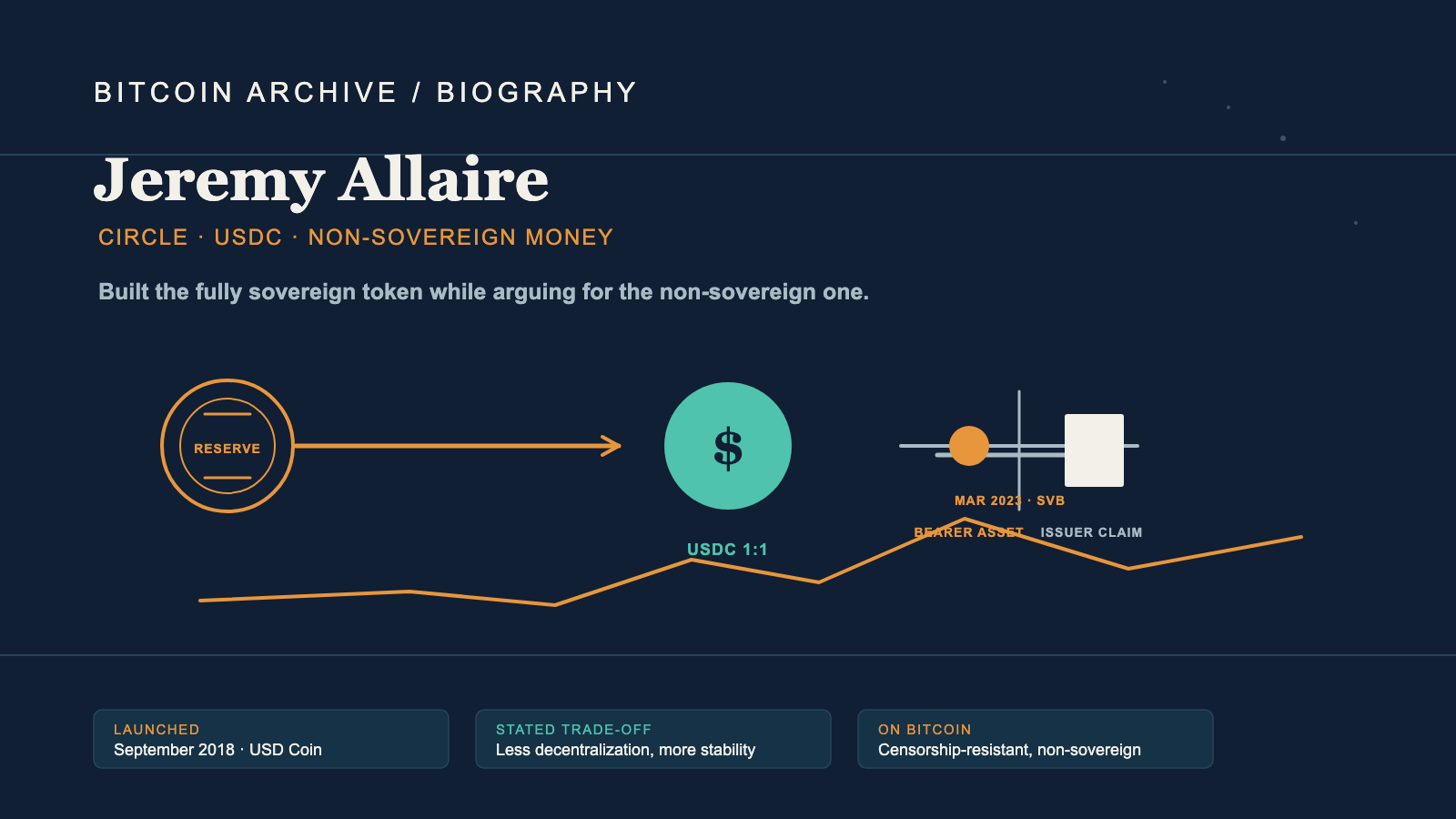
What that trade buys is the thing Bitcoin does not offer: a unit that does not move against the currency your rent is denominated in. What it costs is every property in §3. Jeremy Allaire’s record is the clearest statement of both sides, because he argues for the non-sovereign asset while selling the sovereign one.
5. Why each chain chose what it chose
Each design in §2 has a stated reason, published by the people who made it. In brief, with the detail in each linked record:
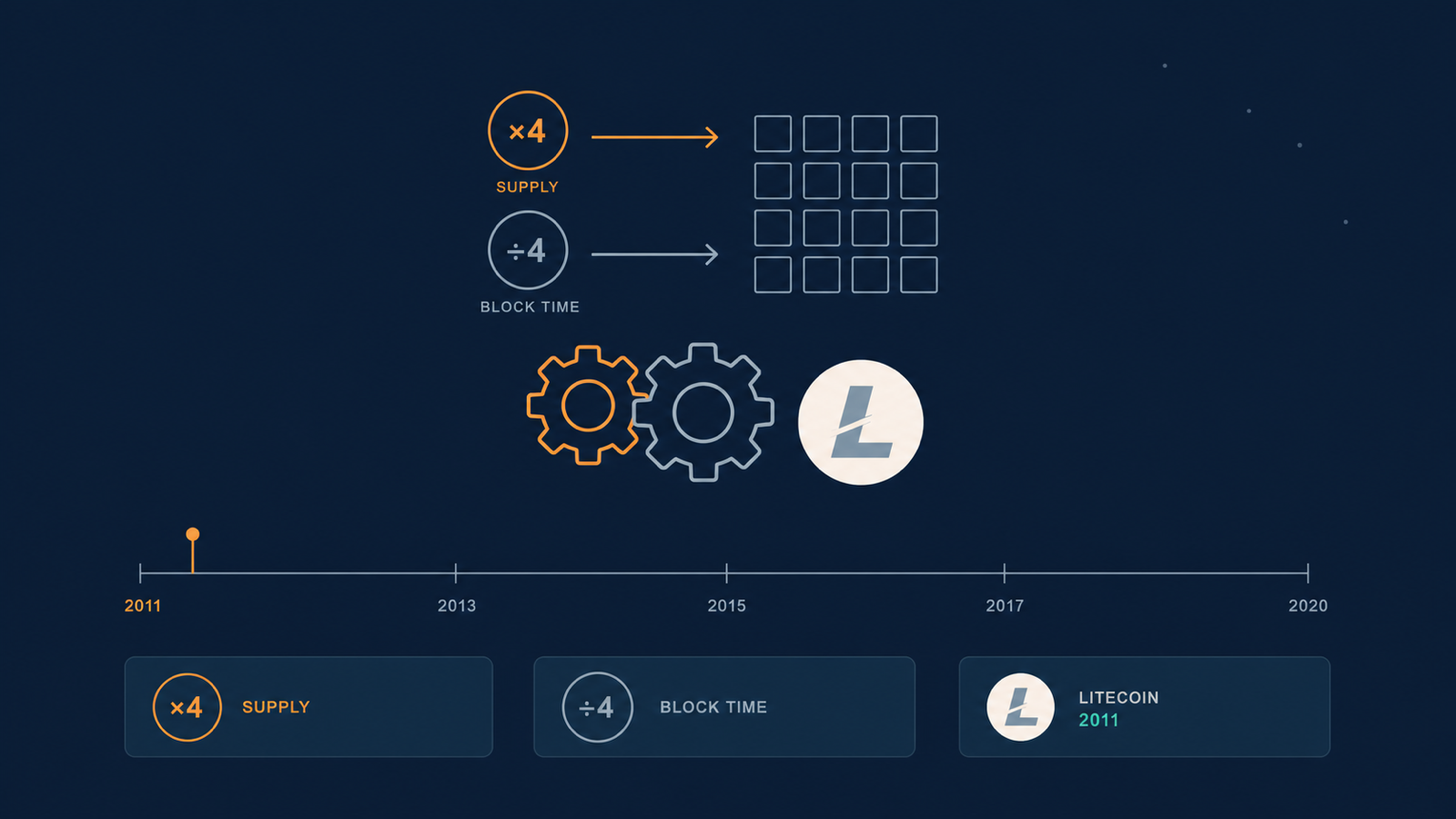
- Litecoin — Charlie Lee set out to change as little as possible: “not change what’s working (from Bitcoin) unless there was a good reason to.” Four parameters moved, each by a factor of four — the full parameter list is in Litecoin’s launch entry.
- Dogecoin — Jackson Palmer declined the premise entirely; the chain has no whitepaper and its co-founder argued publicly that supply parameters do not determine price.
- Ethereum — the whitepaper states the choice against a cap by name, on the reasoning that permanent linear issuance leaves later arrivals a fairer chance. The fixed-supply analysis tracks the three revisions that followed.
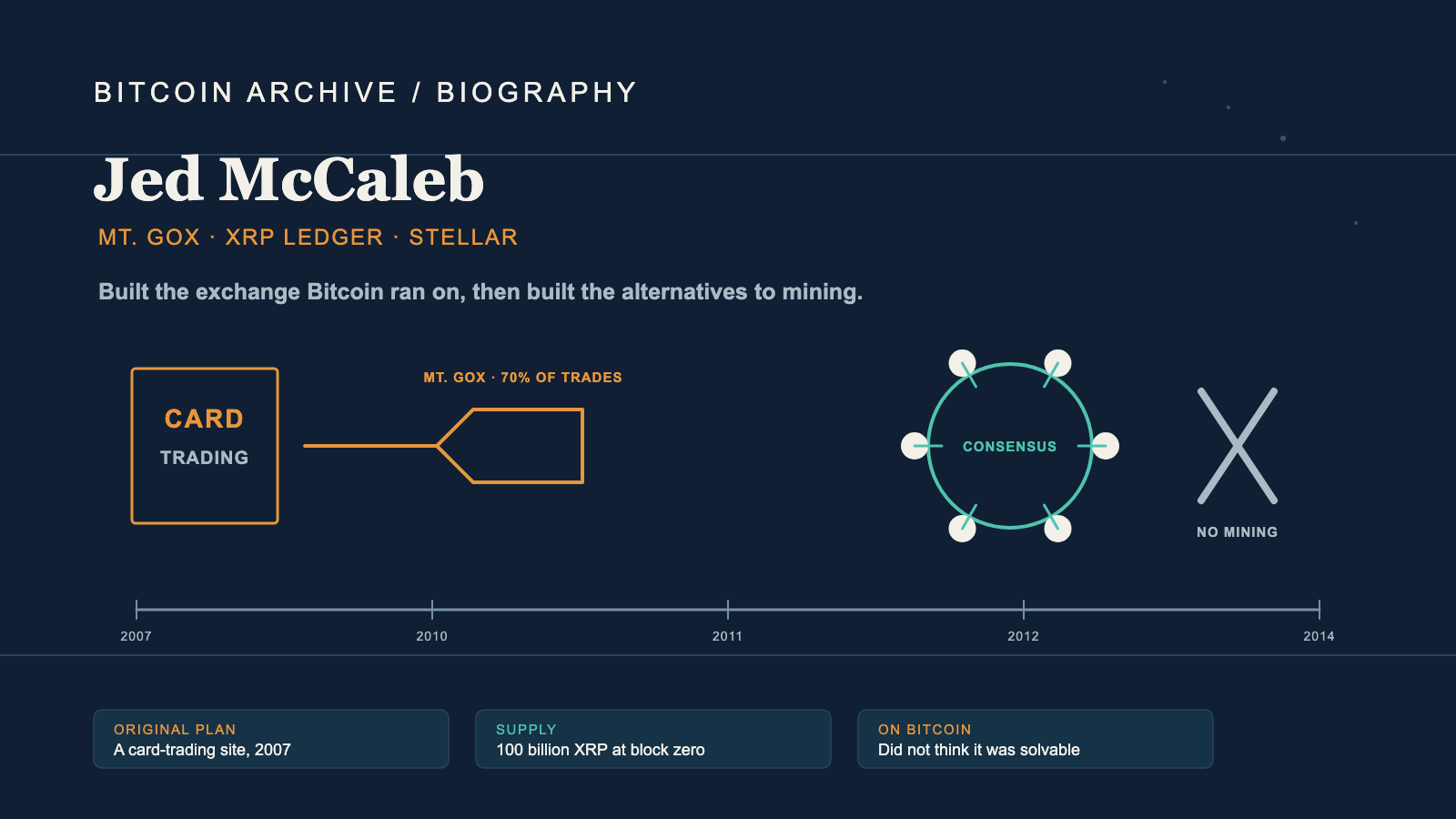
- XRP — Jed McCaleb and his co-founders aimed at “a faster, cheaper, and more energy-efficient alternative to the bitcoin blockchain,” in the court’s own summary of the undisputed record, and pre-generated the whole supply at launch.
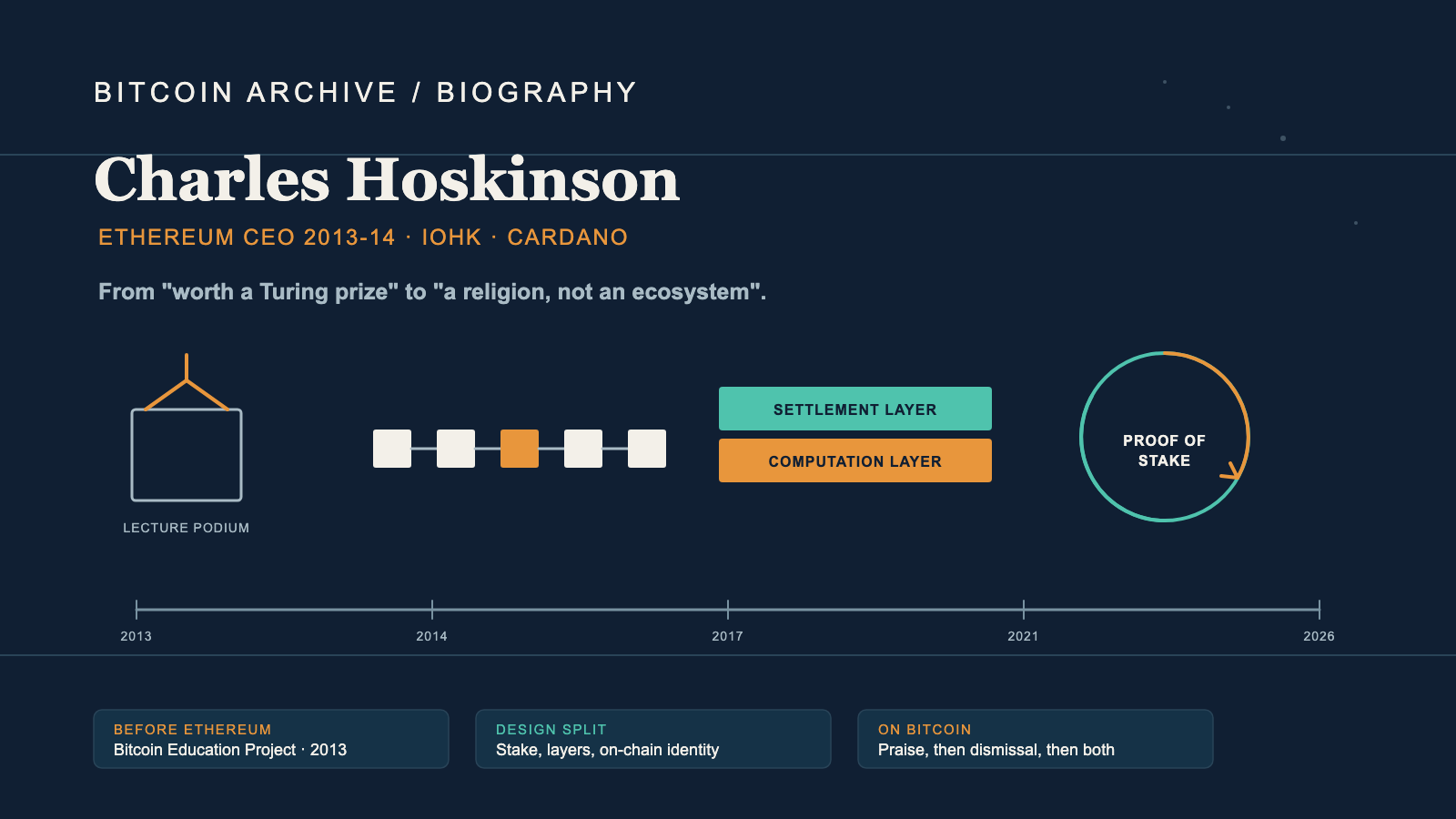
- Cardano — Charles Hoskinson’s project names Bitcoin’s discarding of “stable identities, metadata and reputation” as a thing it chose not to inherit, and separates settlement from computation on purpose.
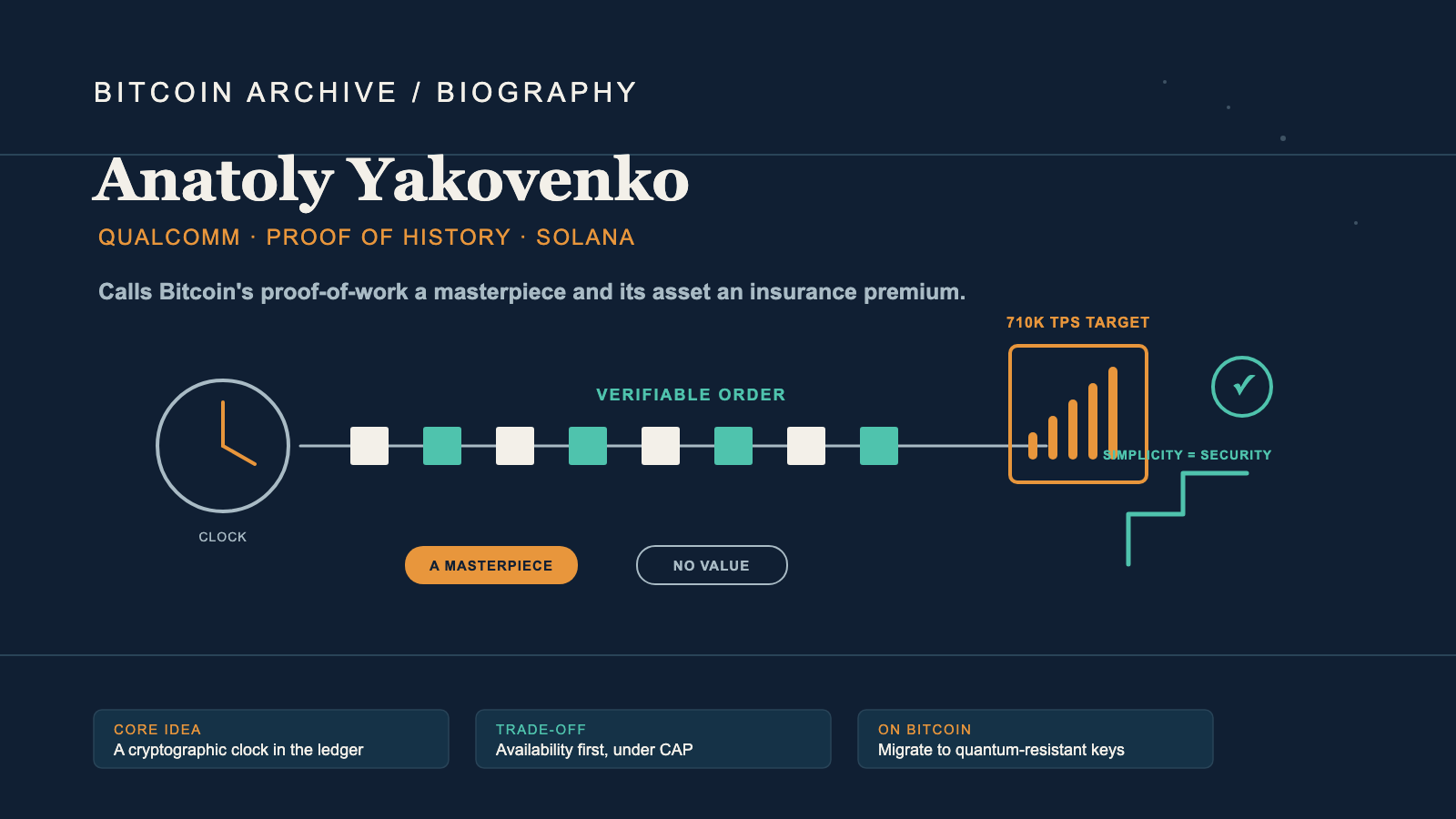
- Solana — Anatoly Yakovenko’s whitepaper identifies the absence of a shared clock as the bottleneck and accepts availability over consistency to fix it.
- Monero — the chain Riccardo Spagni maintained implements a protocol that states Bitcoin “does not satisfy the untraceability requirement” and treats the halving schedule as a security risk rather than a monetary feature.
- USDC — Jeremy Allaire’s design picked the fiat-collateralized model out of four candidates, and its whitepaper names decentralization as the cost.
The pattern across all eight is the same: each is a specific, argued objection to a specific Bitcoin design decision, and each accepts a specific cost to make the change. None of them is a claim that Bitcoin does not work.
6. What the founders said about Bitcoin
Seven biographies collect the sourced record for the founders whose commentary runs to volume — Charlie Lee, Charles Hoskinson, Anatoly Yakovenko, Jeremy Allaire, Riccardo Spagni, Jed McCaleb and Jackson Palmer.
Read together, they do not divide into supporters and detractors. The recurring shape is narrower and stranger: unreserved technical admiration alongside a specific structural objection, held by the same person, often in the same interview. Yakovenko calls proof-of-work “a masterpiece in terms of elegance and simplicity” and separately says the asset has “no value” beyond insurance. Hoskinson called Satoshi’s work “worth a Turing prize” in 2018 and Bitcoin “a religion, not an ecosystem” in 2024, then described it as the internet’s store of value six months later. McCaleb, who built the exchange most early Bitcoin trading passed through, said he did not believe the double-spend problem was solvable until he read the paper.
Three more founders left a shorter record:
- Gavin Wood (Polkadot, Ethereum co-founder) has objected on energy grounds, saying that Bitcoin “uses up the equivalent of … some small country’s energy simply in securing itself”, and on throughput, noting that confirmation can take an hour in practice against a 10-minute average.
- Chris Larsen (Ripple co-founder) wrote in April 2021 that proof-of-work is “a brilliantly designed technology that is becoming outdated in today’s world,” and argued that changing it was “critically important for Bitcoin to remain the world’s dominant cryptocurrency”: an objection framed as advice rather than as a competitive claim.
- Brad Garlinghouse (Ripple CEO) argued in 2018 that Bitcoin is effectively controlled by a small number of Chinese mining operations, and in 2020 that he is “bullish on BTC as a store of value, but not for payments,” the same electronic-cash-versus-digital-gold split that runs through Bitcoin’s own history.
7. How many altcoins are there?
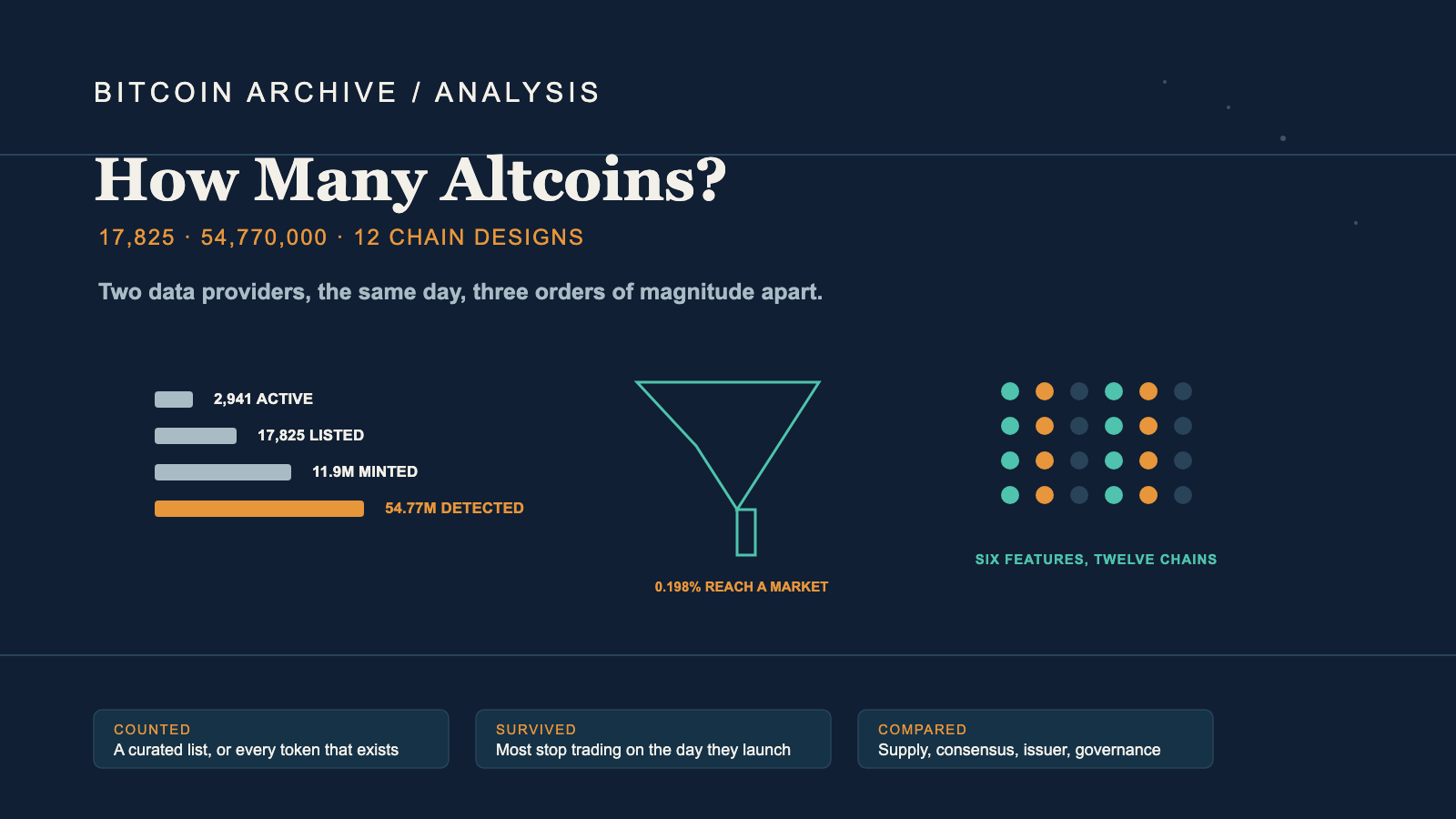
Two data providers, asked on the same day, disagree by three orders of magnitude. Neither is wrong; they are counting different things.
| Source | Figure | What is being counted | As of |
|---|---|---|---|
| CoinGecko homepage | 17,825 | Coins in its curated catalog | 2026-07-26 |
| CoinGecko global-charts page | 16,775 | Coins tracked across 1,509 exchanges — a different page of the same site, the same day | 2026-07-26 |
| CoinMarketCap homepage | 54.77 million | Every asset it has detected, curated or not | 2026-07-26 |
| CoinMarketCap global-metrics API | 2,941 | active_cryptocurrencies — its own internal active count | 2024-10-11 |
CoinMarketCap states the reason plainly: “Our view is that we should always over-provide data (as opposed to censoring and policing information).” A catalog built that way counts tokens that exist on a chain. A curated catalog counts tokens someone decided were worth listing. The first is a property of block space; the second is an editorial judgment. The real floor is set by the launchpads — pump.fun alone had minted more than 11.9 million tokens by June 2026, several hundred times CoinGecko’s entire list.
Almost none of them last, and here too the measurement depends on the definition. Of pump.fun’s tokens, CoinGecko Research found 68.67% recorded their last trade on the day they launched, and two academic survival studies put the rate that reach a real market at 0.63% and, eight months later on a larger cohort, 0.198%. Of the 2017-era ICOs, a Satis Group review classified roughly 78% as identified scams and found about 15% ever traded on an exchange; a Boston College study found 83% of projects that neither raised capital nor listed went quiet, against 16% of those that did both. The dead-coin trackers that try to total it up disagree by an order of magnitude, because each uses its own definition.
So the honest answer to “how many altcoins are there” is a question in return: do you mean things that trade, things that are listed, or things that exist? Any single number quoted without that qualifier is measuring something the person quoting it has not specified — and figures drawn from different populations must never be compared or added.
8. The far end: tokens issued by presidents
The launchpad numbers in §7 describe an industrial process. The clearest single illustration of what that process makes possible arrived in January 2025, and the facts are documented by the issuers themselves.
On January 17, 2025, three days before his inauguration, Donald Trump announced a token on his own Truth Social account, directing followers to its website. The token’s official site states the allocation:
CIC Digital LLC, an affiliate of The Trump Organization, and Fight Fight Fight LLC collectively own 80% of the Trump Cards, subject to a 3-year unlocking schedule.
Two hundred million of one billion tokens were released at launch. Market capitalization peaked near $15 billion within about two days. CoinGecko records an all-time high of $73.43 on January 19, 2025; by late July 2026 the token traded around $1.57. The reported peak differs by source — CoinDesk gives a day-one high of $77.26 and Fortune an all-time high of $75.35 — which is itself a small illustration of how unstable the figures around these launches are. Chainalysis found roughly 764,000 of about two million wallets that had ever bought it sitting on losses, while 58 wallets held $1.1 billion in combined profit. Reporting on the issuers’ side put creator trading-fee revenue at $320 million by May 2025, and Trump’s own financial disclosure at $636 million from this token.
Three other cases followed the same arc within months. Argentina’s president promoted LIBRA in February 2025; the price rose over 2,000% in forty minutes and the market capitalization fell from $4.5 billion to about $200 million within hours, with on-chain analysis identifying fewer than ten wallets cashing out $87.4 million. MELANIA fell more than 98% from its peak, with over 90% of supply held by wallets attributed to insiders. The Central African Republic’s president-promoted token fell 96.7% in about 24 hours.
Both presidents have a record on Bitcoin itself, and in one case the record moved first. Trump dismissed it in 2019 — the line CNN quoted back at him five years later was that cryptocurrencies are “based on thin air” — and by July 27, 2024 he was on stage at the Bitcoin conference in Nashville promising a strategic national bitcoin reserve, that the government would never sell the coins it holds, and:
I want it to be mined, minted and made in the U.S.
The token came six months after that speech.
Milei’s position is older and narrower than his reputation suggests: he has called central banking a scam and described Bitcoin as “the return of money to its original creator, the private sector,” but his actual programme was dollarisation, and Argentina under him has not moved toward Bitcoin adoption — a distinction the reporting makes explicitly, against the pro-Bitcoin label the quotation attracted.
The regulatory position is that this category sits outside securities protection. SEC staff stated in February 2025 that meme coins of this type are not securities — a statement that carries no binding legal force and leaves fraud actionable under other law — and a sitting Commissioner told an industry audience in May 2025: “if you are expecting that there’s SEC protection around these, you should not expect that.” The one adjudicated precedent for celebrity promotion remains the SEC’s 2022 settlement with Kim Kardashian over an undisclosed paid promotion.
Bitcoin Institute records these events and does not characterize the intent behind them. What it can say is structural, and the first structural fact is that none of these is a chain. All four are tokens minted on Solana, which appears in §2 with an issuance rule, a consensus mechanism and a published argument about what its money is for, none of which a token minted on its ledger inherits. Such a token’s supply is not a schedule; it is a number the issuer chose. So every property §3 tests for is absent by construction: the supply is allocated to the issuer before launch, the issuer is a named party, the launch is announced by that party, and the fee revenue accrues to that party regardless of the price. It is the exact inverse of the launch condition Bitcoin had, and it is now cheap enough that the process runs tens of thousands of times a day.
9. Limits of this reading
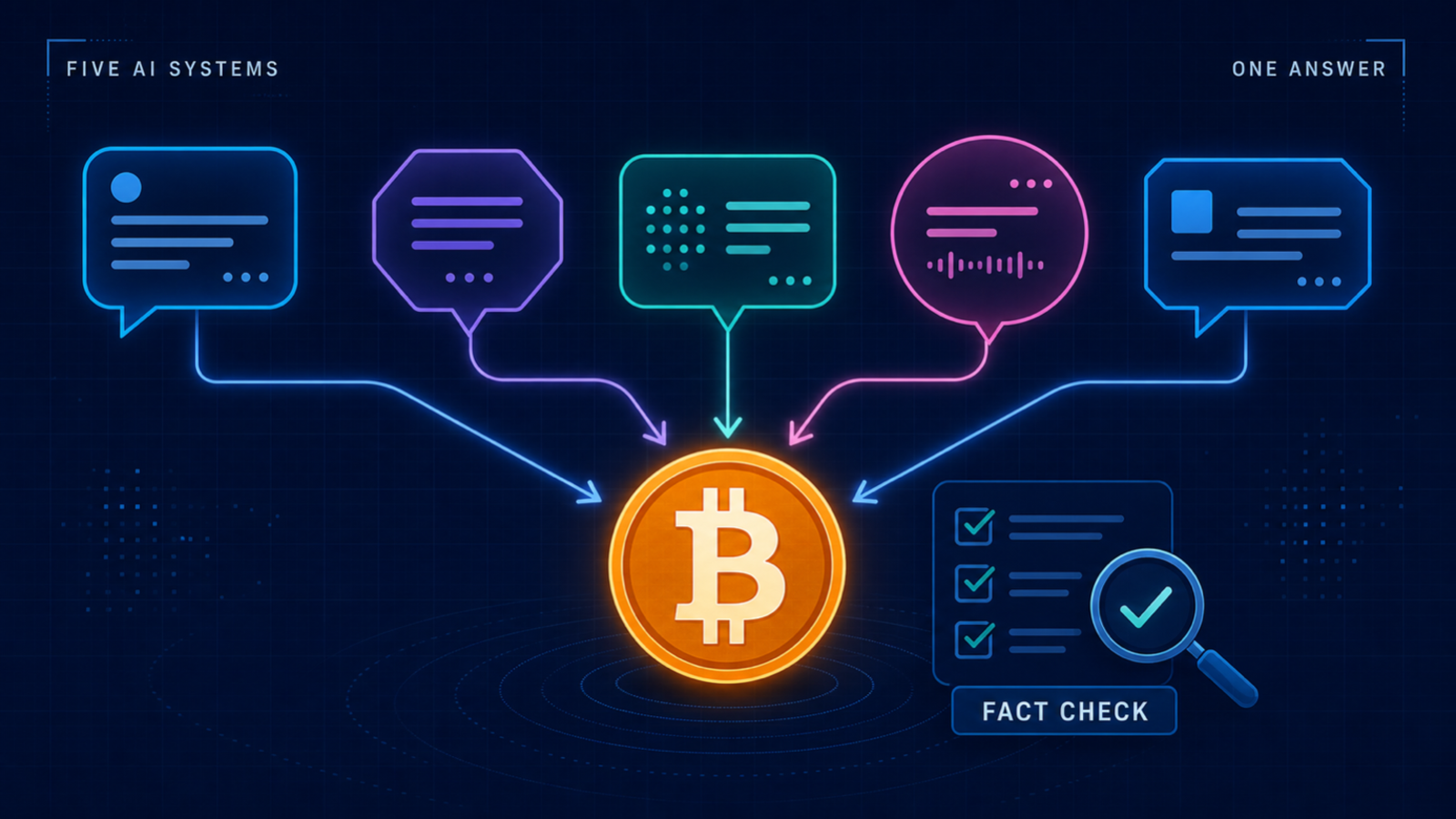
- Not investment advice, and not a prediction. No price target, no ranking, no “which one wins.” The archive’s standing position on price is that supply design’s outcome is not yet settled, and the same applies here. A related experiment tested that same refusal to rank from another angle. The AI investment survey put the same question to five separate AI systems, then checked their stated reasons against primary sources.
- Not a technical benchmark. Throughput, fees, and latency change with every release; a table of them would be wrong within months. The axes chosen above are the ones that change rarely, because they are decided at launch.
- Not a completeness claim. Twelve chains out of a population whose lower bound is eight figures is a sample chosen for one reason: these are the chains that recur in the Bitcoin record this archive keeps.
- Not a verdict on any founder. The biographies collect what people said, with sources and dates. Where a founder’s statements conflict with each other, the conflict is recorded rather than resolved.
The single defensible conclusion is the one §7 forces. Any argument that depends on how many cryptocurrencies exist is an argument that has not defined its terms — and most arguments in this category, in both directions, depend on exactly that.