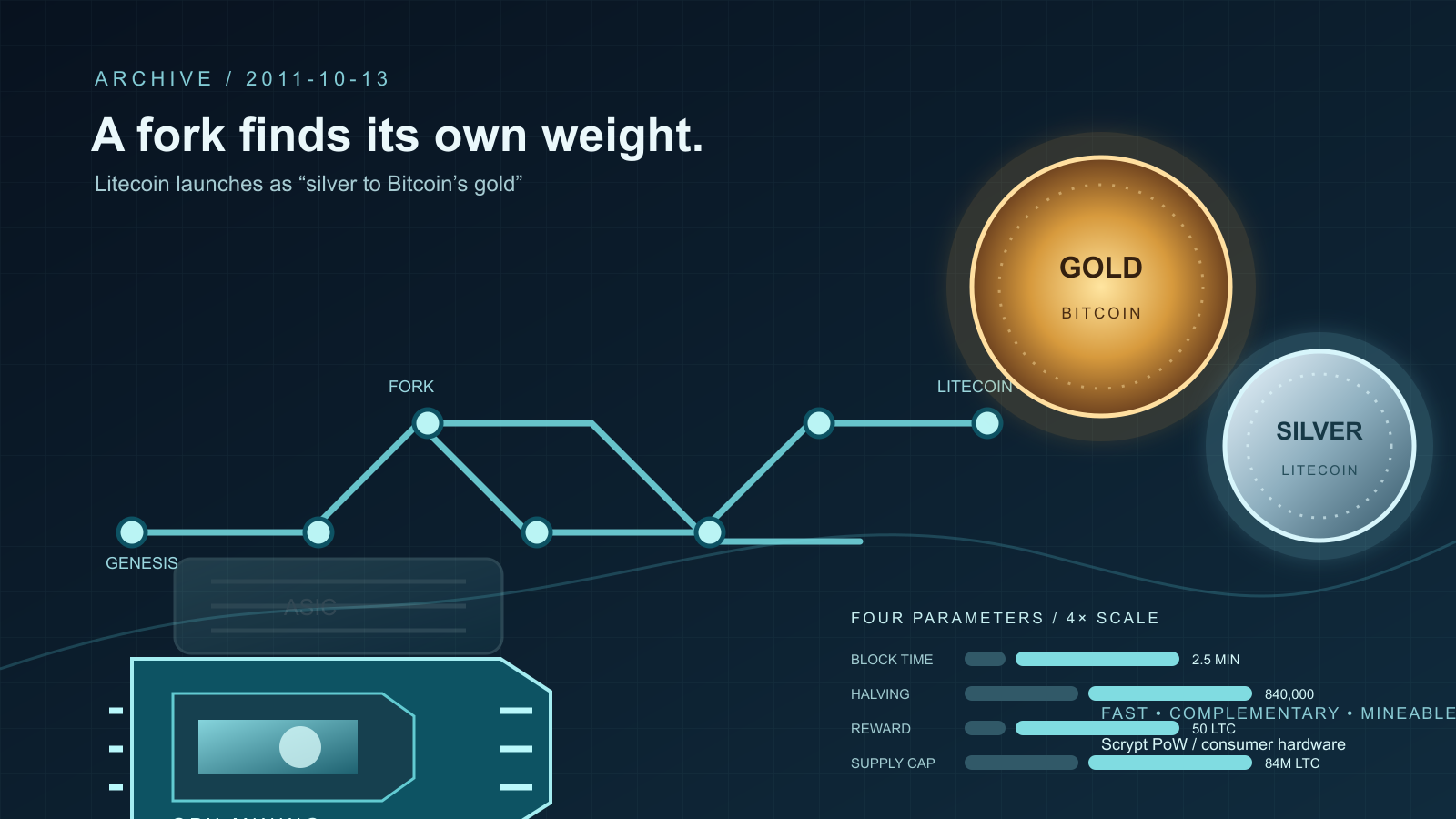
On October 13, 2011, Charlie Lee — then a Google software engineer who had been active on BitcoinTalk under the handle coblee — launched Litecoin (LTC) by mining its genesis block. Four days earlier, on October 9, he had announced the project on BitcoinTalk with binaries available on the litecoin.org website.
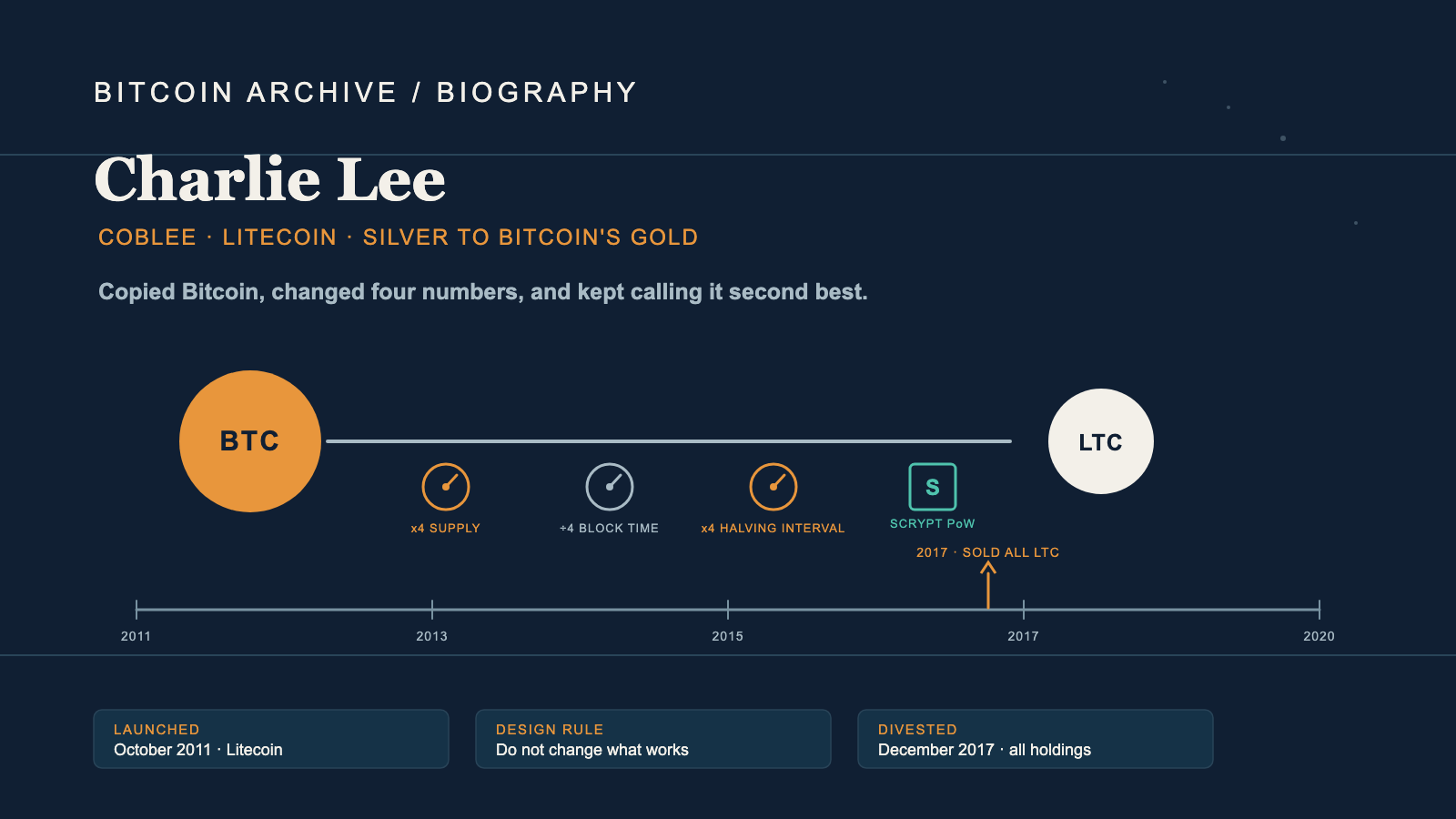
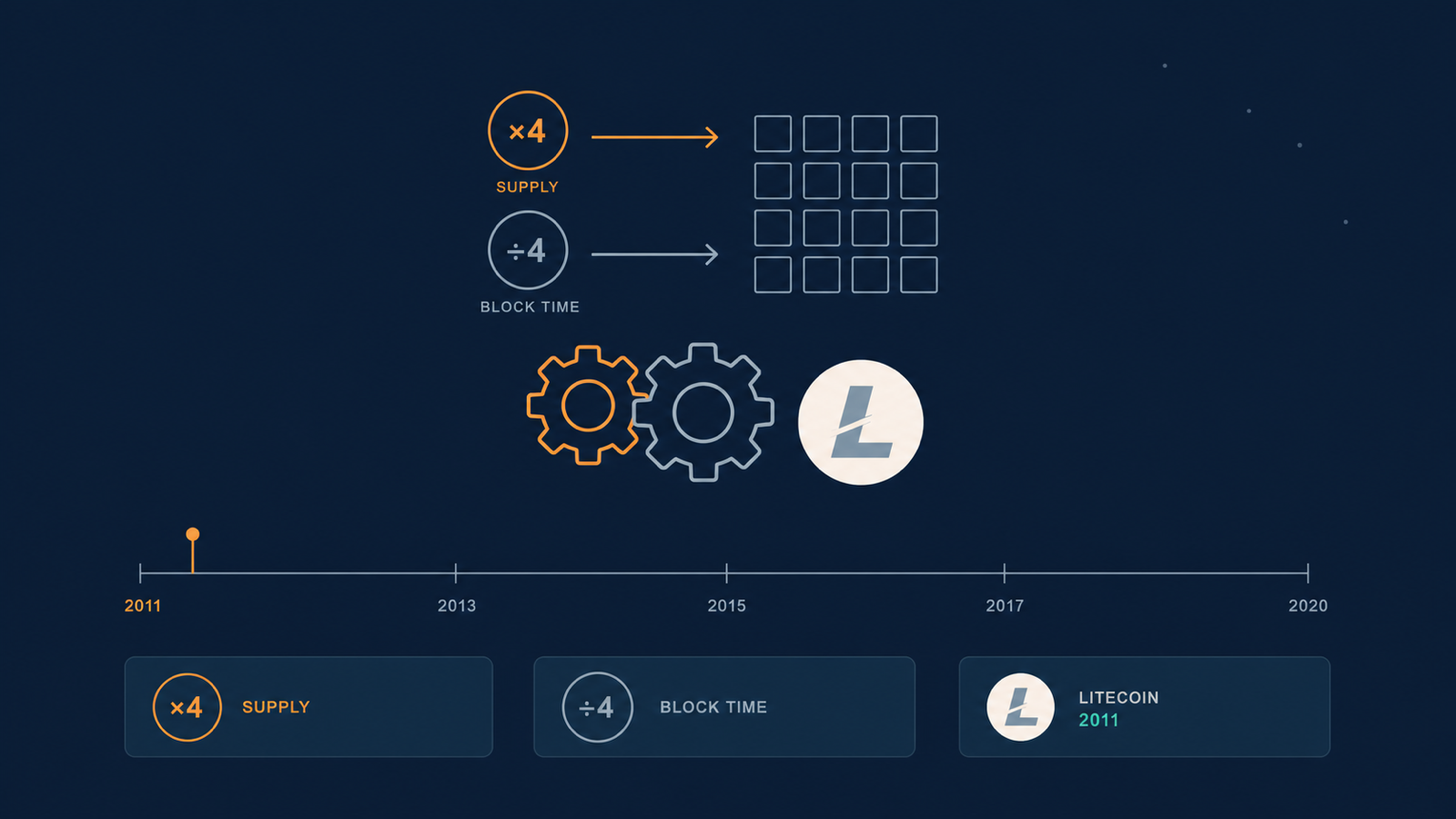
Litecoin was a Bitcoin-codebase fork with four parameter changes:
- Proof-of-work: Scrypt instead of SHA-256, intended to remain mineable on consumer GPUs and later CPUs as a hedge against ASIC concentration
- Block time: 2.5 minutes (1/4 of Bitcoin’s 10 minutes), giving 4× faster transaction confirmation
- Block reward: 50 LTC initially, halving every 840,000 blocks (4× Bitcoin’s 210,000, so the halving still lands at roughly the same four-year mark given Litecoin’s 4× faster block time)
- Supply cap: 84 million LTC (4× Bitcoin’s 21 million)
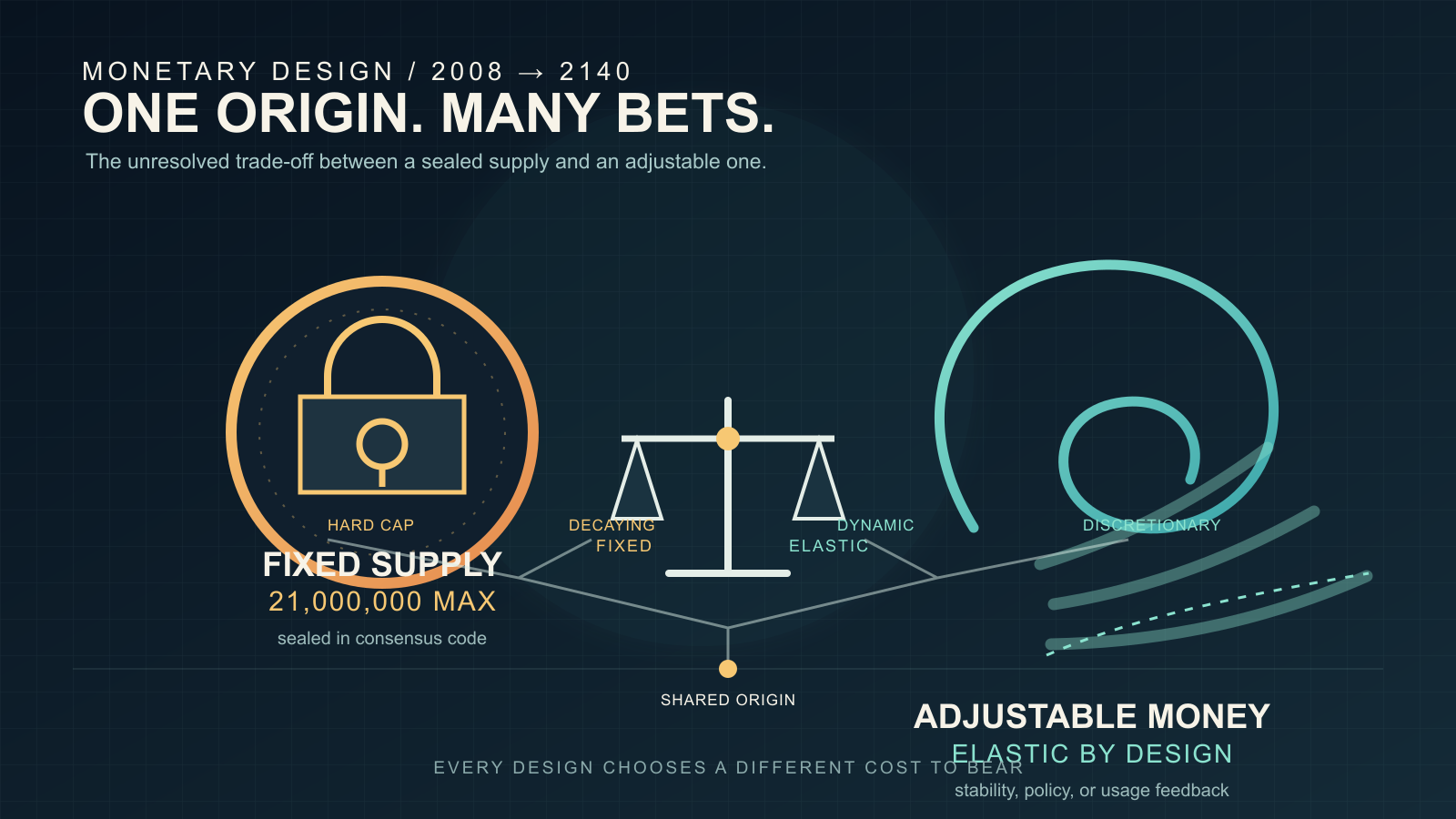
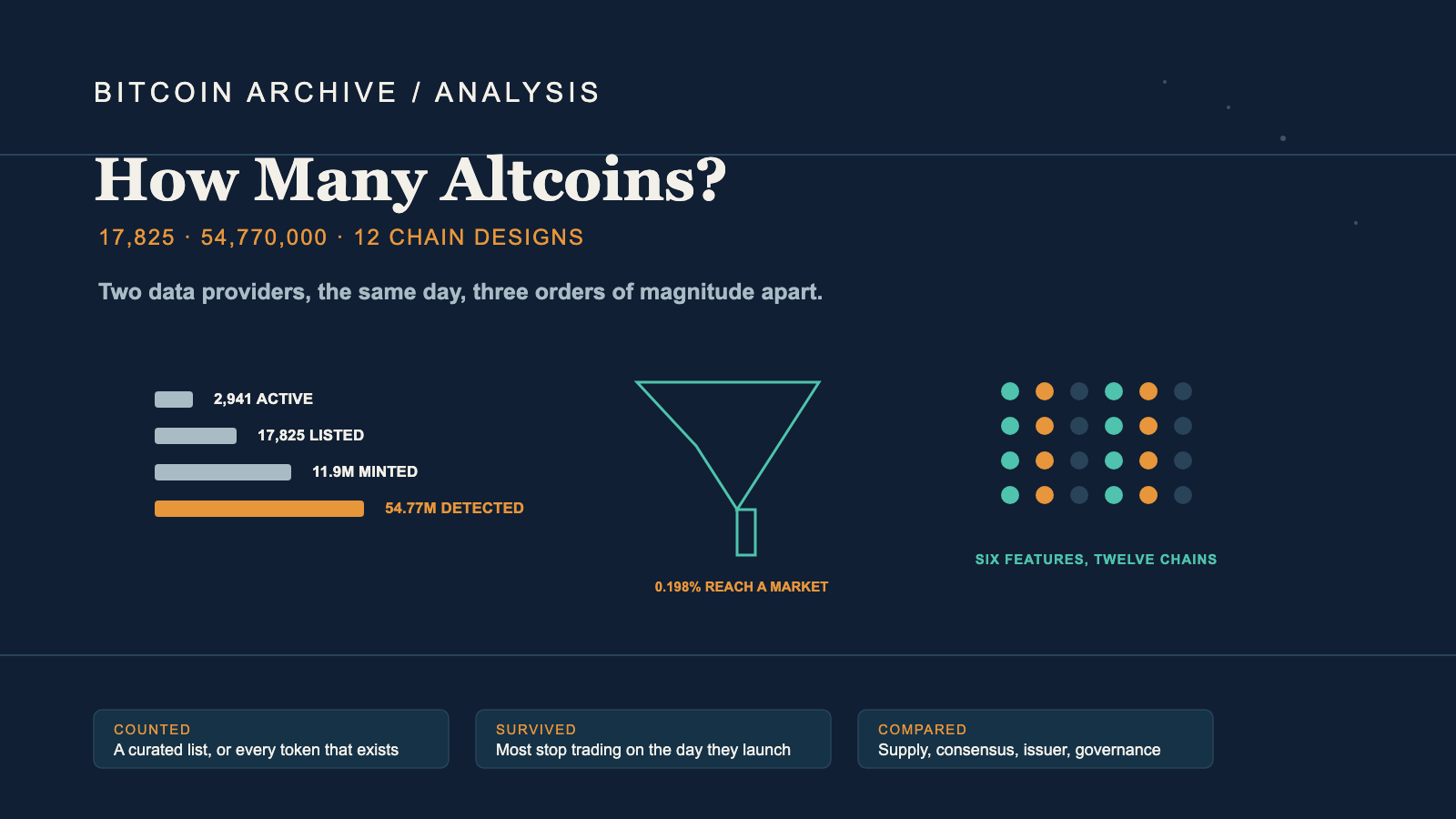
Apart from the proof-of-work function, each parameter was scaled by a factor of four against Bitcoin’s, producing a chain that was internally consistent — the block reward, halving schedule, and supply ceiling all stayed in proportion. This same four-parameter design is one of twelve chains compared in the altcoin count and design comparison, which quotes Lee’s own stated intent to “not change what’s working [from Bitcoin] unless there was a good reason to.” The hard-cap monetary design this scaling produced — Litecoin’s 84 million ceiling, inherited and scaled rather than redesigned — is one of fifteen currencies compared in the fixed-supply vs. adjustable-money analysis.
Lee positioned Litecoin publicly as “the silver to Bitcoin’s gold” — a framing that survived as marketing language for the chain into the late 2010s and 2020s. The metaphor captured Lee’s positioning intent: Litecoin was not a replacement for Bitcoin but a complementary, faster, lower-fee chain for everyday transactions, with Bitcoin reserved for store-of-value usage.
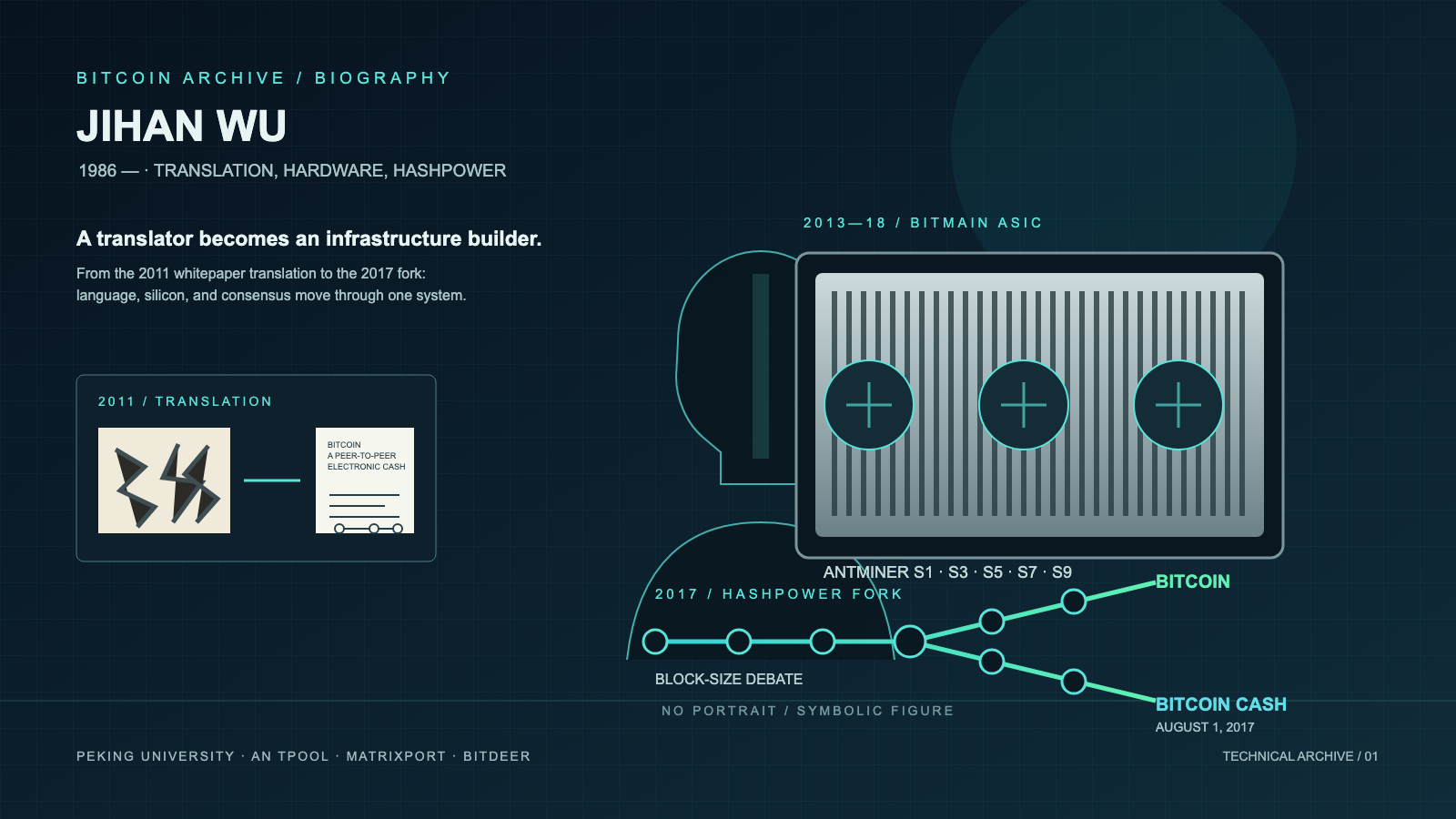
The Scrypt proof-of-work choice did not produce the long-term ASIC resistance Lee anticipated. Scrypt ASICs (most prominently from KnCMiner and later Bitmain’s Antminer L-series) shipped from 2014 onward, and Litecoin mining became as ASIC-dominated as Bitcoin’s by 2015–2016. Bitmain, the manufacturer behind those Scrypt units, is profiled in Jihan Wu’s biography, which traces the company’s parallel rise to dominance in Bitcoin’s own SHA-256 ASIC market. The “ASIC-resistant” framing was retired without explicit retraction; the chain continued operating on Scrypt regardless.
Litecoin survived the early-altcoin era when most contemporaries (Solidcoin, IXCoin, Tenebrix) faded. By 2013 it was the second-largest cryptocurrency by market capitalization, a position it held intermittently through 2017 before the broader altcoin proliferation crowded the rankings.
Charlie Lee left Coinbase in 2017 to focus on Litecoin Foundation work, and disclosed selling his personal LTC holdings the same year on the grounds that his comments on price moved markets unfairly.
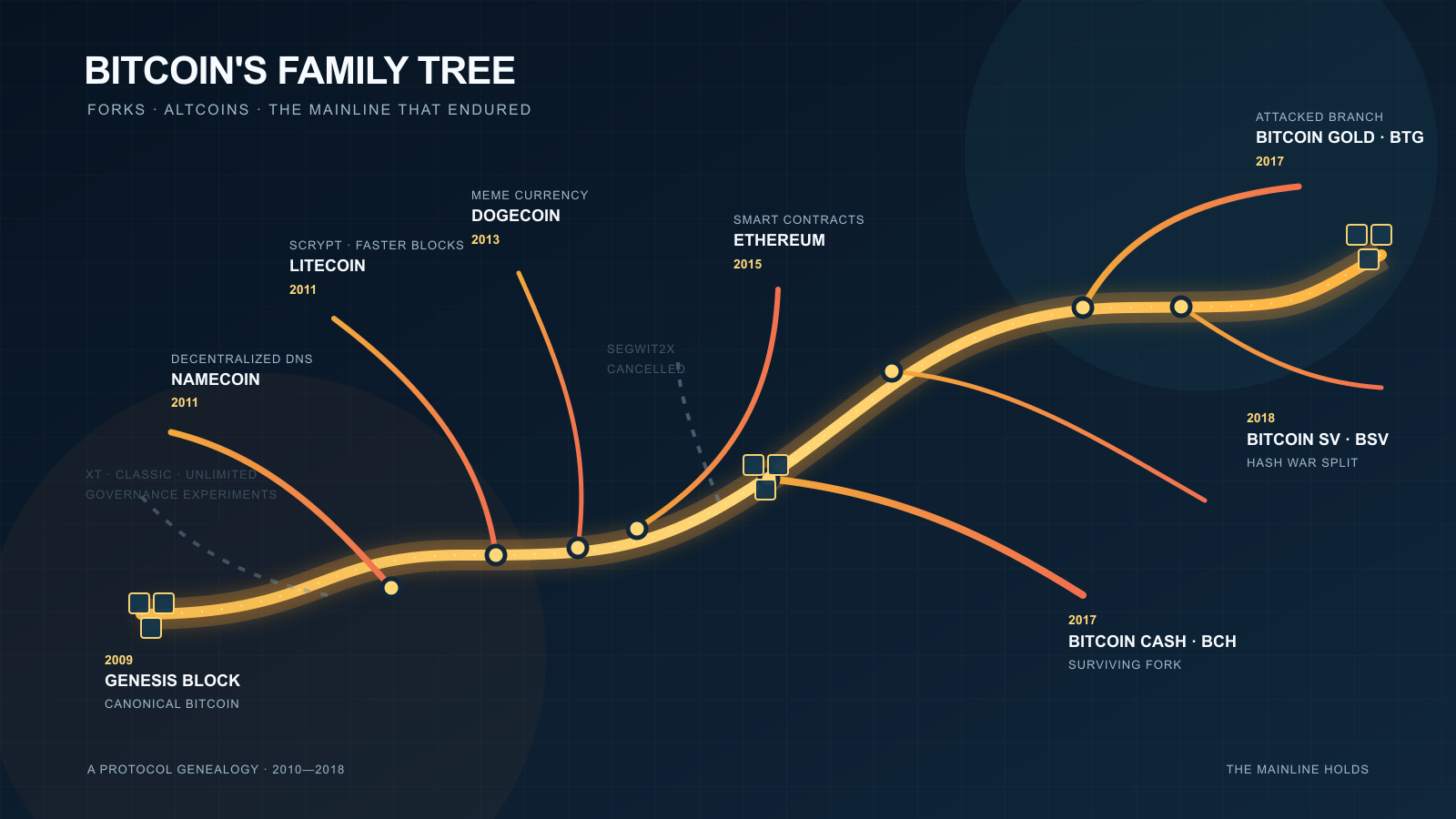
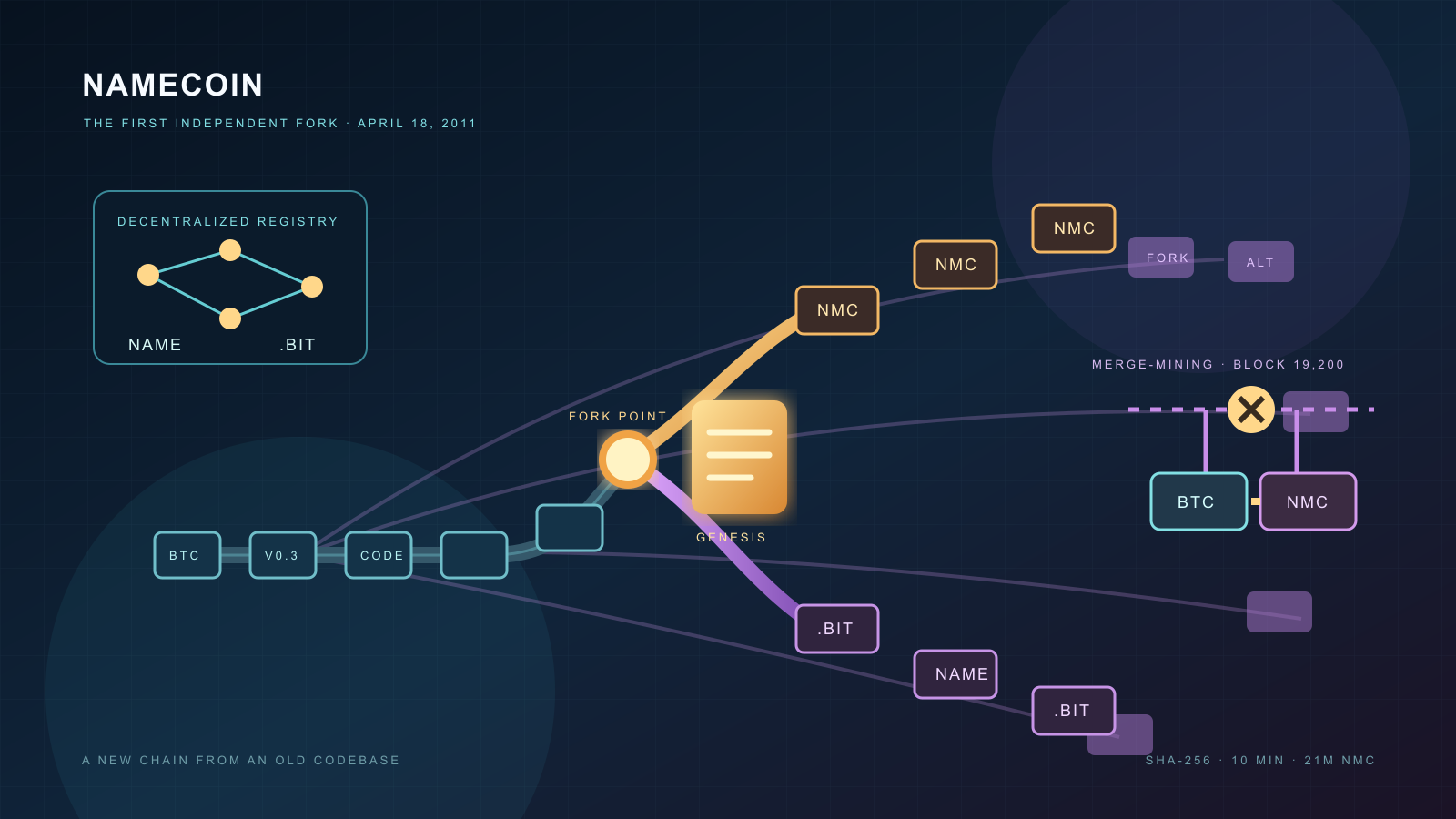
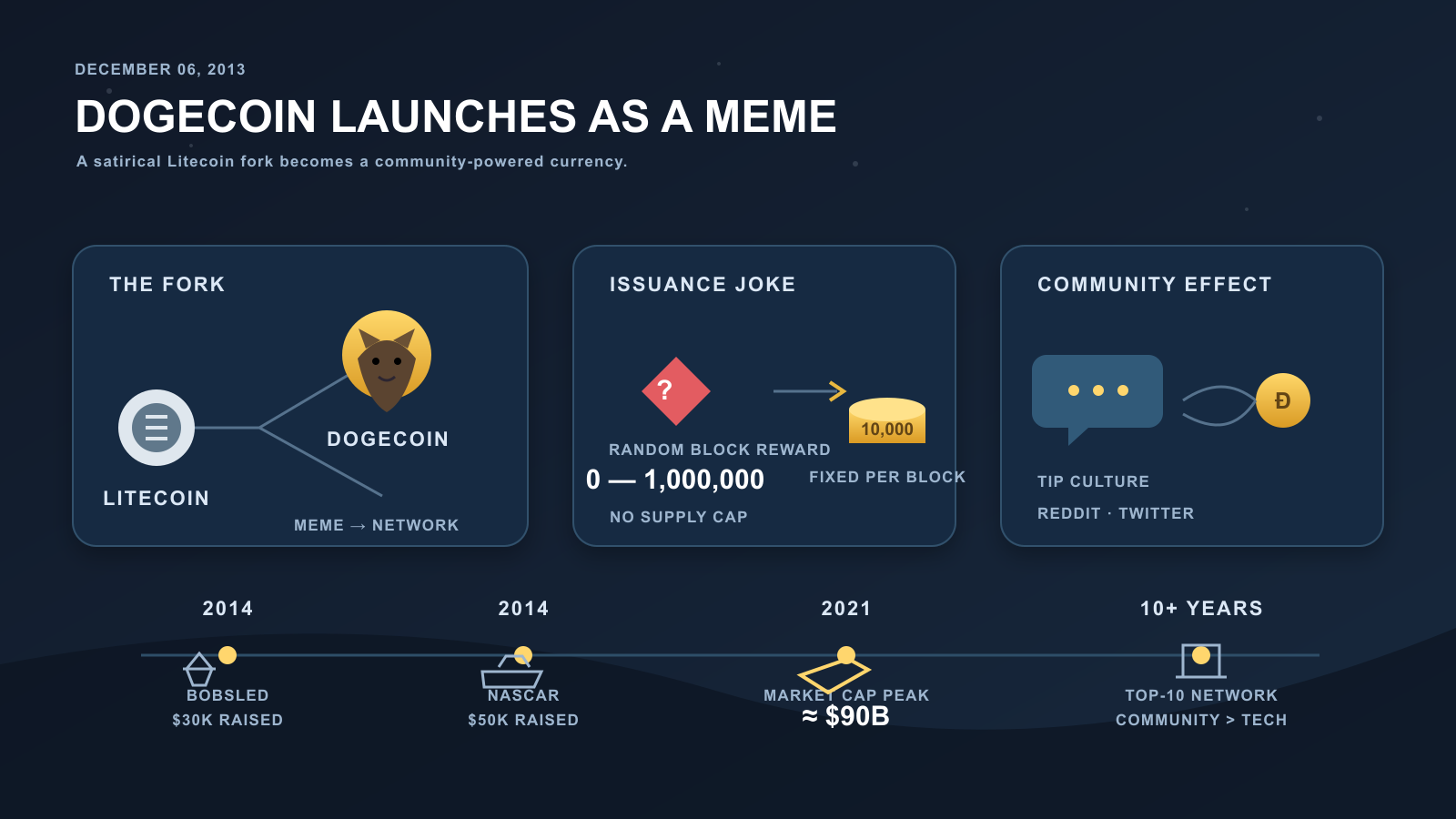
Litecoin’s lasting significance is as the second template for Bitcoin-codebase forks (after Namecoin) and the proximate parent of Dogecoin, which forked Litecoin in December 2013 rather than Bitcoin directly. The full genealogy is recorded in the Bitcoin family-tree analysis.