
Bitcoin Institute

Do Kwon (1991–)

Terraform Labs co-founder sentenced to 15 years for a $40 billion fraud

Figures

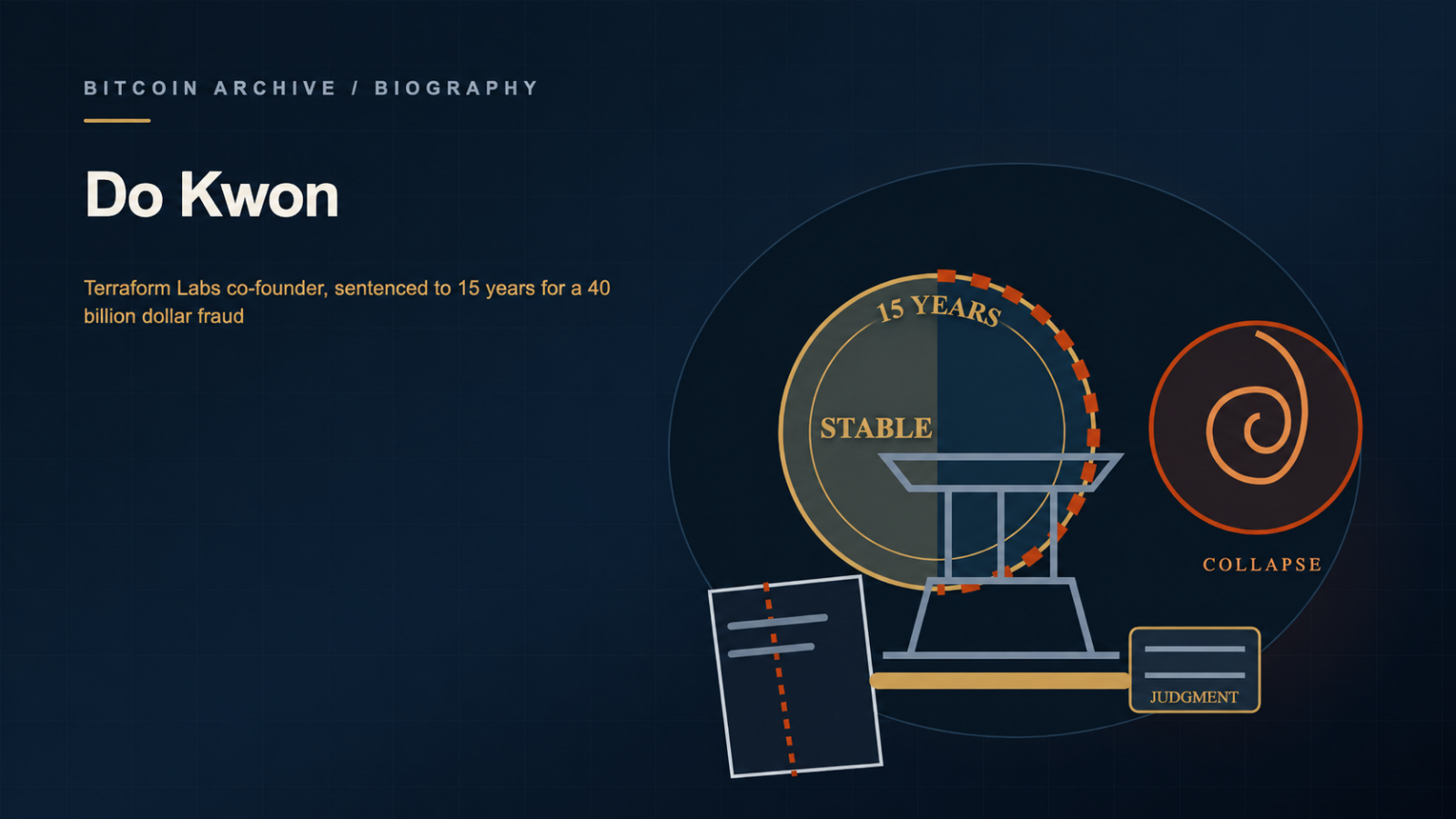
Dark-navy illustration of a coin split into a stablecoin half and a volatile-token half, a spiral of shrinking coin shapes collapsing toward a vanishing point, a torn passport silhouette, and a courthouse column beside a calendar marked with a fifteen-year span.

On May 9, 2022, TerraUSD — the stablecoin Do Kwon had spent four years insisting would hold its dollar peg through code alone — broke it. Within four days its companion token, Luna, fell from above $80 to fractions of a cent, and roughly $40 billion had been destroyed.

Three and a half years later, a federal judge in New York put a name to what had happened.

“This was a fraud on an epic, generational scale.”

Judge Paul Engelmayer said that on December 11, 2025, sentencing Kwon to 15 years in federal prison — three years more than prosecutors had asked for.

1991Born in Seoul, SouthKorea (Sep 6)2015Graduates Stanfordwith a computerscience degree2018Co-founds TerraformLabs with Daniel Shin(Jan)2019Named to Forbes 30Under 302022UST depegs, Luna'ssupply explodes; ~$40Bdestroyed (May 7-13)2023Arrested at PodgoricaAirport on forgedpassports (Mar 23)2024Extradited fromMontenegro to the US(Dec 31)2025Pleads guilty to fraudconspiracy and wirefraud (Aug)2025Sentenced to 15 years,forfeits $19M (Dec 11)

Before Terra

Kwon Do-hyeong was born September 6, 1991, in Seoul. He studied computer science at Stanford, graduating in 2015, and worked briefly as a software engineer at Apple and Microsoft before returning to Korea. In January 2018 he co-founded Terraform Labs with Daniel Shin, who had already built Ticket Monster into one of Korea’s largest e-commerce platforms. The pitch that followed inverted the usual stablecoin design: rather than holding a dollar in reserve for every token issued, Terra’s protocol backed its stablecoin with an algorithm and a second token that absorbed the difference. The full mechanism, and what it took to break it, is recorded on Terra/Luna’s own currency profile. By 2019, Kwon’s name was on Forbes’ 30 Under 30 list.

A Bitcoin standard, borrowed

As UST’s supply grew, Kwon looked for a way to back the peg with something the market already trusted. On March 14, 2022, he posted a plan to the project’s Bitcoin reserve:

“$UST with $10B+ in $BTC reserves will open a new monetary era of the Bitcoin standard.”

The Luna Foundation Guard, the nonprofit Kwon had built to hold that reserve, went on to accumulate nearly 80,000 BTC — roughly $3.5 billion at the time — over the following weeks. Kwon defended the buying pace against skeptics in the same period:

“I don’t understand the distinction, We’re already buying Bitcoin.”

The reserve was built to make UST’s peg credible by association with an asset nobody controlled. Within two months, it would be sold off trying to save a peg that association alone could not hold.

The collapse

When large withdrawals began draining UST’s lending market on May 7, 2022, Kwon’s public response was terse:

“Deploying more capital – steady lads.”

The capital did not hold the peg. By May 13, the reserve Kwon had called the dawn of a Bitcoin standard was nearly gone — sold and lent out in a losing defense, down from close to 80,000 BTC to 313. Luna’s own supply, meant to absorb volatility a few percent at a time, had instead exploded from roughly 343 million tokens to 6.53 trillion in a week, printing its way toward worthlessness in the same motion that was supposed to save the peg.

Fugitive

Kwon left South Korea in April 2022, before the collapse, and did not return. South Korean prosecutors issued a warrant that September. On March 23, 2023, Montenegrin police arrested him at Podgorica Airport, attempting to board a flight to Dubai on a forged Costa Rican passport — he was also found carrying forged Belgian travel documents. Montenegro had no extradition treaty with either country seeking him, and its courts spent nearly two years deciding which one would get him. On December 27, 2024, the country’s justice minister approved extradition to the United States and rejected South Korea’s competing request; Kwon was handed over four days later.

Guilty

In August 2025, Kwon pleaded guilty in the Southern District of New York to conspiracy to commit securities fraud, commodities fraud, and wire fraud, plus a single count of wire fraud — two of the eight counts he had originally faced. He agreed to forfeit more than $19 million in proceeds from the scheme, including his stake in Terraform Labs and its cryptocurrencies. At sentencing, he told the court:

“All of their stories were harrowing and reminded me again of the great losses that I’ve caused.”

Judge Engelmayer’s sentence — 15 years, above the 12 years prosecutors had requested and far above the five years Kwon’s own lawyers had argued for — fell short of the 25-year statutory maximum.

Kwon may still face a separate trial in South Korea after serving part of his US term; Daniel Shin, indicted there in 2023, has not been extradited.

Related Entries

1 entries