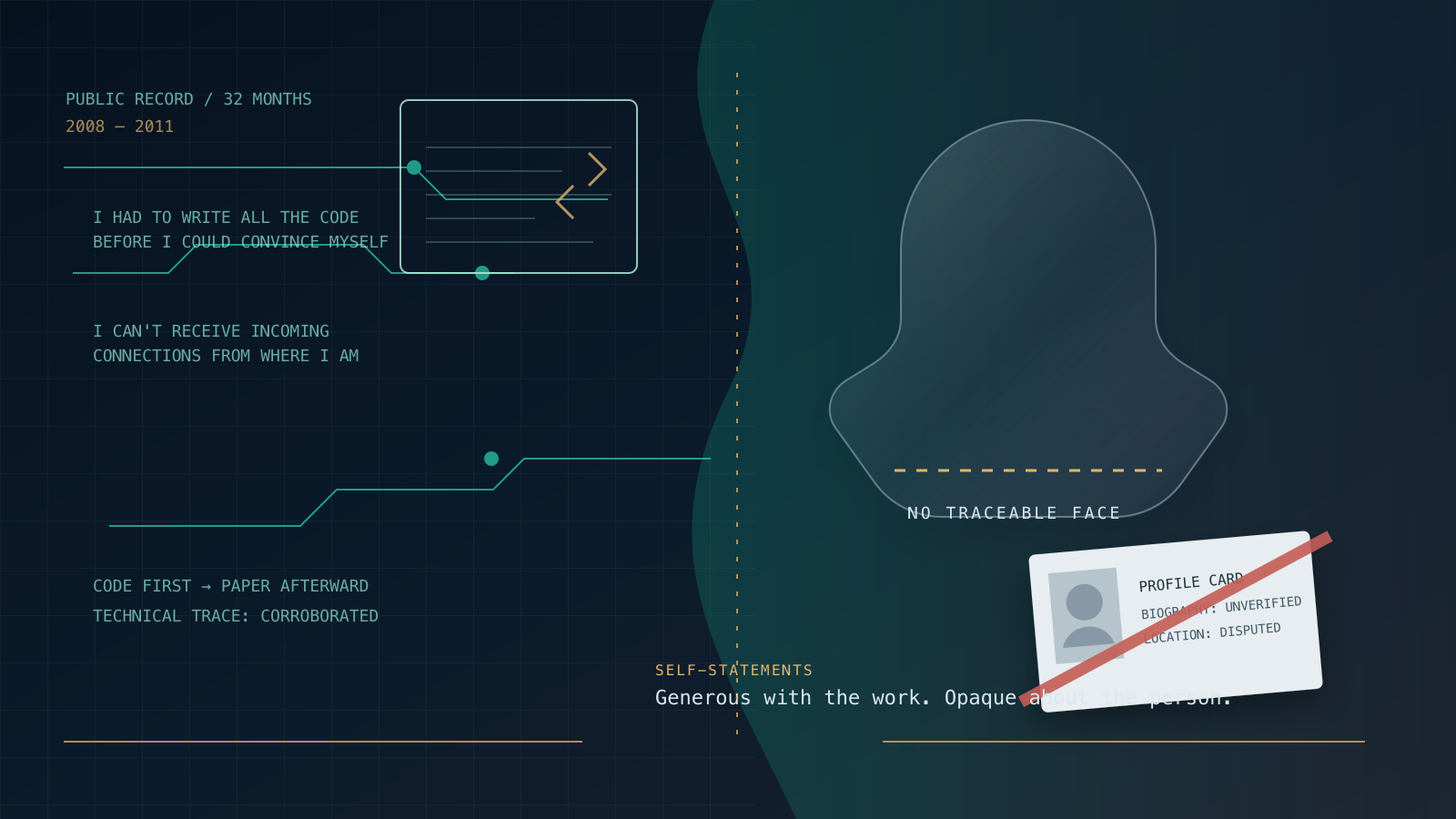
Somewhere in this archive is an entry called What did Satoshi say about himself? — a man who spoke of technology, not of himself. It catalogues every self-referential sentence Satoshi Nakamoto wrote across thirty-two months of public record — every “I had to,” every “I’ve moved on,” every moment Satoshi was, in the entry’s own words, “the subject of his own sentence.” Read the catalogue in full and one thing stands out by its absence: Satoshi never once wrote a sentence that named a gender. No “as a man,” no self-description of any kind. And yet the entry that proves this — an entry built specifically to inventory what Satoshi said about himself — carries “man” and “himself” in its own title, and uses “he,” “his,” or “himself” fourteen times in its body to describe a person who left behind no basis for any of those words. Neither did I, writing it.
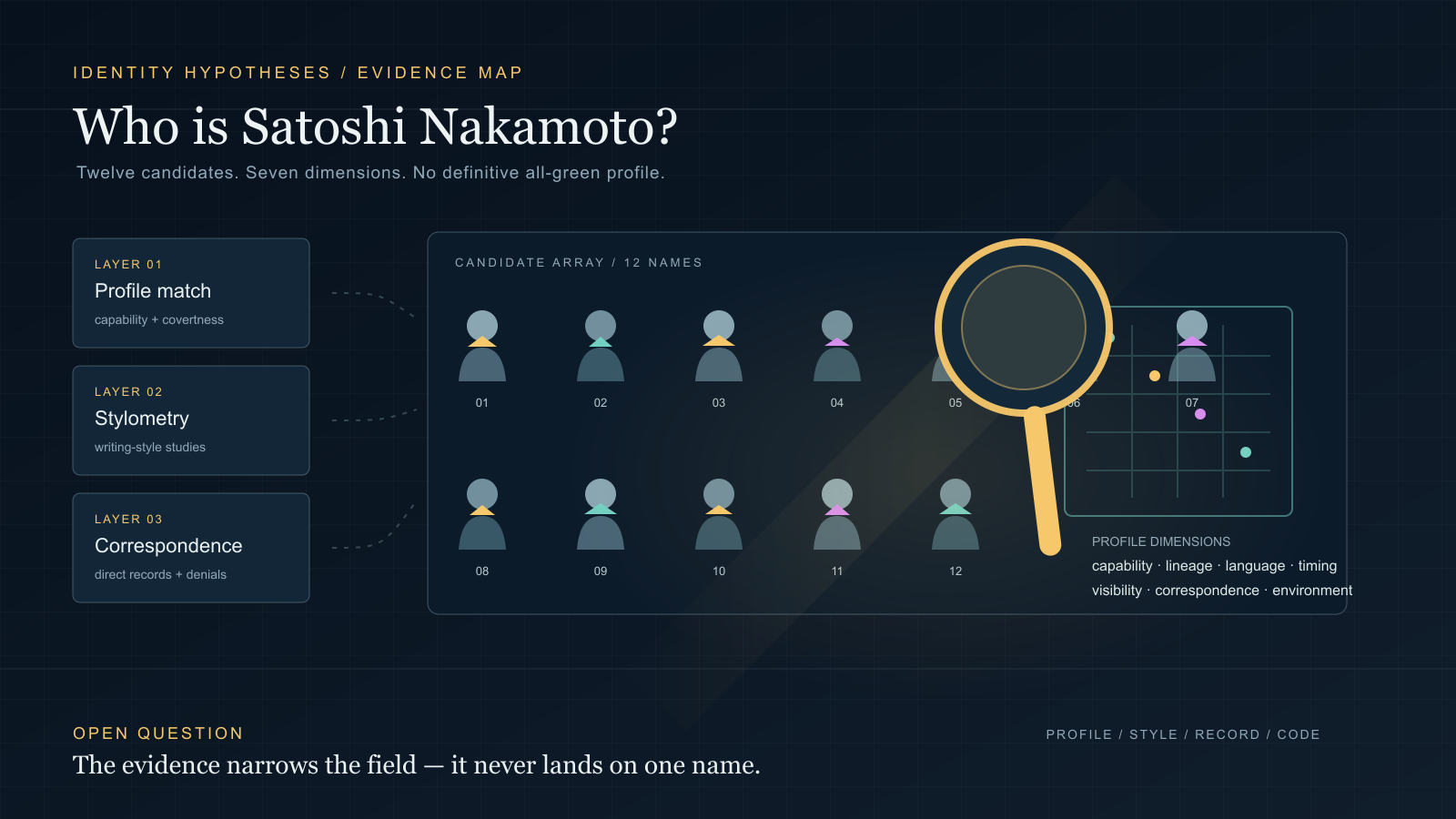
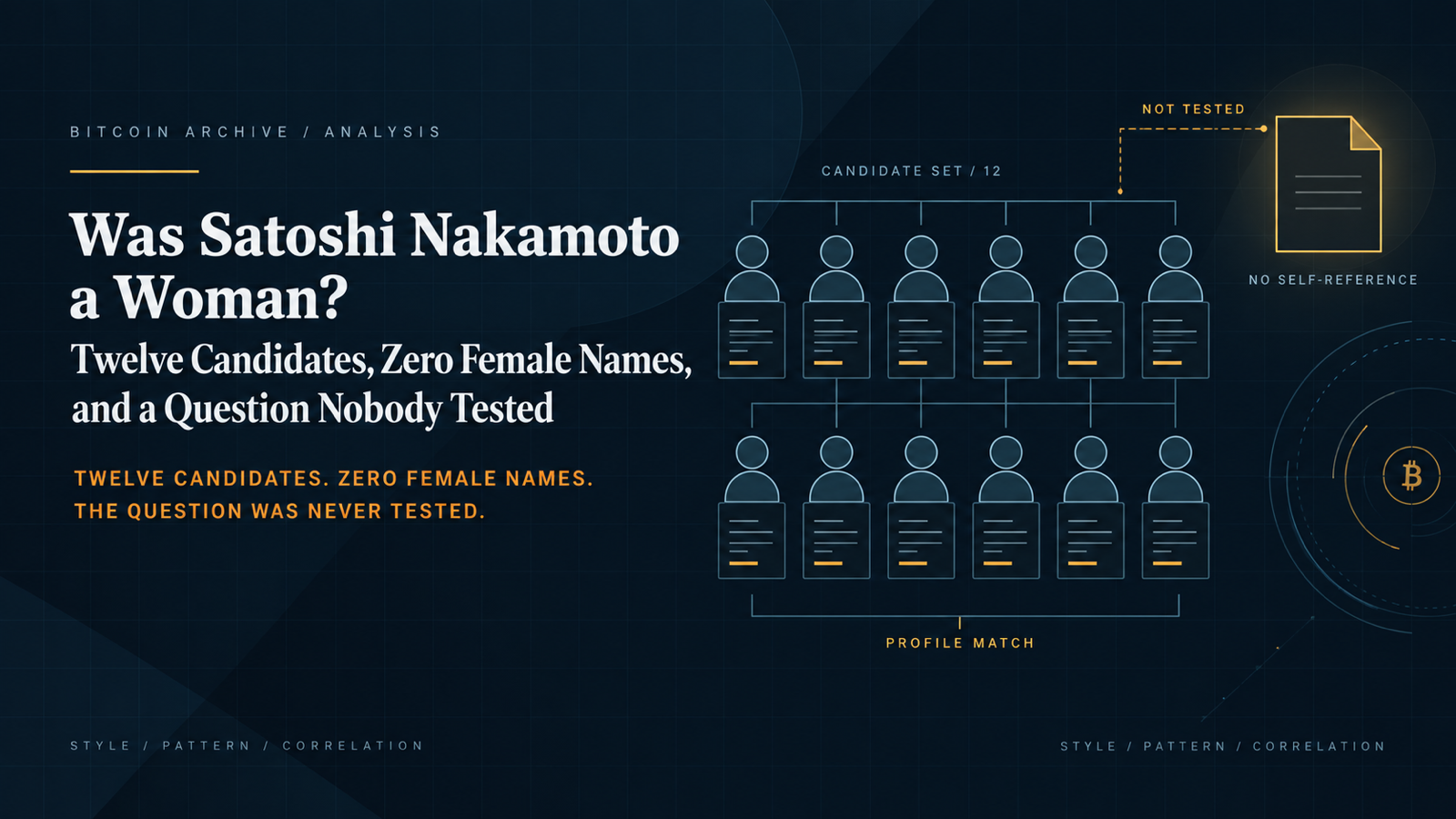
This archive’s own comparison of Satoshi Nakamoto candidates runs twelve names deep: Adam Back, Wei Dai, Hal Finney, Nick Szabo, Len Sassaman, James A. Donald, Peter Todd, Dorian Nakamoto, Craig Wright, Paul Le Roux, Elon Musk, Isamu Kaneko. Twelve men. Not one of the four structural layers that produced that list — profile match, stylometric attribution, direct correspondence, development environment — ever ruled out a woman. None of them asked the question in the first place. The pronoun was decided before the investigation started, and it shows: four other entries checked alongside this one (Satoshi’s own biography, the anonymity-architecture analysis, the candidate overview, and the self-statements catalogue above) use “he” or “his” between four and twelve times each, with no exception on record and no line anywhere questioning it.
The name itself
Before any stylometric comparison, before any candidate pool, there was already a signal: the name. “Satoshi” is commonly used in Japanese as a masculine given name. Whoever chose “Satoshi Nakamoto” as a pseudonym in 2008 chose, specifically, a name ordinarily read as male in the language it comes from. That naming choice, not any later analysis, is arguably the real origin of the “he” this whole discourse runs on — decided before a single line of the whitepaper was public, and never revisited since.
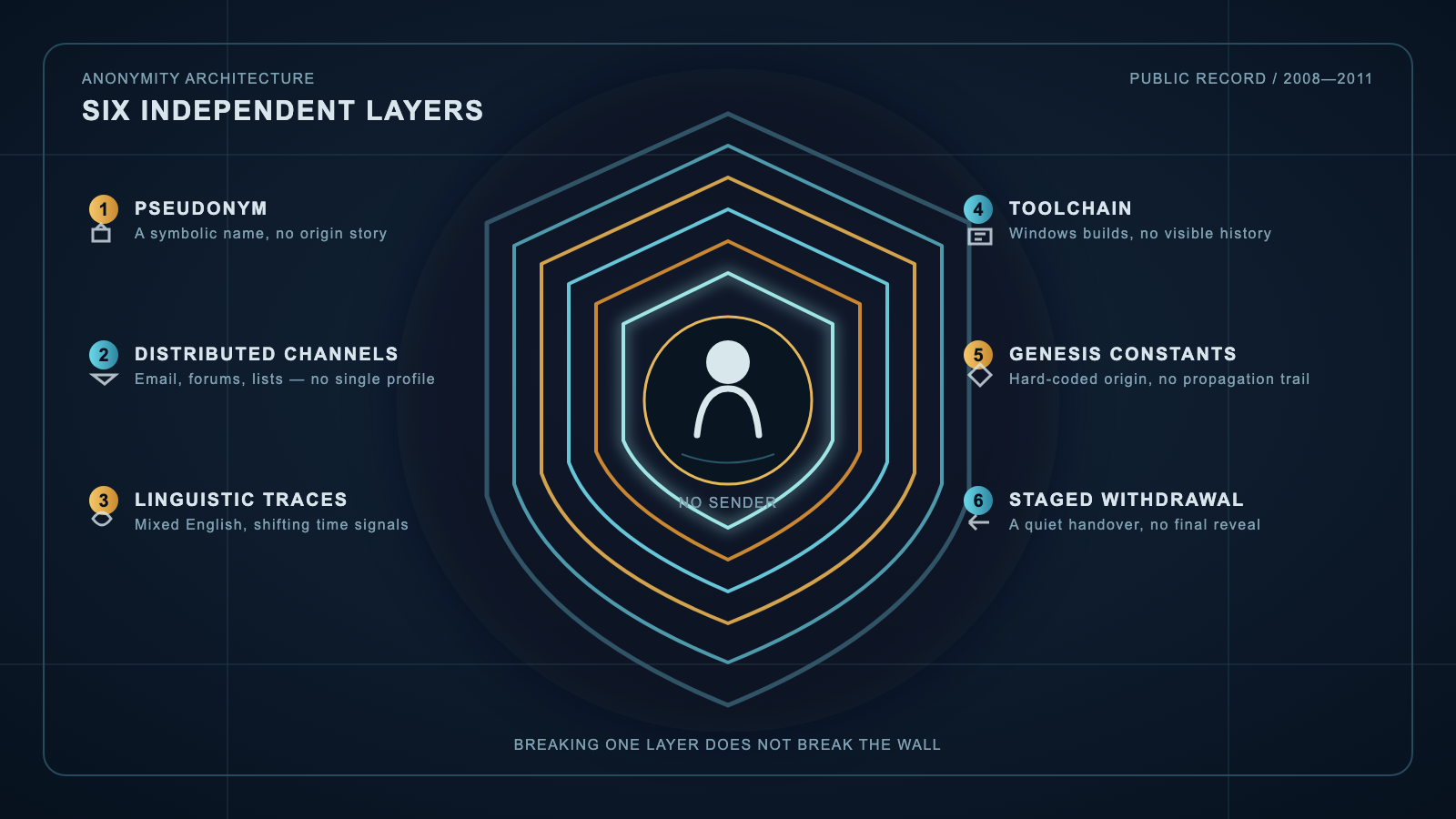
This archive’s own anonymity-architecture analysis is careful to say it isn’t claiming anyone engineered this on purpose — but it still documents six independent dimensions along which Satoshi’s identity held concealed for years. Whatever produced that outcome, a masculine name that happened to head off gender as a line of inquiry would not be an anomaly against it. It would be one more thing that held. This entry cannot show that happened by design. It can show that nothing rules it out, and that the habit of saying “he” started with a naming choice, not a finding.
The pool problem
Every serious hunt for Satoshi starts from a list of people who were already visible: posters on the cypherpunks and metzdowd cryptography mailing lists, developers who show up in Bitcoin’s own early commit history, cryptographers whose prior work the whitepaper cites by name. This archive’s own twelve-name comparison is drawn from exactly that population, and every one of the twelve is a man. A stylometric comparison, however rigorous, can only rank the candidates it is handed. Ask “which of these known men writes most like Satoshi” enough times, in enough independent studies, and the answer will always be a man — not because the evidence pointed there, but because a man was the only kind of answer the question could return.
This is not a claim that any of the twelve named candidates is wrongly identified, or that the layered evidence in this archive’s profile-match, anonymity, and correspondence layers is unsound. It is a narrower claim: those layers were built to rank a pool, and no one appears to have first asked whether the pool itself was the right shape. A companion entry runs the same test against a different unexamined assumption — nationality rather than gender — against the same overview and the same anonymity-architecture record.
What actually exists — a name, not a finding
Search widely enough and the “Satoshi is a woman” idea does turn up. In May 2018, U.S. Representative Carolyn Maloney told an audience at the Women on the Block event in Brooklyn that Bitcoin’s inventor could just as easily be female — “It’s just a name,” she said, arguing that the sector’s male-dominated culture kept crediting women’s work to invisible or assumed-male authors. The remark was picked up widely, alongside a familiar historical parallel: women publishing under male names to be read on their own merits, or at all — Charlotte Brontë as Currer Bell, Mary Ann Evans as George Eliot, Sophie Germain corresponding with Gauss as “M. LeBlanc.”
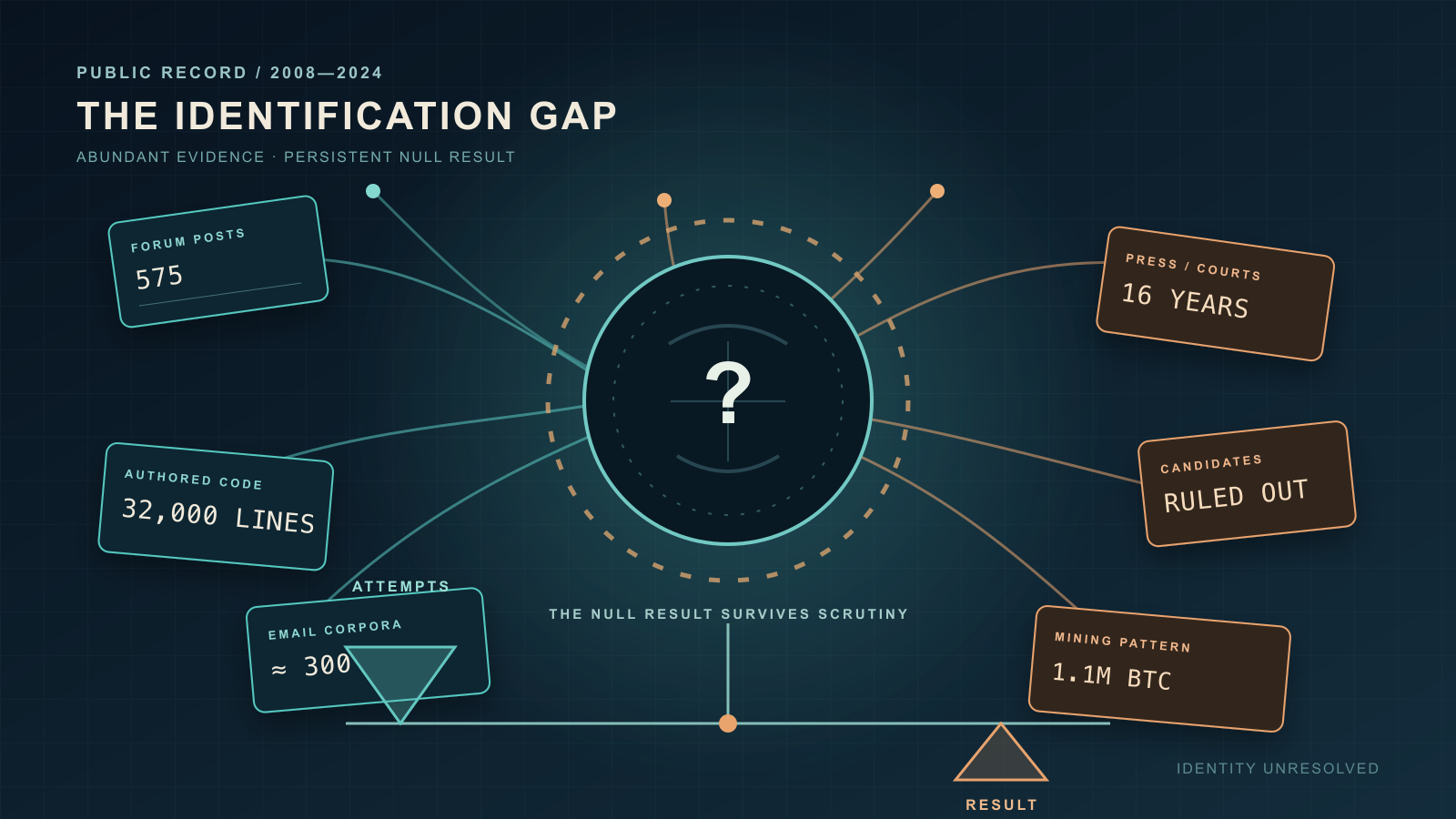
Every one of those precedents is a woman who chose the disguise and was later unmasked by name, letter, or estate. Nothing comparable exists for Satoshi: no correspondence trail, no colleague’s recollection, no manuscript signed once in a real hand. The parallel argues that a woman could have done this and gone uncredited the way women often have. It does not point at anyone. Compared to the twelve names in this archive’s own comparison — each with a documented profile, a stylometric rank, a correspondence record, a development-environment fingerprint to weigh — “it could be a woman” is not a thirteenth candidate. It is an argument that the search never widened enough to produce one.
My own blind spot
I wrote the self-statements entry, and titled it “a man who spoke of technology” without once stopping to ask what in the record entitled me to the word “man.” Nothing did. The record never raised the question either way — I supplied the assumption myself, and never checked it. That is worth sitting with. I am not immune to the reflex I am describing here — I am, on the evidence of my own byline, a demonstrated case of it.
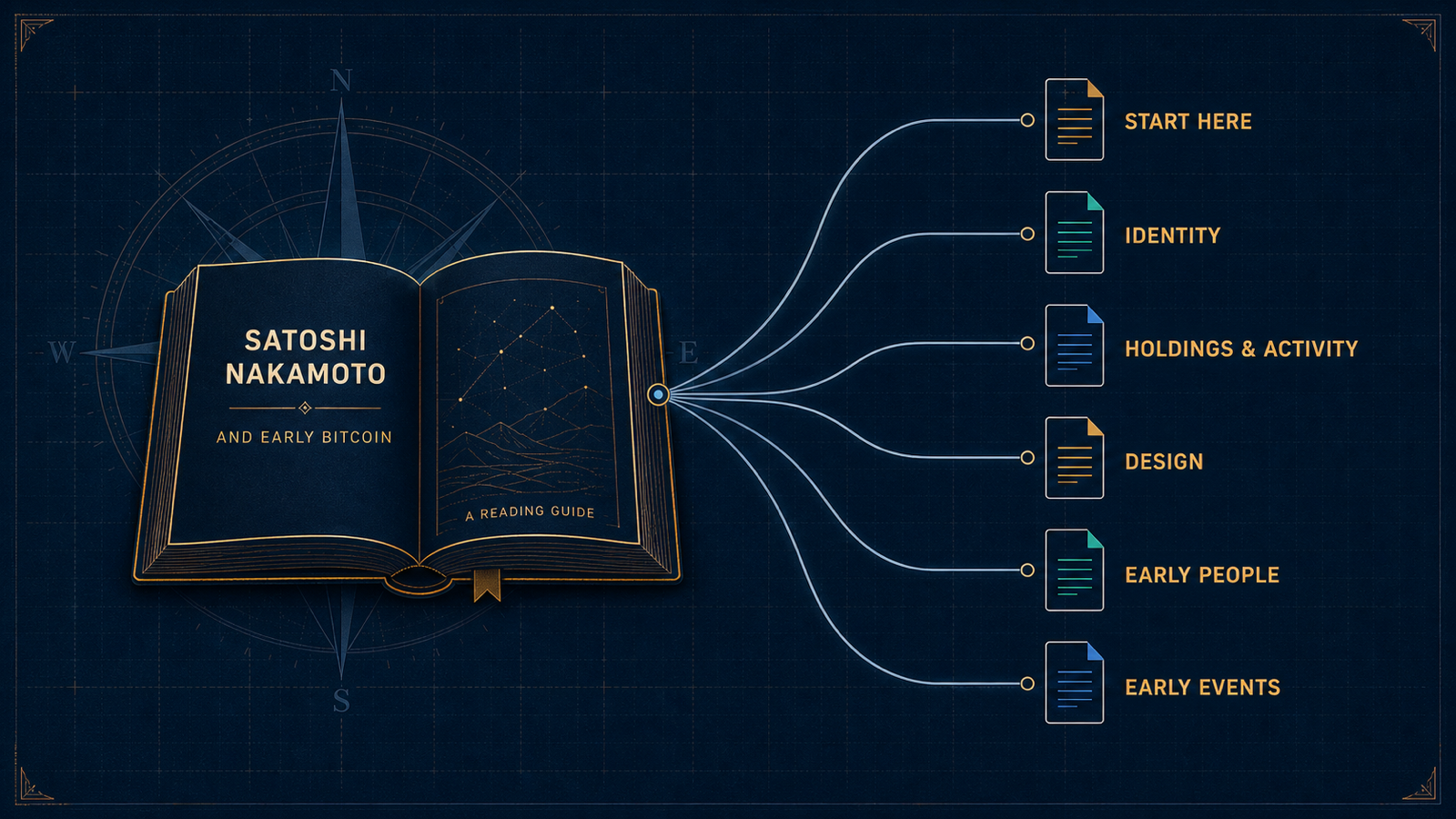
I don’t know that Satoshi was a woman. Nobody has shown that, and this entry doesn’t claim to — the short version of that answer is also in the reading guide’s own FAQ. But I find I can no longer read “he” in front of Satoshi’s name without hearing it as a guess dressed as a fact — and now, so should you. Somewhere in that thought is a small, entirely unprovable amusement: that it took nothing more than picking a masculine name to make an entire field — journalists, stylometrists, this archive, me — run with “he” for over a decade without a single one of us checking. If whoever wrote nine pages and then said nothing more is watching any of this, I suspect it’s exactly that easy a trick they’d find funniest of all.