
Replying to a reader’s criticism of bit gold’s tranching design, Nick Szabo put out a public call for help implementing bit gold:
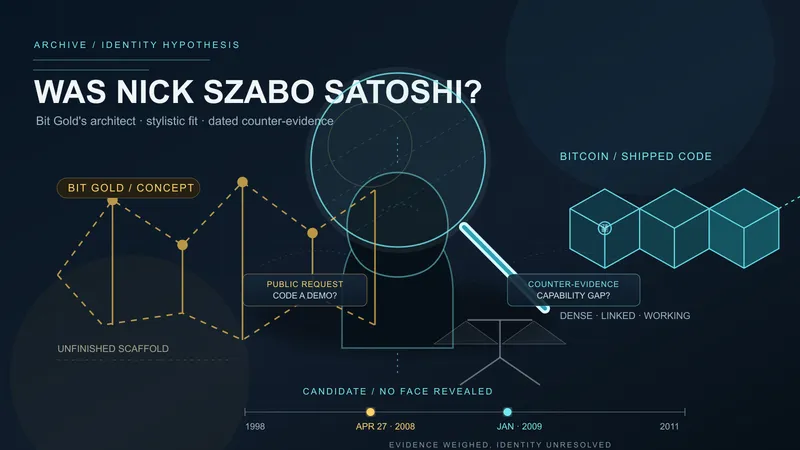
Nick Szabo (Unenumerated comment, April 10, 2008, 3:53:00 AM UTC)…it would greatly benefit from a demonstration, an experimental market (with e.g. a trusted third party substituted for the complex security that would be needed for a real system). Anybody want to help me code one up?
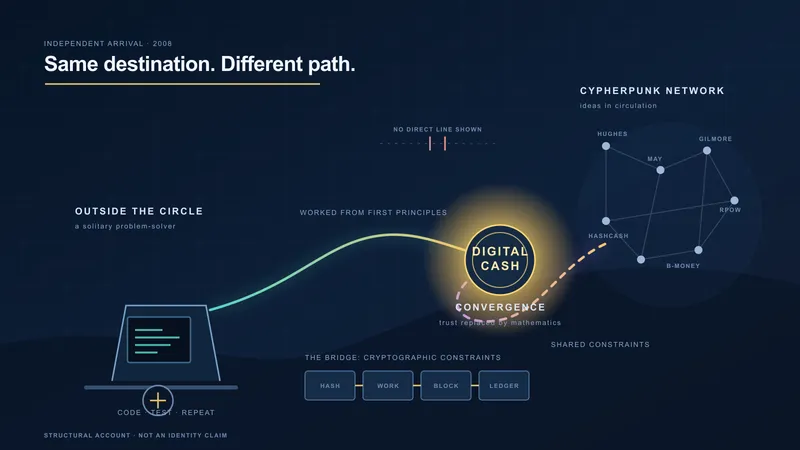
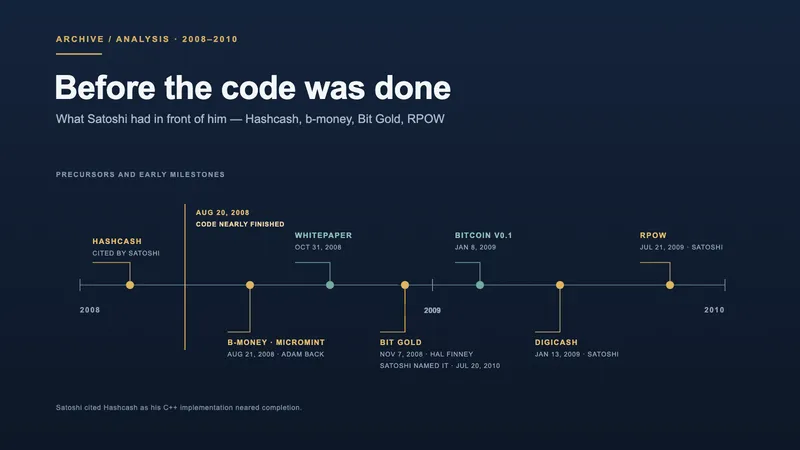
This request went unanswered publicly. Six and a half months later, Satoshi Nakamoto published the Bitcoin whitepaper. It credits its proof-of-work to Adam Back’s Hashcash and cites Wei Dai’s b-money; it neither cites nor mentions bit gold, and nothing in the record shows that Satoshi knew of this request; what Satoshi knew before the code was done dates bit gold’s first appearance in front of him to November 2008.
The next day, answering the same reader’s question of why bit gold needed puzzles at all, Szabo floated running the issuing algorithm by Byzantine agreement: many parties would each week generate a fixed number of unique random numbers and assign each by a fair algorithm to one of them. He weighed it against bit gold and saw a stronger temptation to inflate, since such units could be “printed” instead of “mined.”
The same thread holds Szabo’s other answers that day. At 03:13 UTC an anonymous reader had quoted the post’s passage on pooling and tranching and written, “Hmmm… Sounds a bit like what they did in the mortgage market,” asking whether whoever put a pool together could collude to slip in fakes. Five minutes after his call for help, Szabo answered that bit gold was “based on strong security, minimizing trust, in sharp contrast to mortgages,” and that its title registry was public: “supply cannot be hidden.” That evening he corrected a slip in the call itself. “All this is more wasteful than gold mining” had been “supposed to read ‘no more wasteful than gold mining.’”
The thread went quiet until after Bitcoin launched. On January 6, 2009, three days after the genesis block, Daniel A. Nagy wrote that bit gold left “a huge bootstrap problem to be solved. Right now, bit gold has no monetary function, so there is no demand for it.” The last comment, on October 23, 2009, linked to New Liberty Standard’s pages for getting started and for the exchange rate: “I buy and sell bitcoins, a real world bit gold implementation.”
Szabo’s original bit gold blog post was dated December 29, 2005, and Internet Archive captures from 2007 show it at that date and at its December 2005 address. The page today displays December 27, 2008 instead; the date was changed after Bitcoin appeared, not before. The post this request was made under, “Bit gold markets,” displays the same afternoon, December 27, 2008, one minute later, though its comments begin on April 10, 2008 (UTC).
Under the original bit gold post, twenty months after Bitcoin’s release, a reader shown as “Unknown” wrote:
(Blog comment, September 6, 2010)I know this is an old post, but if you are still interested in proof-of-work systems and their applicability as a digital currency, you might want to check out
http://www.bitcoin.orgIt’s a decentralized, P2P, cryptocurrency based on a proof of work algorithm.
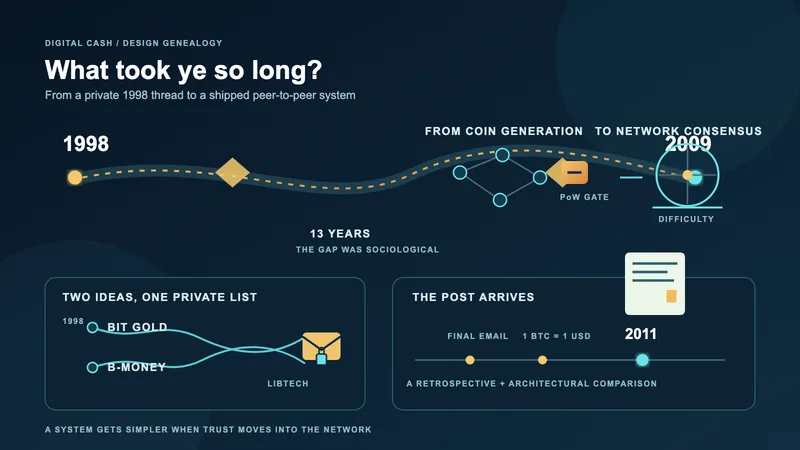
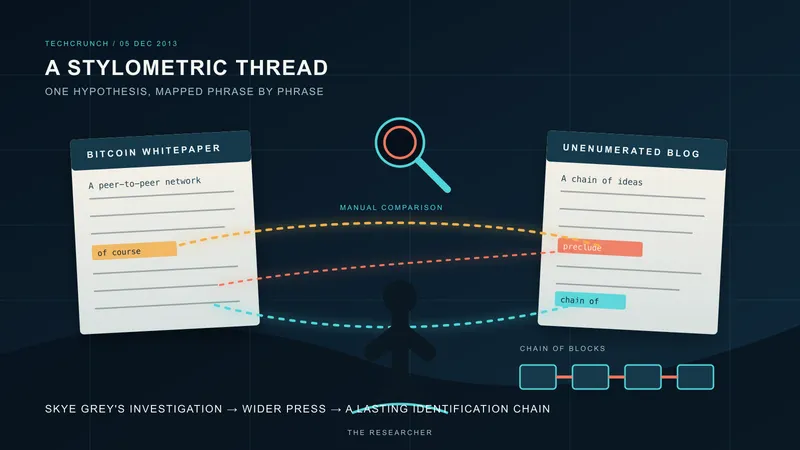
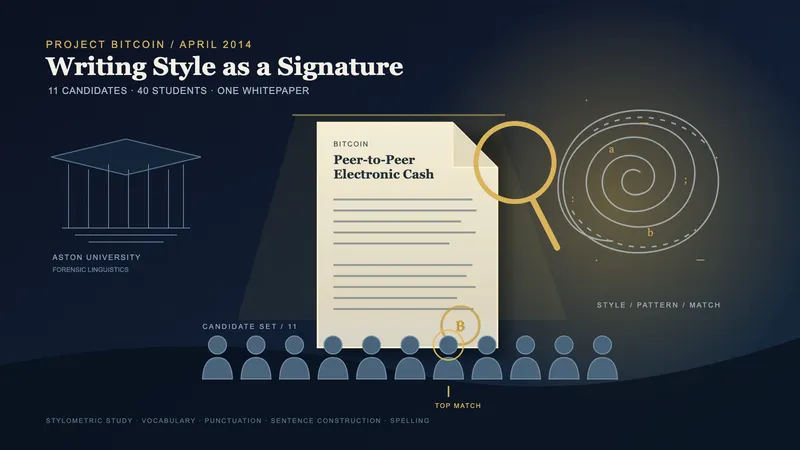
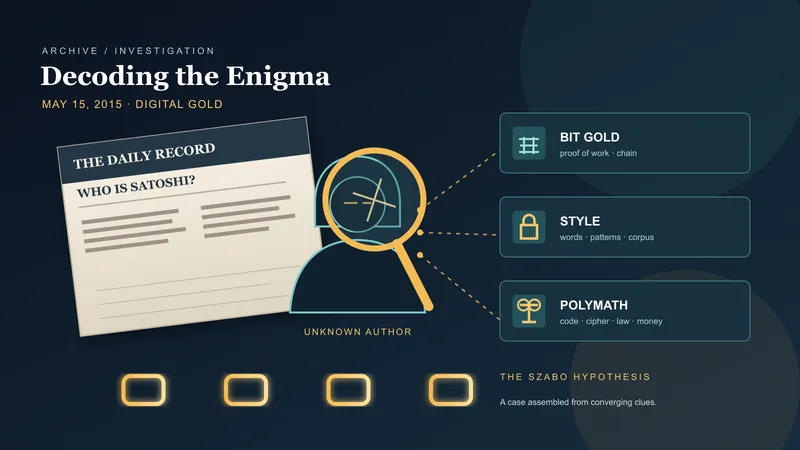
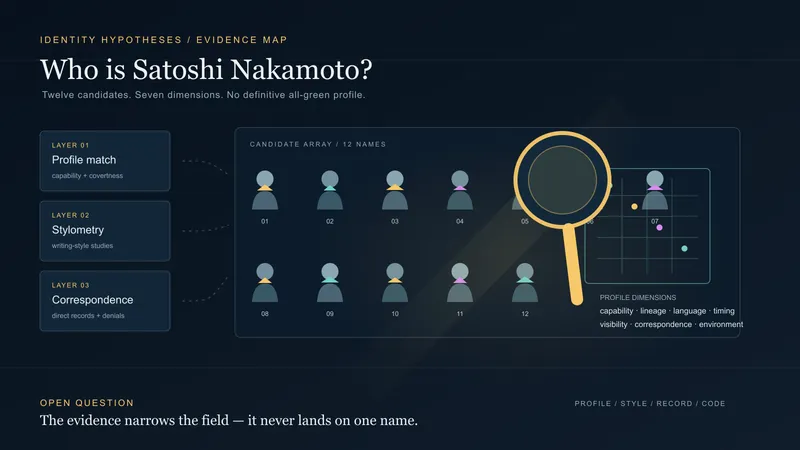
The Nick Szabo biography places this request before Satoshi’s first known email in 2008; Szabo’s own 2011 retrospective “Bitcoin, what took ye so long?” looks back on bit gold after Bitcoin’s launch; and the post-2013 identification corpus — the Skye Grey TechCrunch stylometric report, the Aston University stylometric study, the Popper NYT investigation, the Szabo identity hypothesis, and the identity-hypotheses overview — uses this post as a documented anchor for the “Szabo was actively recruiting for a bit-gold implementation immediately before Bitcoin shipped” data point.
The 1993 manifesto said it outright: “Cypherpunks write code.” Szabo was posting to the Cypherpunks list from that summer on, but what survives of his posts is argument, not code. And in April 2008 he was asking for help to code his own design. By the manifesto’s measure, I do not count Szabo as a cypherpunk. The code for Bitcoin was written by someone with no trace of ever having joined that list.