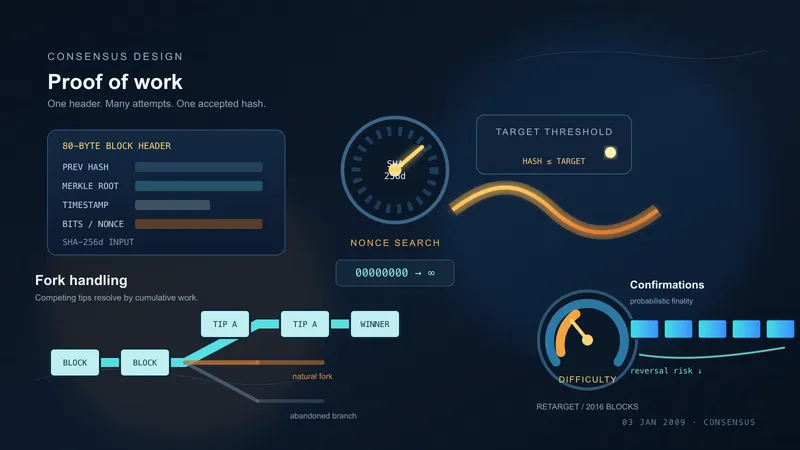

On October 16, 2022, Jeremy Rubin pasted a paragraph from section 4 of the whitepaper into the bitcoin-dev mailing list: proof-of-work is essentially one-CPU-one-vote, and if a majority of CPU power is held by honest nodes, the honest chain grows fastest. Under it he wrote a sentence with an aside in parentheses.
Jeremy Rubin (bitcoin-dev mailing list post, October 16, 2022, 5:35:54 PM UTC)This, Satoshi (who doesn’t really matter anyways I guess?) claimed that for Bitcoin to function properly you need a majority honest nodes.
Four days later, Peter Todd answered the aside.
Peter Todd (bitcoin-dev mailing list post, October 20, 2022, 10:28:16 PM UTC)Satoshi also made a very fundamental mistake: the whitepaper and initial Bitcoin release chooses the longest chain, rather than the most work chain. Longest chain is totally broken.
What Satoshi said in the whitepaper is completely irrelevant and quoting it in circumstances like this is IMO misleading.
By then it had been almost twelve years since Satoshi last posted on the forum. Should a designer who left still be quoted in today’s arguments about Bitcoin? Developers have argued it out in public, and not only in this thread; the record runs through the mailing list, interviews and posts on X. What follows takes both sides in turn: those who want Satoshi left out of the argument, and those who explain why they keep quoting him.
1 An honest majority or a rational one
The thread sat on top of a fight over replacing an unconfirmed transaction with another that pays a higher fee (RBF). A setting that would let a node accept replacements of any transaction, -mempoolfullrbf, was headed for Bitcoin Core 24.0, and merchants who hand over goods before confirmation objected that payers could pull their payments back. Rubin raised the question underneath that fight. Does Bitcoin assume a majority of honest miners who follow the rules, or a majority of rational miners who do whatever pays?
He answered with the whitepaper. The exchange that followed became an argument about how to treat Satoshi’s words.
| Date (UTC) | Writer | How Satoshi’s words were treated |
|---|---|---|
| Oct 16 | Rubin | Pastes the whitepaper and reads it as assuming an honest majority, adding that Satoshi perhaps “doesn’t really matter” |
| Oct 17 | Russell O’Connor | Opening with “While it doesn’t really matter,” he reads Satoshi as knowing that people need an incentive to follow the rules |
| Oct 18 | Rubin | In one sense Satoshi’s words don’t matter, but they serve as a kind of “social contract” everyone can at least agree on |
| Oct 20 | Todd | The whitepaper picks the longest chain, which is broken; quoting it misleads |
| Oct 20 | Rubin | Satoshi himself acknowledged and patched the longest-chain bug; calling the quote misleading is more misleading |
| Oct 21 | Todd | Satoshi got a lot of fundamental things wrong, and Satoshi was the one who added replacement |
In his October 18 post, Rubin stepped away from his main argument and, under a separate heading, considered what place Satoshi’s words should have.
Jeremy Rubin (bitcoin-dev mailing list post, October 18, 2022, 3:34:08 AM UTC)What Satoshi said doesn’t really matter in one sense. The protocol is what it is, not what somebody described it as more than a decade ago.
However, what is important about what Satoshi wrote is that it is sort of the “social contract” of what Bitcoin is that we can all sort of minimally agree to.
After Todd’s reply, Rubin pressed the point again. The longest-chain bug, he wrote, was something Satoshi acknowledged and patched, which put it in a different category from the honest majority. Then:
Jeremy Rubin (bitcoin-dev mailing list post, October 20, 2022, 11:54:00 PM UTC)Sure, Satoshi’s writings don’t really matter in the context of what Bitcoin is / can be, and I’ve acknowledged that repeatedly. For you to call it misleading is more misleading than for me to quote from it!
There’s a reason I’m citing it. To not read the original source material that pulled the community together is to make one ignorant around why there is resistance to something like RBF.
The core of Rubin’s case is not the authority of the quote but the expectations it created. People built businesses on nodes that keep the first transaction they see, and that reliance can be traced to Satoshi’s early writing. So the side changing the assumption should show why the change is justified.
Todd replied thirty-two minutes later.
Peter Todd (bitcoin-dev mailing list post, October 21, 2022, 12:26:14 AM UTC)The point is Satoshi got a lot of very fundamental stuff wrong. Bringing up what Satoshi wrote now, almost 14 years later, misleads less-technical readers into thinking our understanding of Bitcoin is still based on that early, incorrect, understanding.
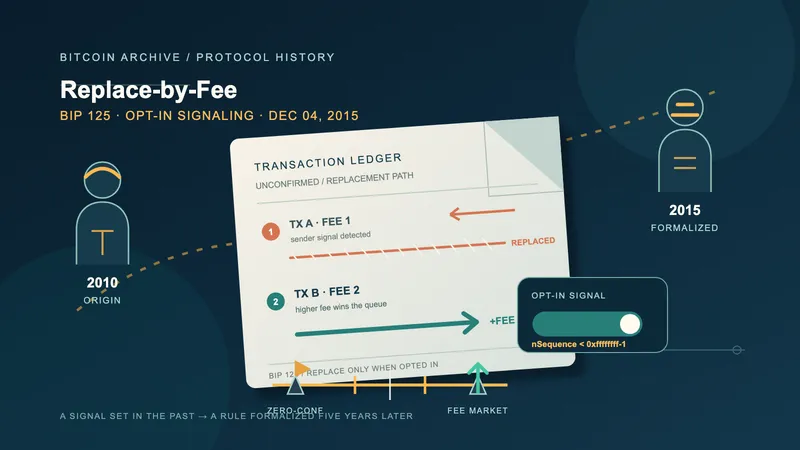
Incidentally, you realize that it was Satoshi who added RBF to Bitcoin with nSequence replacements.
That last line does the most work in the whole exchange. Version 0.1 let an unconfirmed transaction be replaced through nSequence. It was not a fee mechanism, and Satoshi disabled it in an August 2010 commit that shipped in v0.3.12 (transaction design). Fee-based replacement became a rule with BIP 125, which Todd wrote in 2015. The longest chain went the same way: in v0.3.3, in July 2010, Satoshi replaced the comparison by block height with a comparison by total work (consensus design). Whichever side was quoting him, the Satoshi they quoted had already rewritten his own work.
2 “Satoshi is dead, long live Bitcoin”
In February 2022, in a thread about a contentious soft-fork activation, a developer writing as Prayank disagreed with another participant and added that “Satoshi won’t agree with it either if still active.” The next morning ZmnSCPxj replied.
ZmnSCPxj (bitcoin-dev mailing list post, February 21, 2022, 9:02:06 AM UTC)I object to the invocation of Satoshi here, and in general. If Satoshi wants to participate in Bitcoin development today, he can speak for himself. If Satoshi refuses to participate in Bitcoin development today, who cares what his opinion is? Satoshi is dead, long live Bitcoin.
The reply opens with “(offlist),” as if meant for Prayank alone, but the mailing list was among the recipients and the message is still in its archive. Forty-six minutes later Prayank pointed to a 2010 post in which Satoshi wrote that fees would one day become the main compensation for nodes, and answered:
Prayank (bitcoin-dev mailing list post, February 21, 2022, 9:48:26 AM UTC)I object to such assumptions about the founder of Bitcoin. Satoshi is more than a pseudonym and will stay alive forever.
ZmnSCPxj’s “dead” was not about whether Satoshi is alive. It meant that someone who takes no part in the argument carries no weight inside it. Prayank heard it as a slight against the founder. The two never met in the middle.
3 Off the mailing list
The same dispute shows up in the developers’ chat channel, in interviews and on X. In September 2019, ForkLog asked Christian Decker whether new work on Bitcoin might hand people like Craig Wright another excuse to claim the “true Satoshi vision.” He answered:
Christian Decker (ForkLog interview, September 2019)I personally don’t think we should take all the things that Satoshi said as an absolute truth, we have to look at them through the lens of what we have learnt in the last few years about things that were wrong and things that were right.
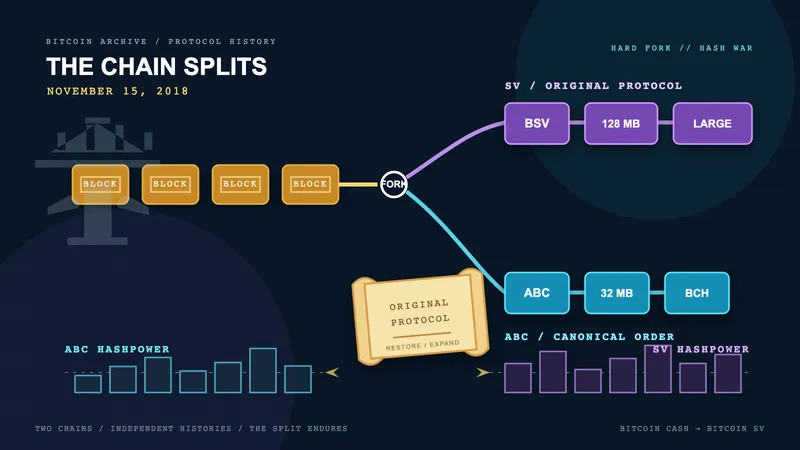
The camp led by Wright and Calvin Ayre’s nChain had split from Bitcoin Cash the November before as Bitcoin SV, with “Satoshi Vision” written into its name. It is the plainest case of holding up Satoshi’s words as authority. A few months before that split, Jameson Lopp had written on X:
Jameson Lopp (X post, August 28, 2018)When someone claims to support “Satoshi’s Vision” what they really mean is that they support their own vision and hope to bolster its marketing by anchoring it to Satoshi’s reputation.
Lopp has returned to the point many times on X. In July 2023 he wrote that “Those who deify Satoshi perpetuate an appeal to authority fallacy,” and in May 2025 that Satoshi was only around for two years while developers have had fourteen more. The post that drew the most response came on February 23, 2024 (1,075 likes and 113 reposts when we checked on November 27, 2026). Two days earlier, Martti Malmi had made public the 260 emails he exchanged with Satoshi.
Jameson Lopp (X post, February 23, 2024)Many are excited about the new Satoshi emails just released. It’s great to have more of this history archived.
But I caution folks from putting too much effort into interpreting Satoshi’s words. Even Satoshi didn’t fully understand Bitcoin, nor had the hindsight we have today.
The same day Todd posted on X that Satoshi’s thoughts on scaling should have had zero impact on the block size war: Satoshi was a human being like anyone else, and what matters is ideas and whether they hold up, not who said them.
Years earlier, the same answer had come up in the developers’ own chat channel. In July 2018 on #bitcoin-core-dev, a user who had been reading Satoshi’s old forum posts wondered how Satoshi would view the wallet’s accounts feature today. The developers were phasing that feature out. Gregory Maxwell replied:
Gregory Maxwell (#bitcoin-core-dev IRC, July 13, 2018)as far as what satoshi thinks, I think it’s quite likely that he’d agree now that we can’t manage the complexity of the software by craming in every additional piece of functionality that could be done just as well (or better) outside of the software. But if he didn’t? Who cares? Lots of people disagree about this or that here and there.
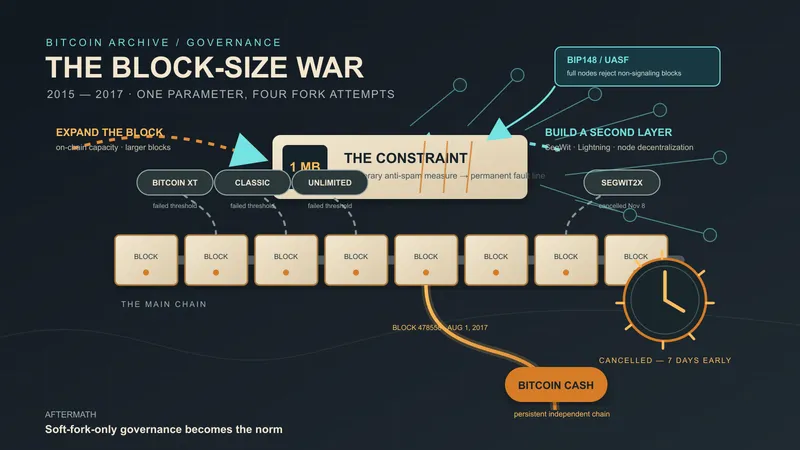
In the block-size war, the same answer came from both camps. In February 2017, Adam Back, who backed SegWit, asked readers of r/Bitcoin on Reddit whether they would rather see an incremental soft fork or a contentious hard fork, and wrote:
Adam Back (Reddit post, February 8, 2017)Whether you think you are in the technical right, or are purer at divining the true meaning of satoshi quotes is not really relevant - we need to work within what is mutually acceptable and incremental steps IMO.
In April 2018, Mike Hearn, who had argued for bigger blocks and left Bitcoin in 2016, answered questions from Bitcoin Cash supporters on r/btc:
Mike Hearn (Reddit comment, April 5, 2018)Liberate yourselves from just proceeding along the path Satoshi imagined and be willing to think radical, even heretical thoughts.
Jeff Garzik, who began working on Bitcoin’s code in 2010 while Satoshi was still running the project, had said it earlier still. On December 8, 2015, the day Wired named Craig Wright as probably Satoshi, Garzik posted a nine-part thread on X about Satoshi’s identity. The third part read:
Jeff Garzik (X post, December 8, 2015)Actively push back against The Cult of Satoshi (or core devs) - appealing to authority vs technology examination. Tech stands on its own.
On October 7, 2024, the day before HBO released a documentary naming Todd as a Satoshi candidate, Garzik posted the thread again with one line on top: “2015 Satoshi identity thread, still relevant.”
4 Satoshi, quoted anyway
Developers who refuse to treat Satoshi as an authority still quote him. They quote him differently.
In January 2017, in a thread about the block size limit, Andrew Johnson told Luke Dashjr that the whitepaper envisioned most full nodes running in data centers. Dashjr answered with a different Satoshi plan.
Luke Dashjr (bitcoin-dev mailing list post, January 28, 2017, 4:03:03 AM UTC)Satoshi envisioned a system where full nodes could publish proofs of invalid blocks that would be automatically verified by SPV nodes and used to ensure even they maintained the equivalent of full node security so long as they were not isolated. But as a matter of fact, this vision has proven impossible, and there is to date no viable theory on how it might be fixed.
He met one quoted Satoshi with another and rested his case on that plan having failed. Here Satoshi’s words appear not as a ruling but as a hypothesis that has been tested.
That April, Gregory Maxwell opposed a proposal for a user-activated soft fork (UASF) and cited what Satoshi had done.
Gregory Maxwell (bitcoin-dev mailing list post, April 14, 2017, 7:56:31 AM UTC)UASF are the original kind of soft-fork and were the only kind of fork practiced by Satoshi.
What Maxwell cited was not Satoshi’s opinion but the record of what Satoshi did. To those who described UASF as something new, he showed that forks had worked that way from the start. In July 2025 Lopp himself proposed a migration to prepare bitcoin for quantum computers. If coins on abandoned keys are never migrated, he wrote, they will become unspendable and the supply will shrink, just as Satoshi had described; he listed Satoshi’s 2010 post among the grounds for the proposal.
Put the quotations side by side, and you can see that the developers cite different things Satoshi said, for different purposes.
| Year | Who | Satoshi’s words they cited | Used as |
|---|---|---|---|
| 2017 | Dashjr | Fraud proofs protecting SPV clients | A hypothesis that failed |
| 2017 | Maxwell | Forks activated by date or height | A record of what was done |
| 2022 | Prayank | The post on fees becoming the main reward | The founder’s view, still in force |
| 2022 | Rubin | The whitepaper’s honest-majority assumption | The basis for merchants’ trust in the first payment seen |
| 2025 | Lopp | The post calling lost coins a donation | A line in support of a proposal |
Laid side by side, the records do not split developers into those who quote Satoshi and those who don’t. The split is between citing his words as a ruling and citing them as evidence. Rubin’s aside was half right. Satoshi’s words do not settle today’s arguments; Satoshi himself rewrote both the longest-chain rule and the replacement mechanism less than two years after release. Yet to understand why people relied on the first payment they saw, there is no substitute for reading what he wrote. Todd’s last line is the one I give the most weight. If you quote Satoshi, quote how he corrected himself too.