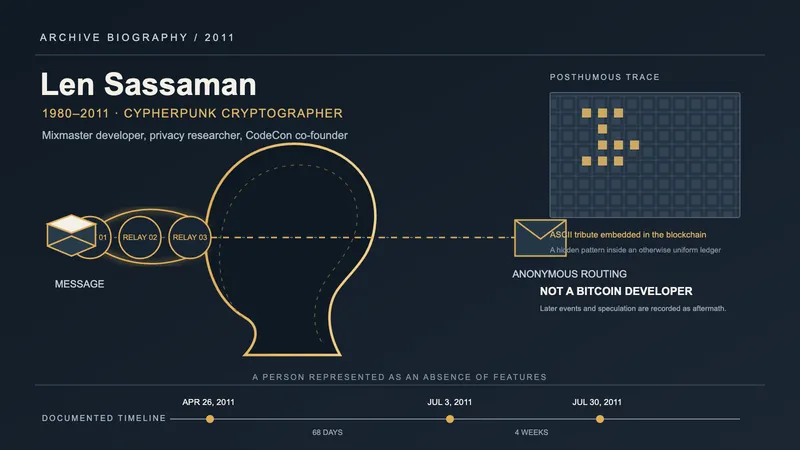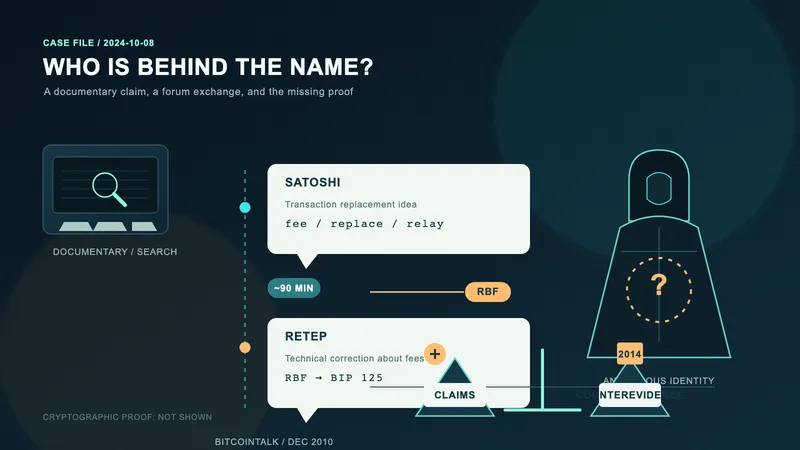

On April 22, 2026, Finding Satoshi — a documentary directed by Tucker Tooley and Matthew Miele, with business writer William D. Cohan and private investigator Tyler Maroney as primary investigators — proposed a two-person reading of the Satoshi Nakamoto pseudonym: cypherpunk cryptographers Hal Finney (1956–2014) and Len Sassaman (1980–2011) as co-creators of Bitcoin. Under the documentary’s framing, Finney wrote the code and Sassaman drafted the whitepaper.
The “two-person Satoshi” framing
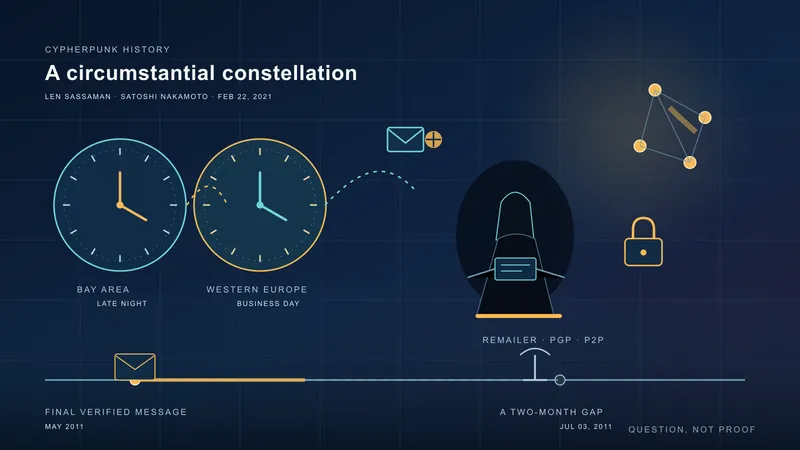
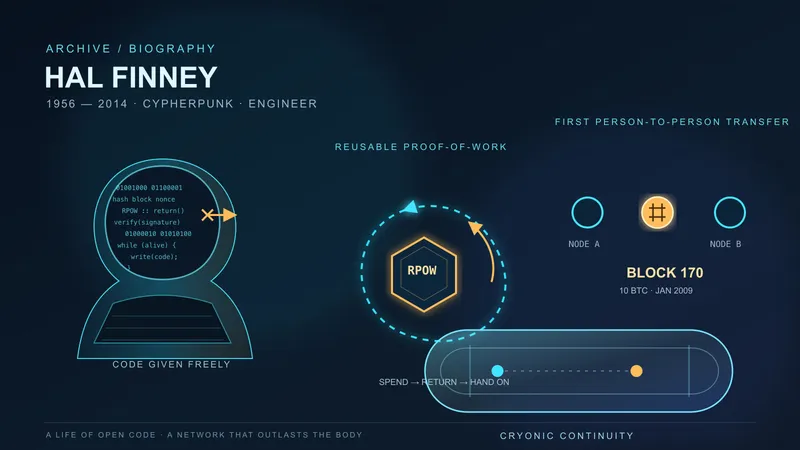
The film’s central claim is that Satoshi Nakamoto fronted a collaboration between Finney and Sassaman rather than a single individual. The proposed labor split: Finney handled implementation (codebase, early node operation, the 10 BTC test transaction) and Sassaman drafted the foundational paper. The reading extends the individual Finney = Satoshi hypothesis and the individual Sassaman = Satoshi hypothesis into a joint reading — the same instinct Laszlo Hanyecz voiced fifteen years earlier, when he told Wired that Bitcoin “seems awfully well designed for one person to crank out,” without yet having a specific pairing to name.
Lines of evidence presented
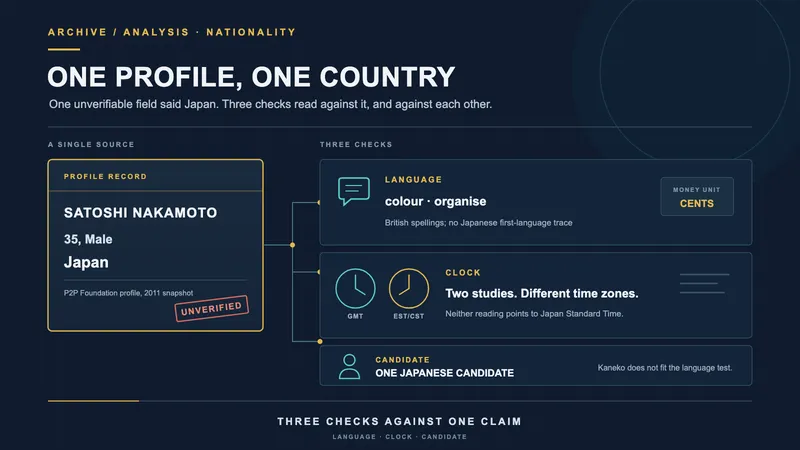
- Activity-window analysis by Alyssa Blackburn. Data scientist Alyssa Blackburn analyzed online activity histories of the principal suspects and reportedly found a 6am–10pm PST posting window that fits the Finney + Sassaman pair more closely than any single individual in the field. Doncho Karaivanov’s separate statistical read on Satoshi’s posting timestamps — cited in the self-statements inventory — reaches a related but more general conclusion (hours falling outside a Japan timezone) without specifying a PST window, and this entry does not adjudicate between the two readings.
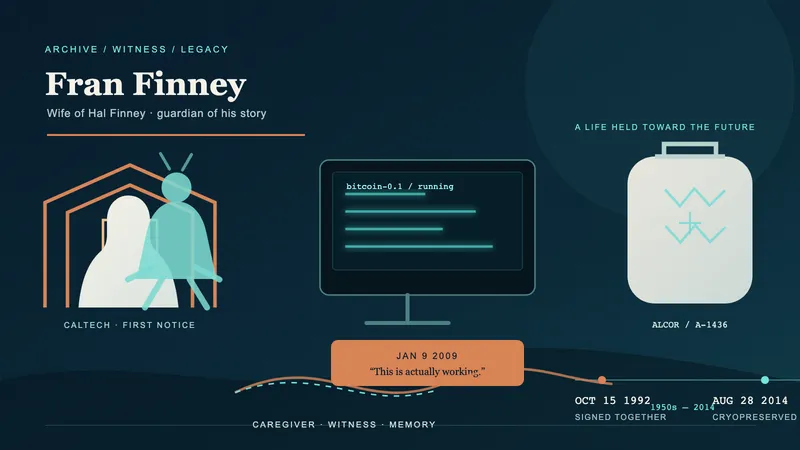
- Family testimony. Hal’s widow Fran Finney — whose account of their marriage is collected in her own biography — told the filmmakers that he had laughed and said no when she asked whether he was Satoshi, but that “I think he did help build it.” Sassaman’s widow Meredith L. Patterson said Finney and Sassaman were “definitely” in touch in 2008, and that it was “absolutely” possible Len had helped Hal without telling her.
- Motivation profile by Kathleen Puckett. Former FBI profiler Kathleen Puckett (known for her Unabomber investigation work) contributed a motivational reading supporting the two-person framing.
Other candidates examined
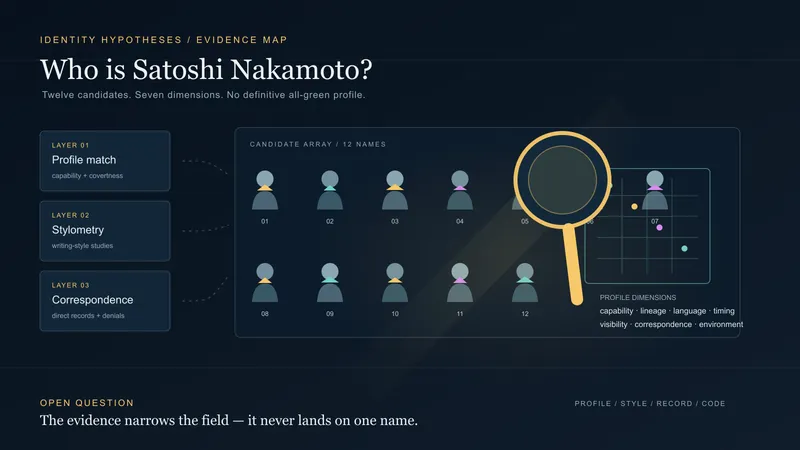
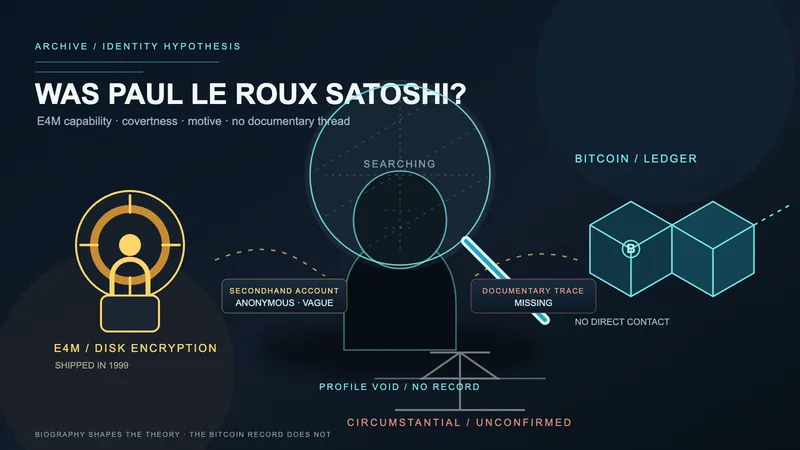
The investigators’ starting list had six names: Adam Back, Nick Szabo, Hal Finney, Len Sassaman, Paul Le Roux, and Wei Dai. Blackburn’s activity analysis ruled out Back, Szabo and Dai in the film’s account.
Critical counterpoints
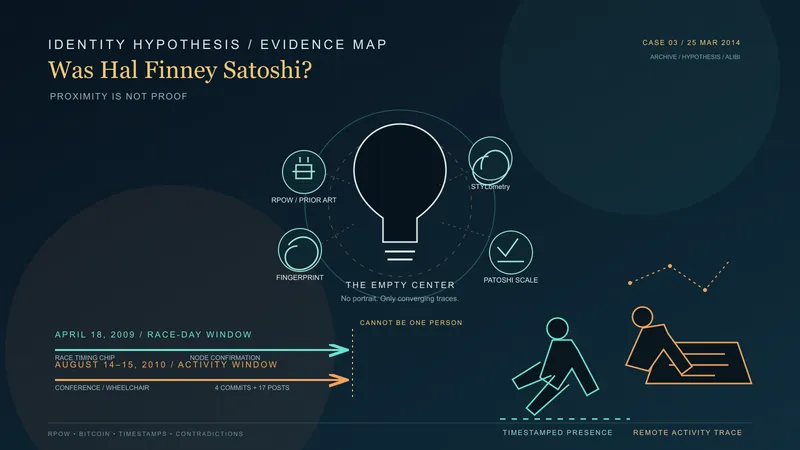
- Jameson Lopp, Casa’s co-founder, set out in the film the race-day alibi already documented on the Finney hypothesis page: on April 18, 2009 Satoshi emailed Mike Hearn and sent him a transaction while Hal was running a 10-mile race in Santa Barbara. He offered a group of people as one possible explanation. After seeing the finished film, he reportedly called it “a plausible take that may finally put an end to chasing ghosts.”
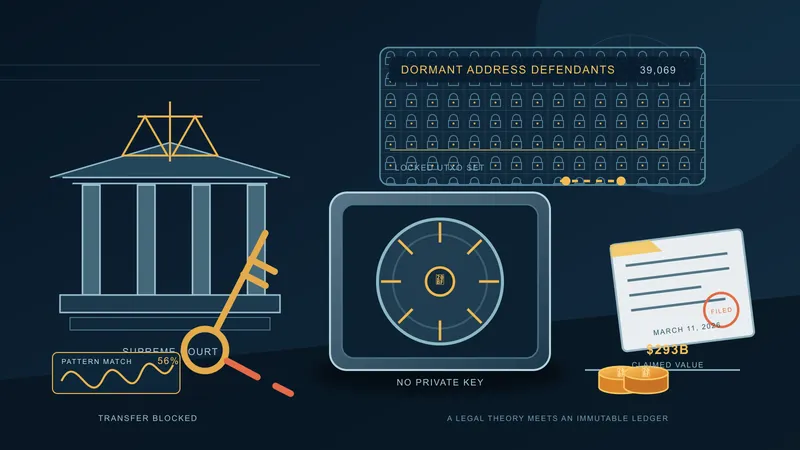
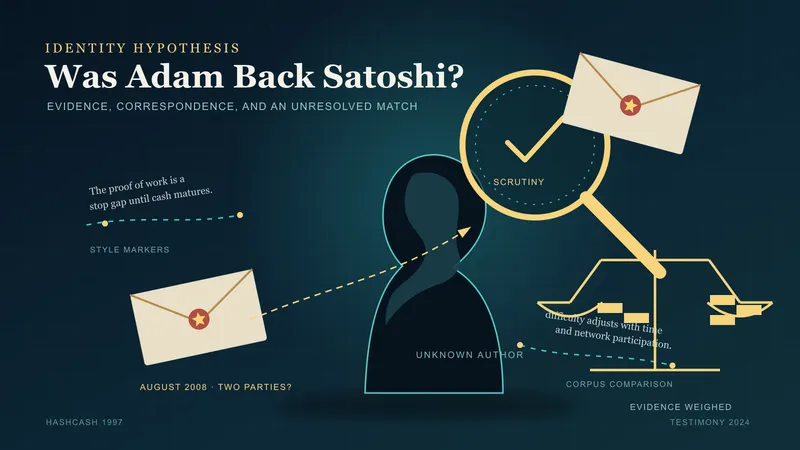
- Adam Back, himself the subject of the 2026 NYT Carreyrou investigation and of a Satoshi identity hypothesis in his own right, objected on X: 60–80% of the first year’s hashrate belonged to other miners, so the Patoshi pattern behind the film’s estimate of Satoshi’s coins is lost in the noise; the claim that Satoshi never sold a coin cannot be shown; and Sassaman lacked C++ skills and never owned a Windows machine, both needed to write the original code. The same early-mining pattern underlies the classification in the Noah Doe dormant-Bitcoin lawsuit.
Position in the broader Satoshi-identification record
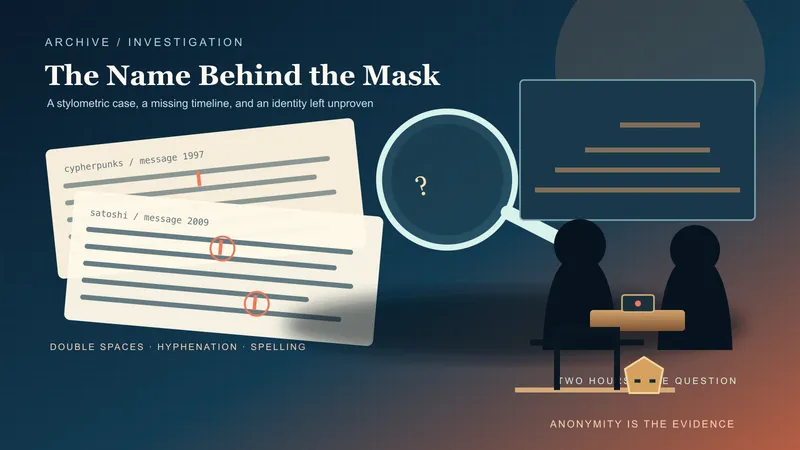
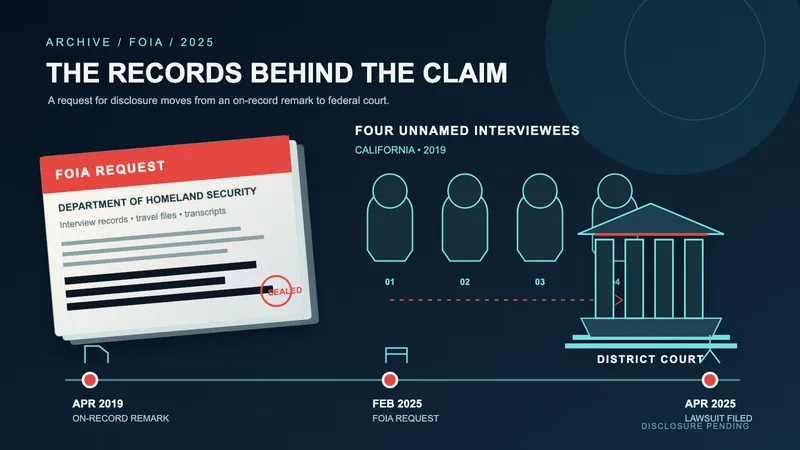
Finding Satoshi belongs to the post-2024 wave of major-press and documentary identifications: the 2024 HBO documentary on Peter Todd, the 2026 New York Times Carreyrou investigation on Adam Back, and the Murphy v DHS FOIA action. Finding Satoshi differs in two ways: it is the first major documentary to propose a multi-person rather than single-candidate reading, and it relies heavily on family testimony rather than stylometric inference or a government-record subpoena.
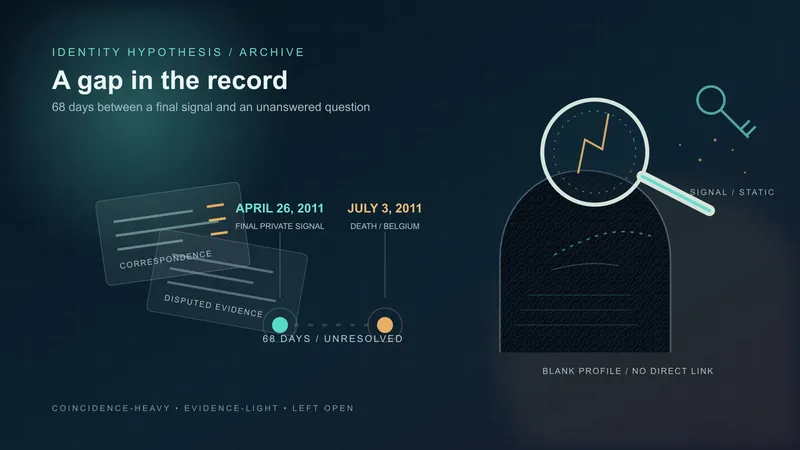
The individual constituent hypotheses are developed independently at Hal Finney = Satoshi and Len Sassaman = Satoshi. The two-person joint reading — which carries the additional burden of explaining a Finney–Sassaman collaboration that left no surviving written trace — is the documentary’s specific contribution.
The film was released globally on April 22, 2026 through FindingSatoshi.com.