
Bitcoin Institute

Sam Bankman-Fried (1992–)

FTX founder sentenced to 25 years for an $8 billion fraud

Figures

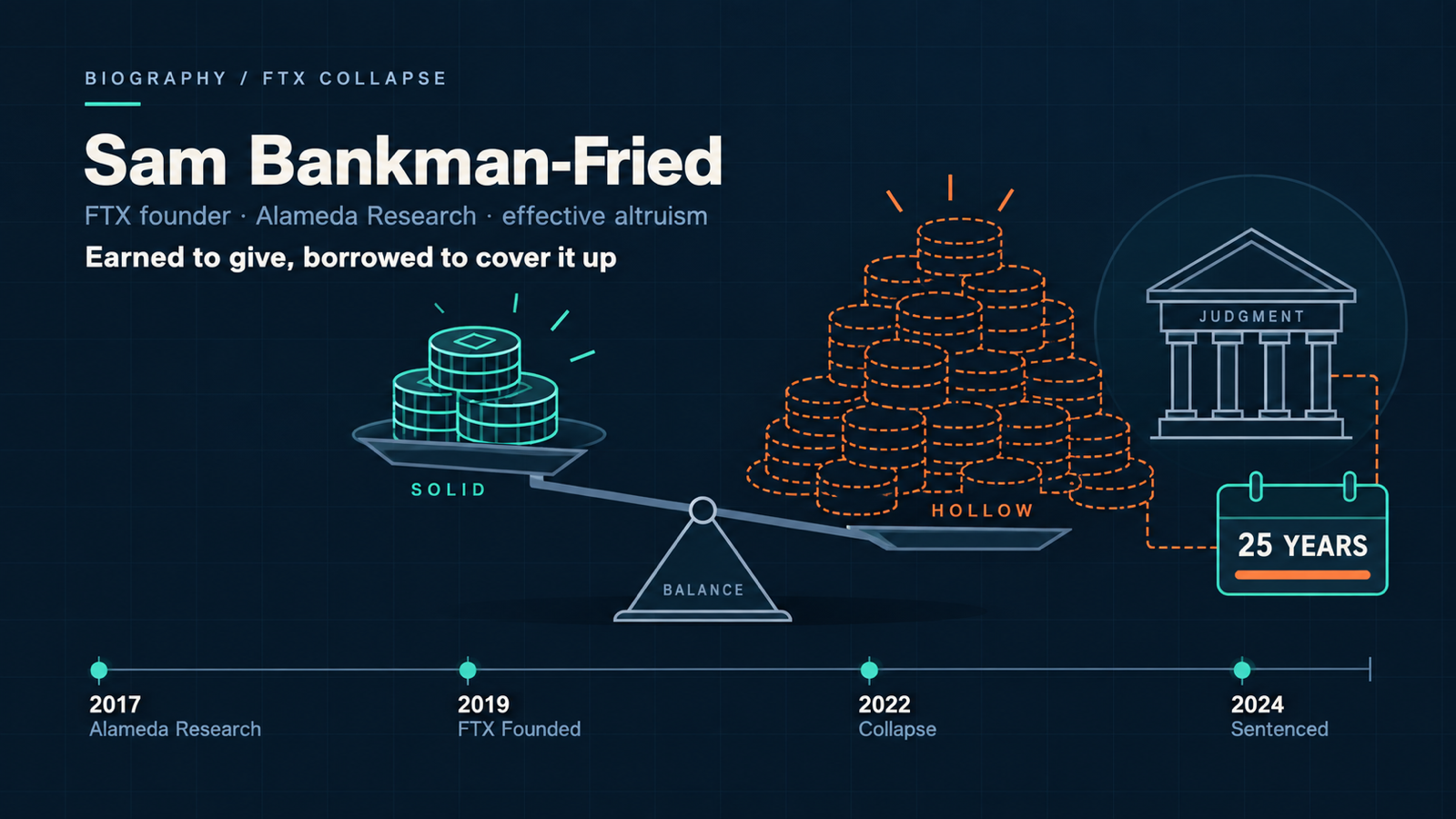
Dark-navy illustration of a stack of tokens splitting into a small honest pile and a much larger hollow, dotted-outline pile, a set of scales tipping toward the hollow side, and a courthouse column beside a calendar marked with a twenty-five-year span.

On November 11, 2022, FTX — the exchange Sam Bankman-Fried had built into the industry’s second-largest in barely three years — filed for bankruptcy. The collapse itself, and the eight-day run that caused it, is recorded on its own page. This entry covers the person: a Jane Street quant who left a guaranteed fortune to build one, on the promise that he would eventually give almost all of it away.

Before FTX

Samuel Bankman-Fried was born in March 1992 in Stanford, California, to Joseph Bankman and Barbara Fried, both Stanford Law School professors. As an MIT physics undergraduate, he had lunch in 2012 with William MacAskill, a co-founder of the effective altruism movement, who made the case for “earning to give”: that someone with Bankman-Fried’s aptitude could do more good taking a high-paying finance job and donating the proceeds than working directly for a charity. Bankman-Fried was persuaded. He graduated in 2014 with a physics degree and a minor in mathematics, and went to work at Jane Street Capital, the proprietary trading firm where he had interned the previous summer.

He stayed at Jane Street for three years, ranked among its top traders, before quitting in September 2017. Later that year he co-founded Alameda Research, a cryptocurrency trading firm, recruiting effective-altruist friends under the same pitch MacAskill had made him: earn a lot, then give most of it away. In April 2019, with Alameda engineer Gary Wang, he founded FTX, a cryptocurrency derivatives exchange that opened for business the following month.

1992Born in Stanford,California (Mar)2014Graduates from MIT;joins Jane StreetCapital2017Leaves Jane Street(Sep); co-foundsAlameda Research2019Founds FTX with GaryWang (Apr)2022Gives over $40 millionahead of the USmidtermsFTX files for bankruptcy(Nov 11)Arrested in theBahamas (Dec)2023Convicted on all sevencounts (Nov 2)2024Sentenced to 25 years,$11 billion forfeiture(Mar 28)

The giving pledge, in public

Bankman-Fried built his public identity around the “earn to give” premise years before FTX failed. He gave more than $40 million to political campaigns and committees ahead of the 2022 US midterm elections — the second-largest individual donor to Democratic causes that cycle, behind only George Soros — with the single largest sum, $27 million, going to a super PAC organized around pandemic preparedness, a cause effective altruists had also championed. He described the eventual goal in terms of total wealth, not a fixed dollar amount: giving away nearly everything he made, on the theory that money did more good funding pandemic preparedness and existential-risk research than sitting with him.

Collapse and conviction

The pledge and the fortune behind it did not survive contact with FTX’s own books. When a report on Alameda’s balance sheet triggered a run on FTX in early November 2022, the exchange collapsed within eight days, taking roughly $8 billion in customer funds with it — funds federal prosecutors said Bankman-Fried and his inner circle had used for venture investments, political donations, and personal spending, not held in trust the way FTX had told depositors. He was arrested in the Bahamas a month later, convicted on all seven counts against him on November 2, 2023, and sentenced on March 28, 2024.

“This is one of the biggest financial frauds in American history.”

Federal prosecutors said that at sentencing. The judge gave Bankman-Fried 25 years and ordered $11 billion in forfeiture.

Significance

The effective-altruism framing was never a side detail to the fraud — it was the rationale Bankman-Fried offered publicly for why what he was doing didn’t amount to one. A philosophy built on doing the most good with the money you have does not obviously survive contact with a rule that says the money has to actually be yours first. Bitcoin’s own design answers that problem by removing the step where anyone has to trust a custodian’s arithmetic at all; FTX is the case for why that design choice was never a technicality.

FTX belongs to the same custody-collapse lineage as Mark Karpelès’s Mt. Gox and Gerald Cotten’s QuadrigaCX — three exchanges built on the same promise, broken three different ways: Mt. Gox lost roughly 850,000 bitcoin over years through falsified books and losses whose ultimate cause was never proven in court, QuadrigaCX’s sole custodian died with the cold wallets already empty, and FTX simply spent what it told depositors was untouched.

Related Entries

2 entries