
Bitcoin Institute

Mark Karpeles (1985–)

Acquitted of embezzling Mt. Gox's bitcoin, convicted of faking its books

Figures

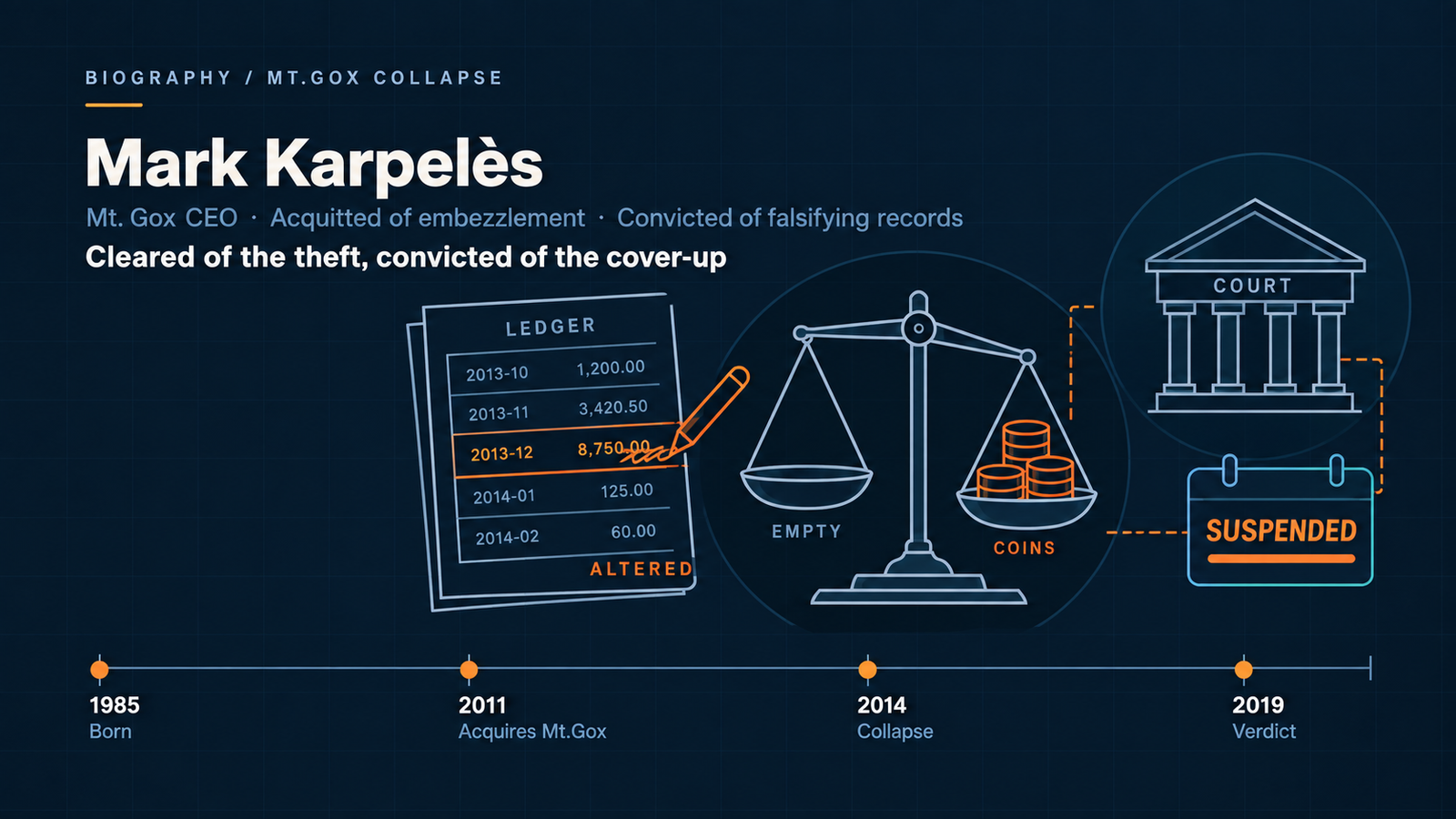
Dark-navy illustration of a ledger page with rows of numbers, one row highlighted and visibly altered with a pen icon beside it, a set of scales with an empty pan on one side and a small stack of coins on the other, and a courthouse column beside a calendar marked with a suspended-sentence ribbon.

On March 15, 2019, a Tokyo court delivered a verdict far short of what prosecutors had sought. Mark Karpelès, the man who had run Mt. Gox through the largest exchange collapse in Bitcoin’s history, was acquitted of embezzlement and aggravated breach of trust — the charges that could have sent him to prison for years. He was convicted of a narrower crime: falsifying Mt. Gox’s own electronic records to inflate its account balances by $33.5 million. The sentence was 30 months, suspended for four years.

Before Mt. Gox

Karpelès was born June 1, 1985, in Chenôve, France, and raised in Dijon. His record before Bitcoin was already unusual: French authorities arrested him twice as a young man on computer-fraud allegations, and in 2010 a French court convicted him in absentia of fraud connected to actions on a private server, sentencing him to a year in prison. He moved to Japan in 2009 and founded Tibanne Co. Ltd., a Tokyo-based web-hosting company, becoming its CEO.

1985Born in Chenôve,France (Jun 1)2009Moves to Japan, foundsTibanne Co. Ltd.2010Convicted in absentia inFrance on an unrelatedfraud charge2011Acquires Mt. Gox fromJed McCaleb2014Mt. Gox files forbankruptcy (Feb 28)2015Arrested by Japaneseauthorities (Aug 1)2019Acquitted ofembezzlement,convicted of falsifyingrecords (Mar 15)

Acquiring an accident

Mt. Gox began as a website Jed McCaleb had registered in 2007 to trade Magic: The Gathering cards, then redeployed in 2010 as a Bitcoin exchange. In early 2011, McCaleb sold it to Karpelès, who took over as CEO while McCaleb retained a minority stake. Karpelès has since claimed the platform was already compromised by the time he had full control: “Between the time I signed the contract and the time I got access to the server, 80,000 bitcoins were stolen.” That figure is a fraction of the roughly 850,000 bitcoin that would later go missing in the 2014 collapse; Karpelès’s account explains none of the rest. Under his ownership, Mt. Gox grew into the exchange through which most of Bitcoin’s early trading volume passed, handling more than 70% of the world’s bitcoin transactions by 2013 and into 2014.

The collapse

On February 28, 2014, Mt. Gox filed for bankruptcy. The collapse itself, and the roughly 850,000 bitcoin that had gone missing, are recorded on their own page. Karpelès was arrested by Japanese authorities on August 1, 2015, on suspicion of manipulating Mt. Gox’s account balances, and held for nearly a year — more than six months of it in solitary confinement. He later described the psychological toll of that detention as more severe than anything about running the company itself.

What the verdict actually found

The 2019 verdict is easy to misread as a full vindication, and Karpelès himself has pushed back on that reading no more than the facts allow. Prosecutors had sought ten years and pursued the far larger allegation: that he had embezzled customer funds and breached his duty as an executive. The court rejected both. What it found instead was that he had doctored the exchange’s own books, inflating declared holdings by $33.5 million — a crime about the accuracy of Mt. Gox’s records, not a finding about where the missing 850,000 bitcoin actually went. That question was never resolved in the criminal case at all.

After Mt. Gox

Karpelès has continued to work in the industry whose largest early institution he ran into the ground. He now serves as Chief Protocol Officer at vp.net, a privacy-focused VPN project built on Intel’s SGX secure-enclave technology, and separately operates shells.com.

Significance

Mt. Gox is Bitcoin’s oldest cautionary tale about custody, and Karpelès is the person the story keeps needing a villain to be. The 2019 verdict complicates that need without resolving it: the court that examined Mt. Gox’s internal records most closely convicted him of cooking the books, not of the theft the public still associates him with. Both things can be true about the same collapse — that the record was falsified, and that where 850,000 bitcoin actually went was never proven in a courtroom at all.

The same promise — that a company’s stated balance could be trusted without independent proof — failed twice more in Bitcoin’s next decade: Sam Bankman-Fried’s FTX spent customer deposits outright rather than merely losing track of them, and Gerald Cotten’s QuadrigaCX collapsed only when its sole custodian died, exposing funds that had already been gone for months.

Related Entries

2 entries