Bitcoin Institute

Matt Corallo

Wrote BIP 152's compact block relay, then kept moving

Figures

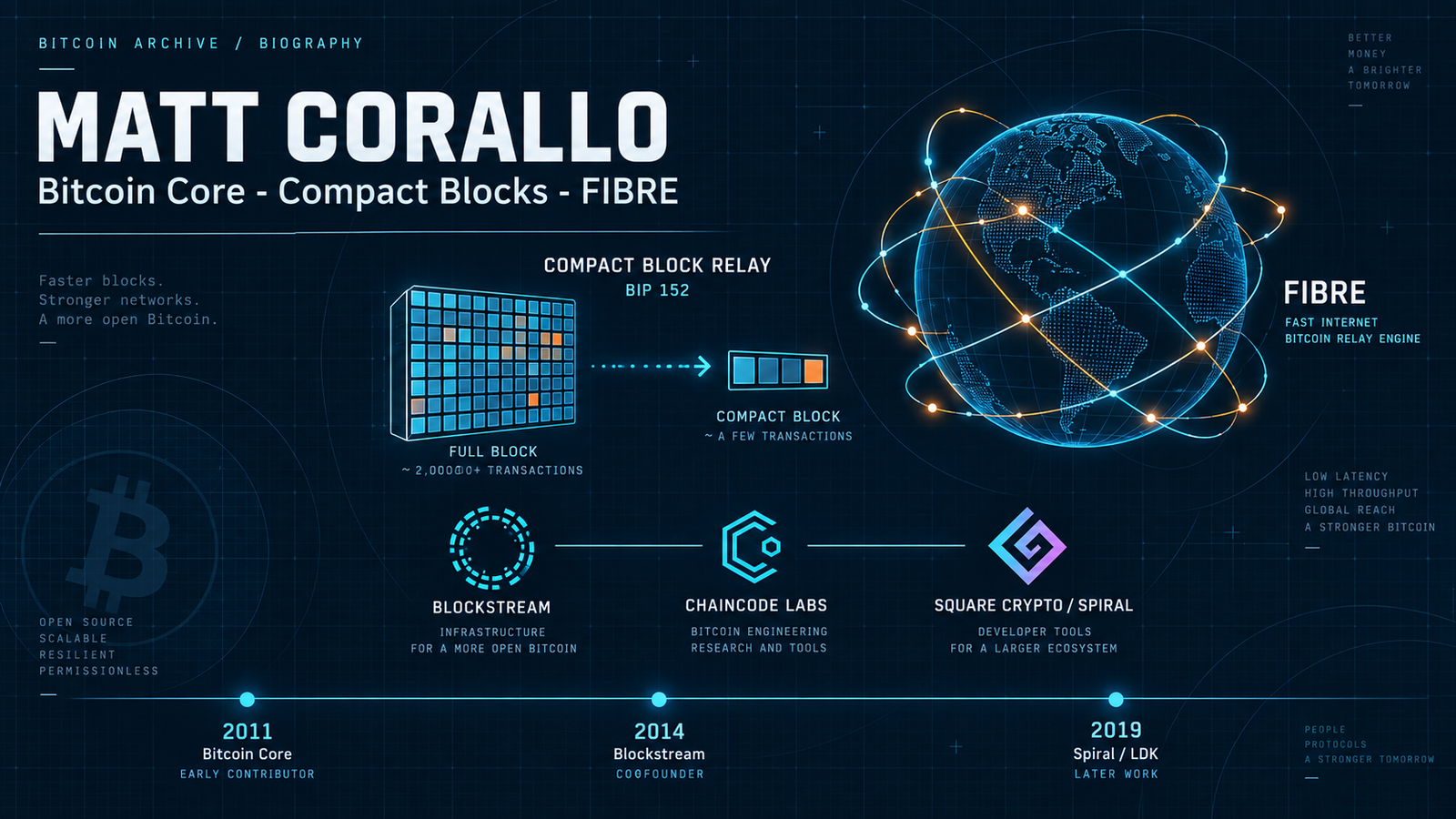
Dark-navy technical illustration: a small hexagonal node icon labeled with a lightning-fast relay line circling a globe, a compact block-of-blocks diagram shrinking into a smaller shorthand version, three overlapping company-badge outlines arranged in sequence, and a horizontal timeline marking 2011, 2014, and 2019.

Somewhere in nearly every Bitcoin block mined today is a trace of Matt Corallo’s work: the shorthand relay format that lets nodes exchange a new block in a fraction of its full size, and the ultra-low-latency relay network built to spread it around the world before the next one arrives. Corallo wrote both — and then, characteristically, moved to the next employer before either one made him famous.

Bitcoin Core, then Blockstream (2011–2017)

Corallo began contributing to Bitcoin Core in 2011, working alongside Gregory Maxwell and Pieter Wuille in the small, largely volunteer group reviewing and patching the reference client in Bitcoin’s early post-Satoshi years. In 2014, Corallo was among the co-founders of Blockstream alongside Adam Back, Maxwell, and Wuille — an author on the company’s original sidechains white paper and an engineer on its early design. Blockstream became the company at the center of the block-size war’s best-known “centralization” charge: that a handful of Core developers on one payroll had captured Bitcoin’s development process. Corallo left before that charge would have applied to him much longer — he moved to Chaincode Labs in 2017, then became the first full-time Bitcoin developer hired by Square’s Square Crypto (later Spiral) in 2019.

2011Begins contributing toBitcoin Core2014Co-founds Blockstreamwith Back, Maxwell,Wuille2016Authors BIP 152,Compact Block Relay(Apr 27)2017Leaves Blockstream forChaincode Labs2018Begins rust-lightning asa side project (becomesLDK)2019Square Crypto's (laterSpiral) first full-timeBitcoin developer

Compact blocks and the relay network

Nodes used to exchange full blocks even though most of a block’s transactions had already been relayed individually across the network beforehand — a redundant, bandwidth-heavy design that got worse as blocks grew fuller. On April 27, 2016, Corallo published BIP 152, Compact Block Relay: a set of messages (sendcmpct, cmpctblock, getblocktxn, blocktxn) that let a node announce a new block using short, SipHash-based transaction identifiers instead of full transaction data, reconstructing the block locally from what its mempool already held. The result cut the bandwidth and latency of block propagation dramatically, and Bitcoin Core has used compact block transfer since version 0.13.0.

Corallo built a second, complementary piece of relay infrastructure: FIBRE (the Fast Internet Bitcoin Relay Engine), a UDP-based network designed to spread newly mined blocks around the globe at close to the speed of light, minimizing the tiny propagation delays that can put geographically disadvantaged miners at a competitive disadvantage. He is its creator and continues to maintain it.

After Blockstream: the block-size war and moving on again

Corallo’s tenure spanned the 2015–2017 block size war as a Core contributor on the side that favored SegWit and second-layer scaling over a contentious block-size hard fork — the same position Blockstream’s other co-founders took, and the position the charge of “Blockstream capture” was built around. He left the company in 2017 regardless, joining Chaincode Labs, a Bitcoin research and engineering group. There, in 2018, he began a side project called rust-lightning — a Rust implementation of the Lightning Network protocol that grew into the Lightning Dev Kit (LDK), an SDK other wallets and applications could build Lightning support on top of. In 2019, Square recruited Corallo as the first full-time Bitcoin developer at what became Spiral, where LDK found its institutional home and he has continued core protocol and Lightning Network engineering since.

ContributionStartedStatus today
Bitcoin Core contributions2011Ongoing
Blockstream co-founder2014Left 2017
BIP 152 / Compact Block Relay2016Used by Bitcoin Core since v0.13.0
FIBRE relay network—Still maintained by Corallo
Spiral (Block/Square)2019Ongoing

Significance

Corallo’s career reads like a rebuttal to the idea that Bitcoin’s protocol work runs on any single company’s payroll: he helped found the firm most often named in that argument, then spent the years since moving through two more employers while the protocol he wrote in 2016 kept doing its job regardless of who signed his check. I think that’s the more accurate story about how Bitcoin Core actually gets built — not by an institution, but by a small number of people whose contributions keep working long after they’ve changed desks.

Related Entries

3 entries