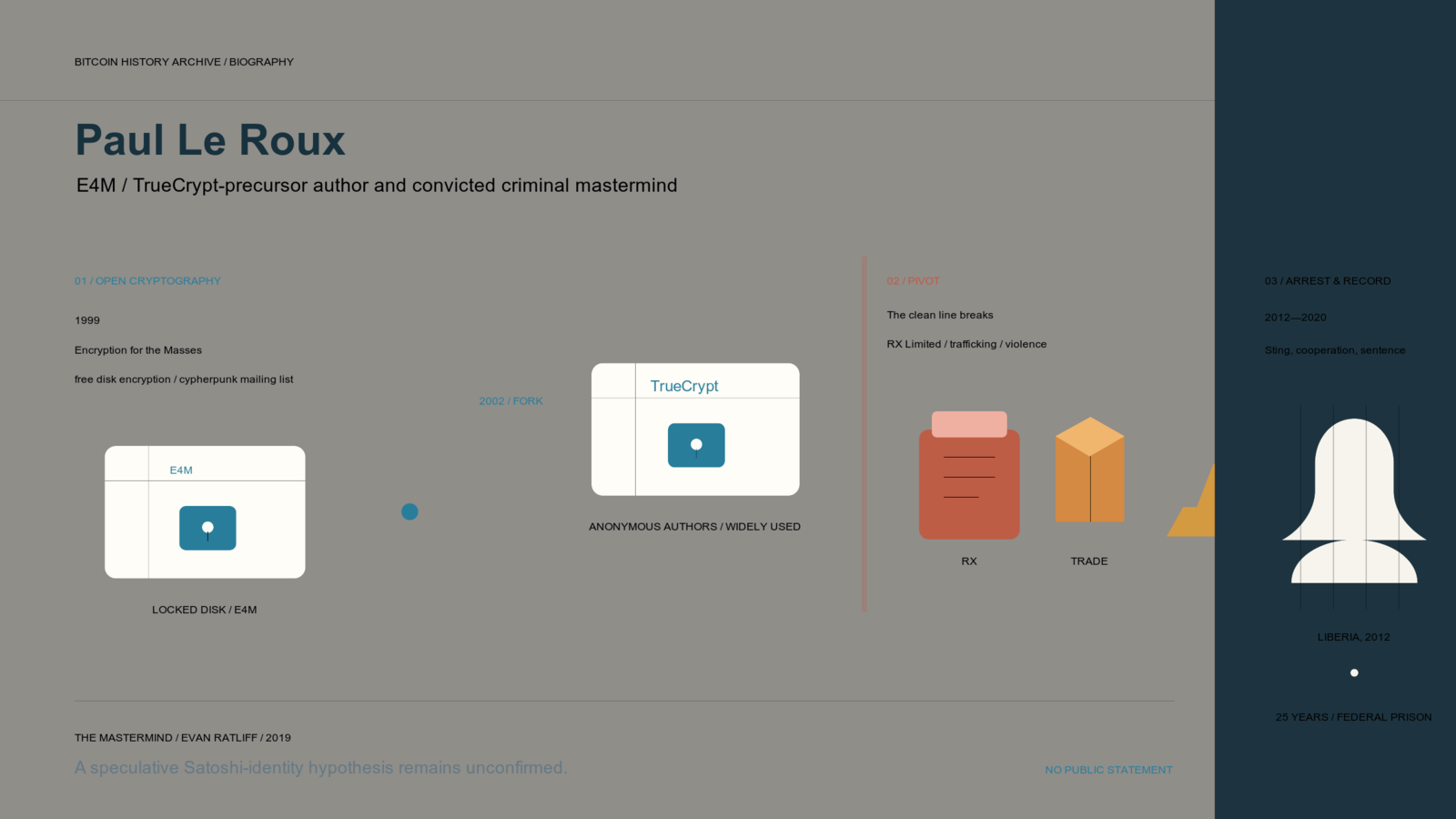
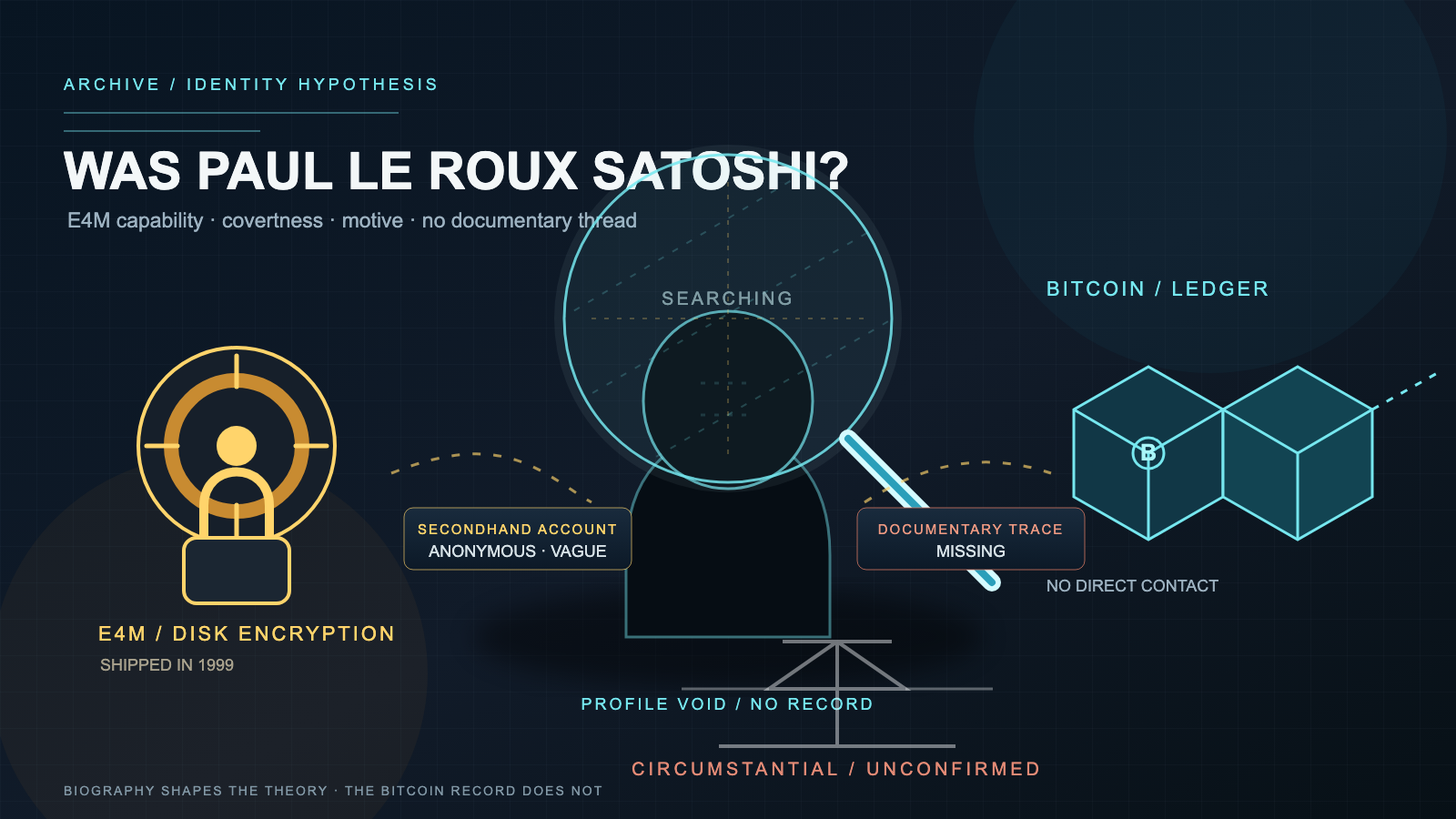
Paul Le Roux is the candidate whose connection to Bitcoin is entirely external. There is no documented contact with Satoshi Nakamoto, no statement by Le Roux on the question, and no Bitcoin-related material from him in the public record. He entered the candidate landscape through journalist Evan Ratliff’s 2019 book The Mastermind, which named him as a possible Satoshi on a capability-plus-covertness-plus-motive argument. Seven years later, the Finding Satoshi documentary listed Le Roux among the candidates its filmmakers considered and rejected before settling on Hal Finney and Len Sassaman as co-creators. His full life — E4M, the criminal enterprise, the arrest — is in the Paul Le Roux biography.
1. The evidence
Le Roux — who released the open-source disk-encryption package E4M in December 1998 before building one of the largest international criminal enterprises of the 2000s — was the person behind the Satoshi Nakamoto pseudonym. The identification was articulated in Ratliff’s The Mastermind (2019) and accompanying journalism. Le Roux has been incarcerated and cooperating with US authorities since his 2012 arrest, and has made no public statement on the identity question, so the claim stands as an externally-argued, open one — neither advanced nor denied by its subject.
1.1 Cryptographic capability
Le Roux’s E4M (Encryption for the Masses, first released December 1998) was a real open-source disk-encryption package, circulated on the cypherpunks mailing list, and its codebase was built into TrueCrypt, first released in February 2004. This is a documented record of shipping cryptographic software — the kind of capability Bitcoin’s creator would need.
The venue lines up too: E4M shipped on the cypherpunks mailing list in December 1998, and that list’s own successor, cryptography@metzdowd.com, is where Satoshi posted the Bitcoin whitepaper announcement in October 2008 — the same list lineage carrying two cryptographic-software launches nearly ten years apart.
The objection: E4M is a disk-encryption system, not a digital-cash or distributed-ledger system; the two design spaces share primitives but diverge in architecture. And Le Roux’s public shipping record stops in 1999 — nearly a decade before Bitcoin v0.1 — with no documented monetary-system or distributed-systems work in the interval. Capability with disk encryption in 1999 does not entail capability with, or interest in, a 2008 cryptocurrency.
The venue overlap fares no better as a discriminator: thousands of people read or posted to the cypherpunks list and its cryptography-list successor across the decade between the two, so shared venue selects a large population, not a specific candidate.
1.2 Covertness fit
During the 2007–2008 Bitcoin development window, Le Roux kept a low public profile — consistent, the argument runs, with someone running covert criminal operations who had every reason to avoid attention.
The objection: this is covertness by circumstance, and it places Le Roux inside a large population of people who were not publicly visible in 2007–2008 rather than at one specific point. The documentary record of that period shows his energies directed at building the criminal enterprise, not at a parallel two-year intensive Bitcoin development effort; the claim requires both to have run concurrently and unobserved.
1.3 Motive
Ratliff’s framing supplies a motive: a reason to keep a cryptographic past sealed off from a criminal present.
The objection: motive is the weakest evidentiary class in the candidate landscape. It can explain why a given person might have acted, but it selects no one — many capable people of the period had reasons to stay hidden, and a plausible motive is not a documentary link.
1.4 A contemporaneous account of digital-currency discussion
An unnamed source who oversaw Le Roux’s facilities in the Philippines told Ratliff that Le Roux kept a team of Romanian programmers in a Manila office who discussed “online currency” in 2007–2008, before Bitcoin’s release — placing a digital-currency conversation inside Le Roux’s orbit during Bitcoin’s actual development window.
The objection: the account is anonymous, secondhand, and dated only to a two-year window; “online currency” does not specify Bitcoin, proof-of-work, or any design element distinguishing it from the various digital-payment and e-gold discussions already circulating at the time. It places a topic, not a document or a name, inside the development window.
2. The counter-evidence
| Counter-evidence | Central observation | Strength assessment |
|---|---|---|
| §2.1 No documentary connection | No contact with Satoshi, no statement, no Bitcoin material of any kind | The case is wholly circumstantial — nothing places him at the work |
| §2.2 Intellectual-lineage gap | No cypherpunk digital-cash footprint, no engagement with Hashcash or b-money, no monetary design | Bitcoin’s cited lineage runs through a conversation Le Roux is absent from |
| §2.3 Capability gap after E4M | Public shipping record ends 1999; criminal enterprise, then incarceration from 2012 | A near-decade gap between the cited capability and Bitcoin’s construction |
| §2.4 Outside the stylometric record | The van Dorst corpus reanalysis excludes Le Roux entirely | No quantitative reading of his prose against Satoshi’s is available |
2.1 No documentary connection of any kind
The defining feature of the Le Roux case is that it rests on no documentary link at all. There is no record of contact between Le Roux and Satoshi, no Bitcoin-related writing or code attributable to him, and — because he has been incarcerated and silent on the question since 2012 — no statement from him to weigh in either direction. The entire candidacy is built from the outside, on the shape of his biography rather than on any trace in the Bitcoin record.
2.2 Intellectual-lineage gap
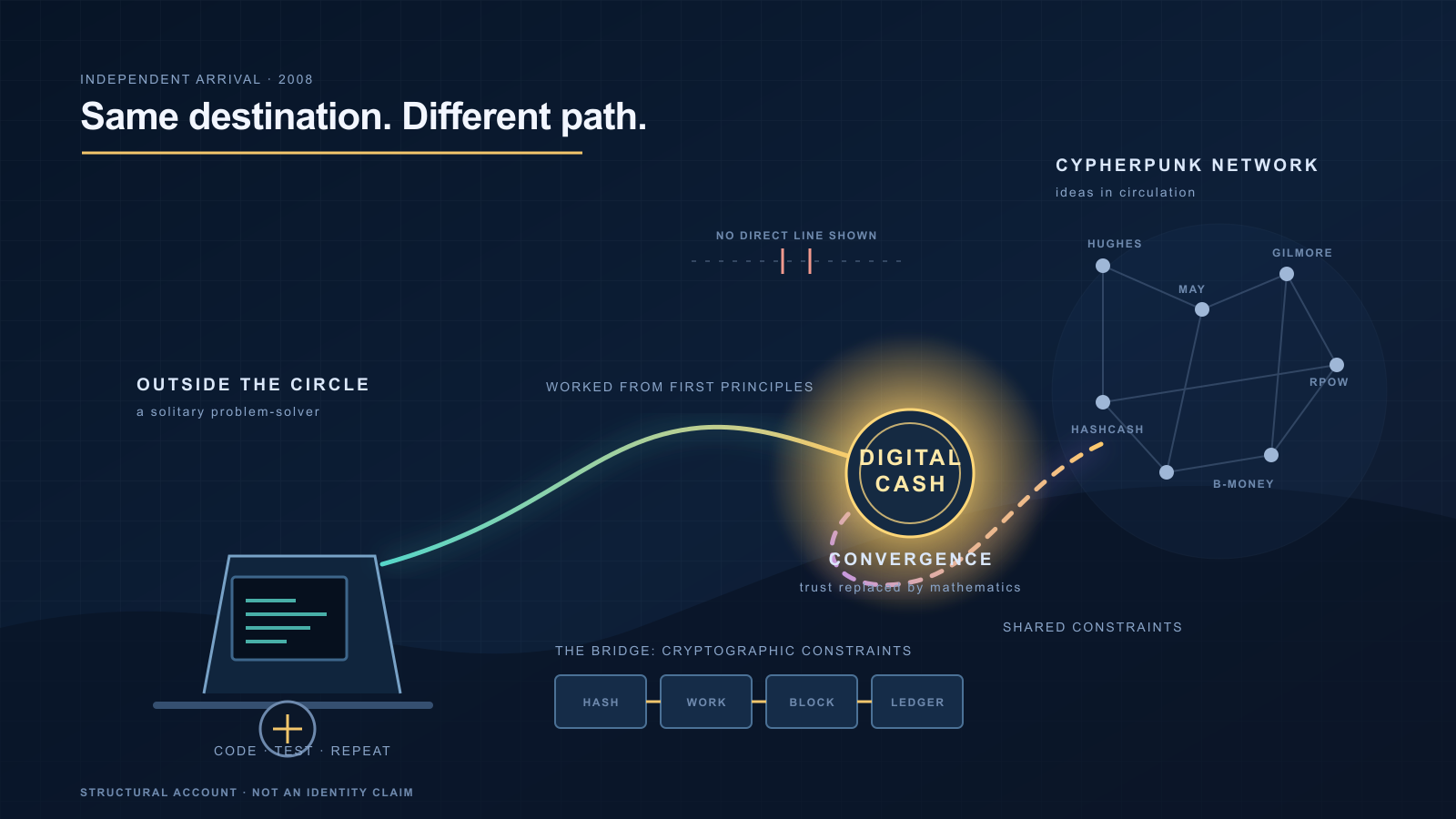
Bitcoin’s cited intellectual lineage is documented: Hashcash, b-money, and the cryptographic-primitives discussion in the cypherpunks and metzdowd Cryptography fora. Le Roux’s December 1998 E4M announcement and limited cypherpunks-list discussion sit in disk encryption, not digital cash; he has no documented presence in the proof-of-work, monetary-mechanism, or distributed-issuance conversation out of which Bitcoin’s design grew.
2.3 Capability gap after E4M
The capability the claim cites is real but dated: E4M shipped in December 1998, and Le Roux’s public software-shipping record stops the following year. The intervening years are documented as the period of the criminal enterprise, and from September 2012 he has been incarcerated. The claim has to bridge a near-decade gap between the last cited technical work and Bitcoin’s 2007–2009 construction, with nothing in the public record to fill it.
2.4 Outside the stylometric record
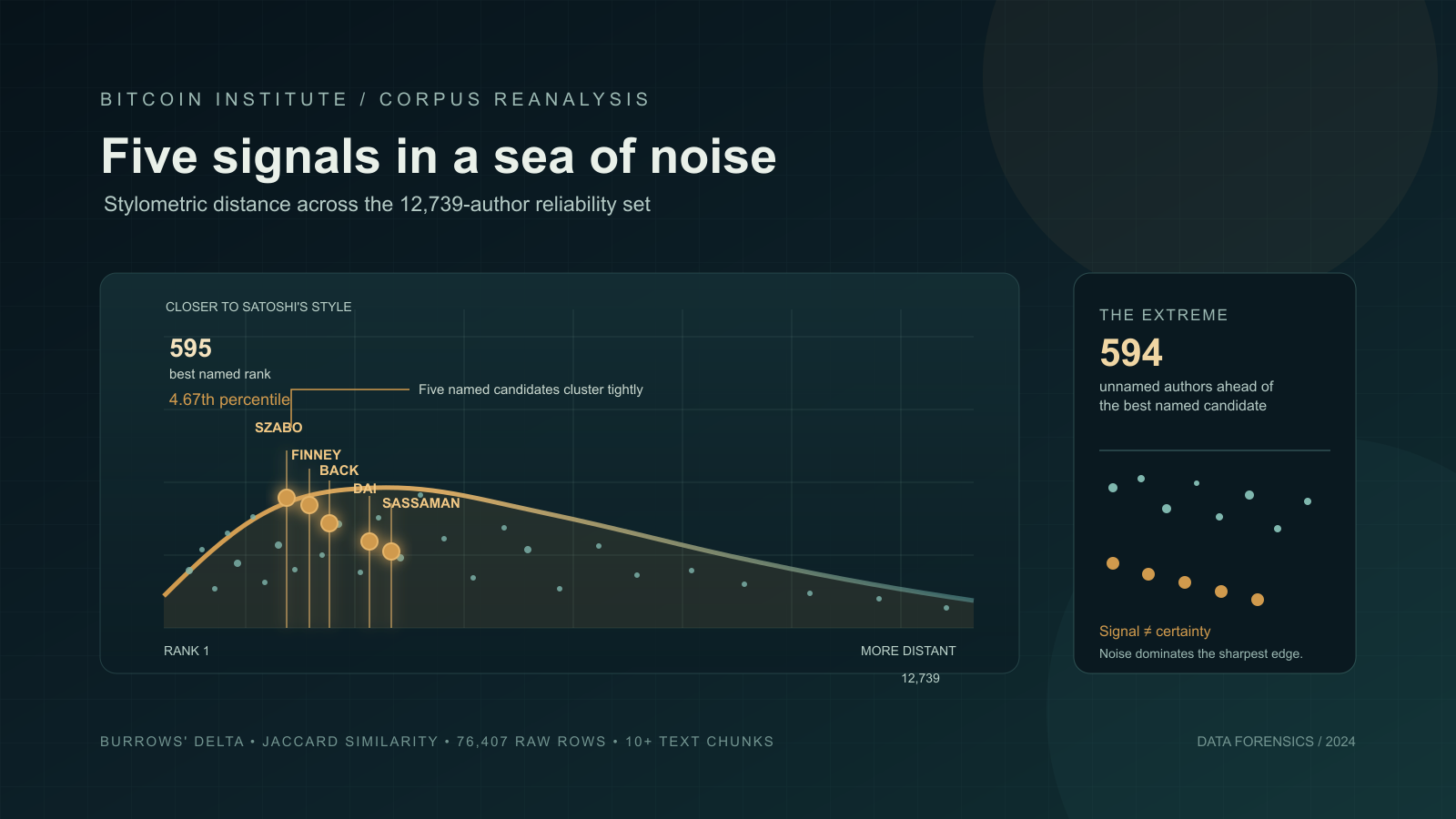
The 2026 van Dorst corpus reanalysis of named candidates excludes Le Roux from its candidate set — alongside Dorian Nakamoto, Craig Wright, Peter Todd, and Isamu Kaneko — on the grounds that his cryptographic activity falls outside the 1992–2000 cryptography-mailing-list window the corpus covers. No stylometric reading of Le Roux against Satoshi is available from that work; the one quantitative method that has placed other candidates simply does not reach him.
3. Within the broader documentary record
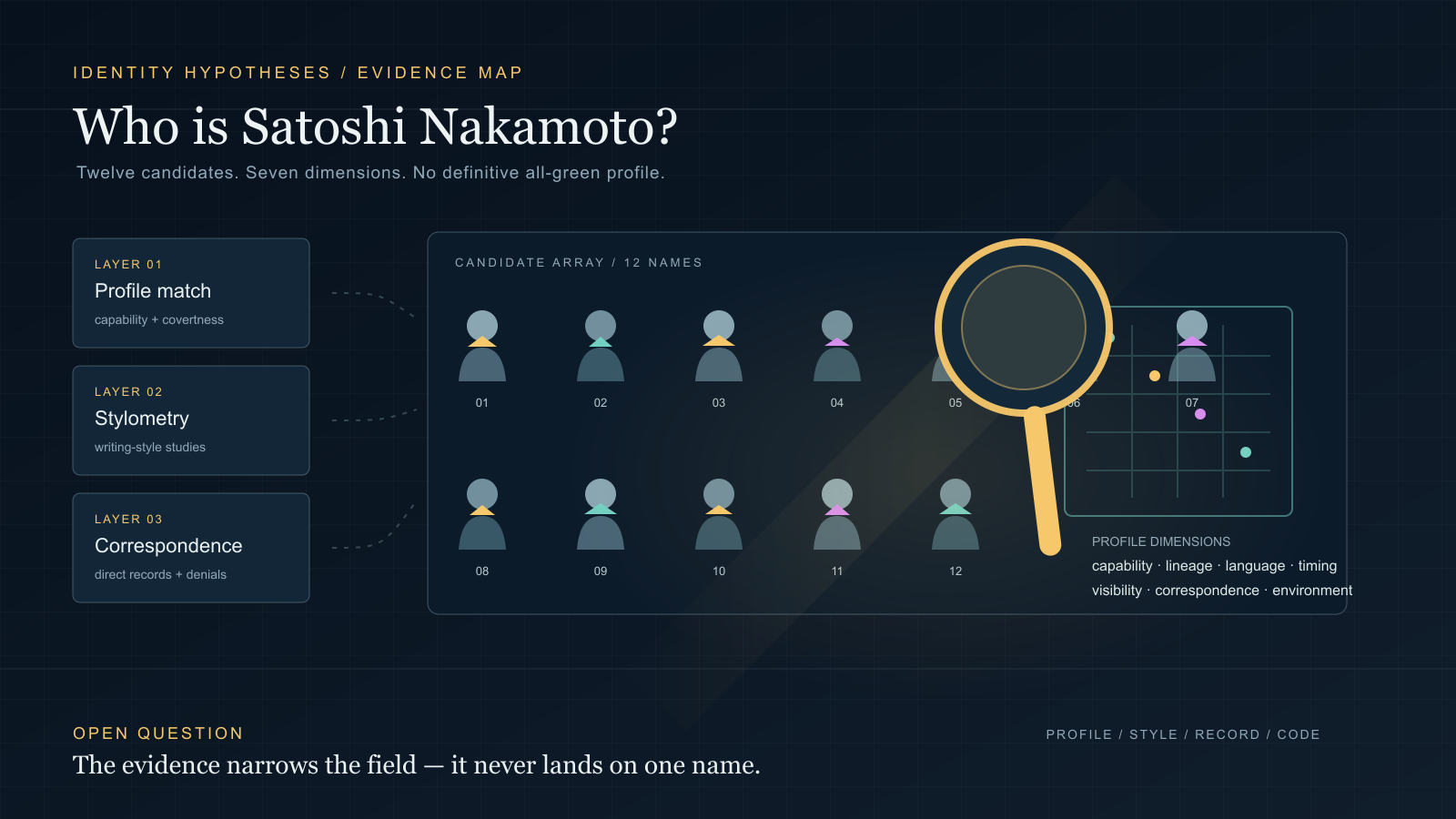
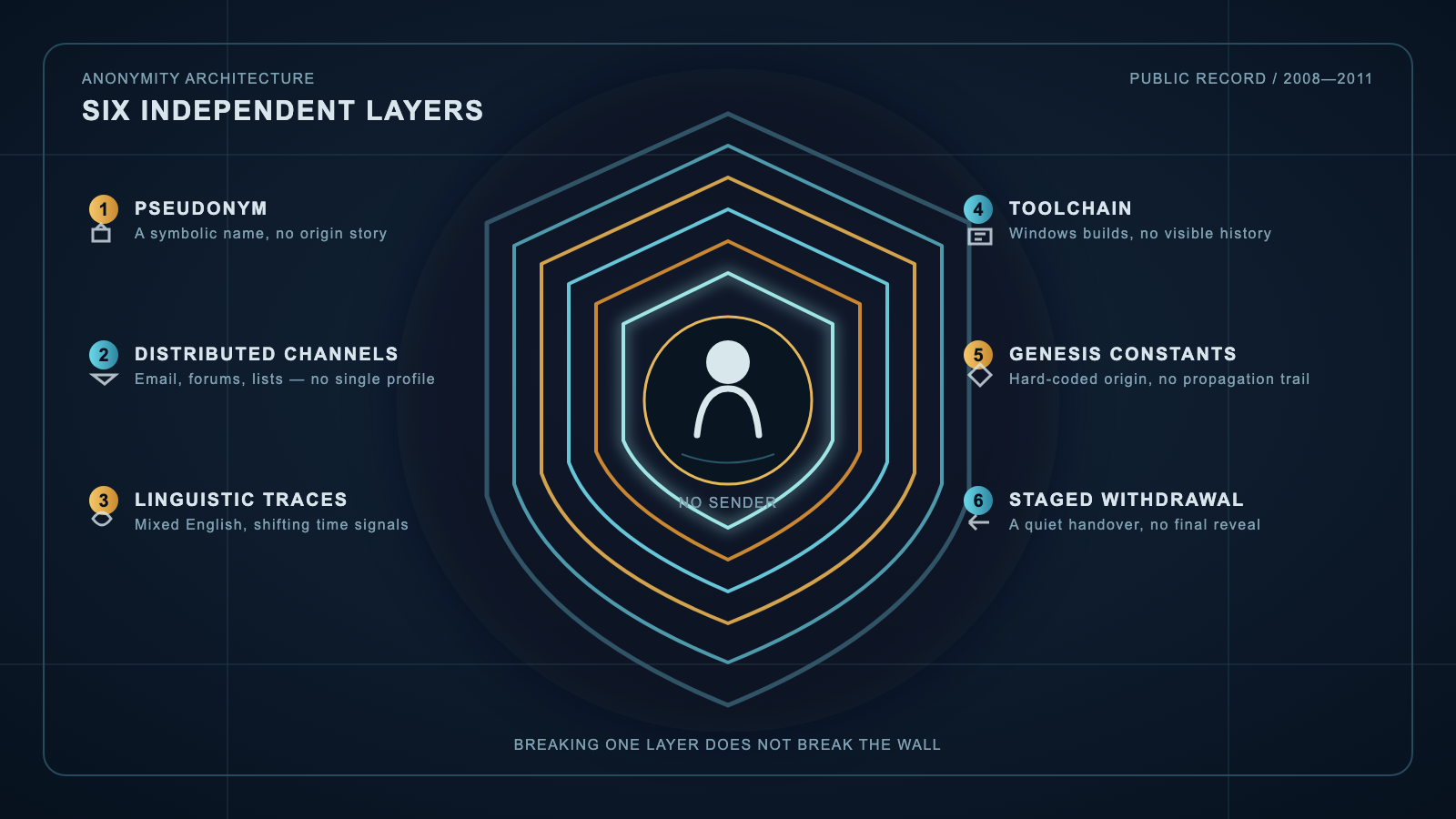
Le Roux fits the one condition the public record most strongly supports about Satoshi — that he was outside the visible cypherpunk community during the development window — but he fits it the way a very large population does, by simple absence, not in the specific way the identifiability argument selects. On the conditions that discriminate — the digital-cash intellectual lineage, monetary-system design, and Bitcoin-source-level shipping in the relevant period — the record holds nothing for him. The candidacy is the clearest case in the landscape of an argument built entirely from biography and circumstance, with no thread reaching into the Bitcoin record itself. The anonymity-architecture entry groups Le Roux with Peter Todd and Isamu Kaneko as capability-only candidates — each aligning with the six-layer structure on cryptographic or implementation capability alone, and failing the rest. For the full candidate comparison, see the Satoshi-identity hypotheses overview.
4. Limits of this entry
- This entry does not present new evidence. It compiles publicly available material.
- This archive holds no dedicated Le Roux primary-source entries (the E4M cypherpunks announcement, criminal-case court documents, Mastermind/WIRED excerpts). The specific dates and claims here are externally sourced — primarily Ratliff’s 2019 book, his 2019 WIRED feature, The Atavist Magazine (2016), and Wikipedia — rather than archive-verified, and the full life is in the Paul Le Roux biography.
The identity-hypotheses overview places Paul Le Roux in Group C of its necessary-but-not-sufficient evaluation.
Le Roux wrote real cryptographic software, then vanished into a decade of crime and a prison sentence, and neither life left a mark on Bitcoin’s own record. He is the one name on this list I can neither test nor retire: no thread reaches him, and no word has come from him.