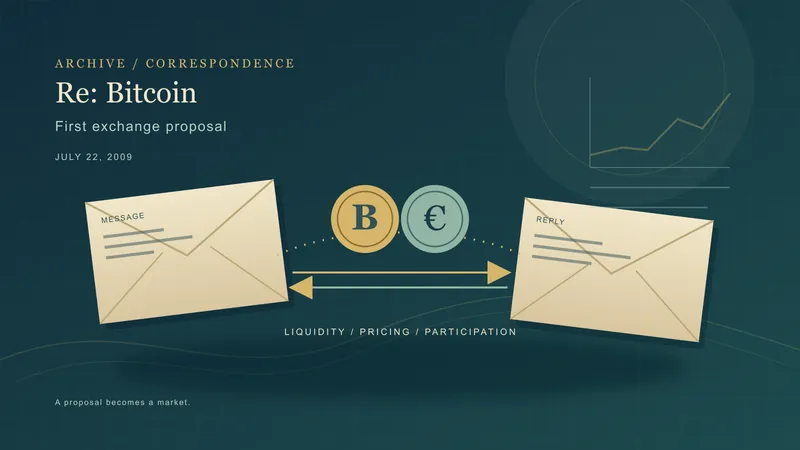

A month after Martti Malmi proposed a service that would buy and sell bitcoins for euros, Satoshi answered him. He went through the proposal point by point, and near the end he drew one line:
Satoshi Nakamoto (email to Martti Malmi, August 24, 2009, 10:00:35 PM UTC)That’s great, I could probably get a donor to send currency to you which you convert to euros and pay out through methods that are convenient for users. I don’t want to do an exchange business myself, but it can be done independently of me.
Eleven months later four exchange services were taking orders, and none of them was his. The record also shows what he did in place of running one. He gave advice on how to price coins, warned about payments that can be taken back, sketched an exchange that never touches money, and steered a donor’s cash into someone else’s reserves. Almost all of it went to one person, in private email.
1. Four exchanges in eleven months
| Exchange | Run by | Earliest record | How it priced and paid | Satoshi’s part |
|---|---|---|---|---|
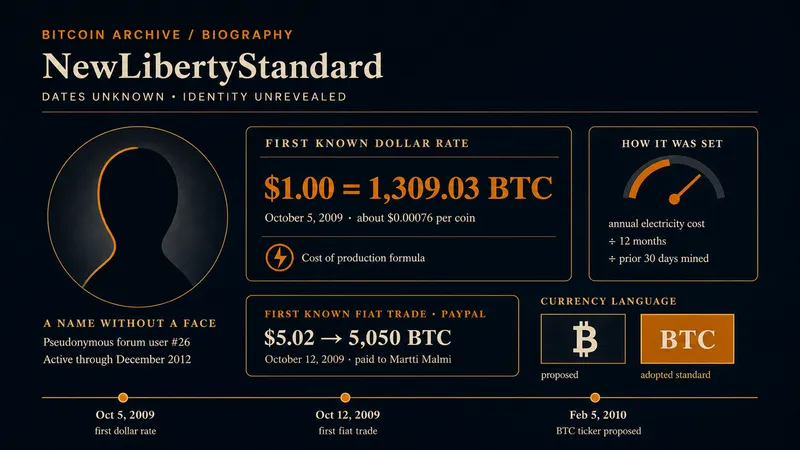
| New Liberty Standard | NewLibertyStandard | Oct 5, 2009 — first exchange rate; trading for dollars by Oct 8 | A set price derived from the electricity cost of mining; PayPal; trades handled by hand | Praised the electricity estimate in emails to Malmi (Oct 16 and Nov 20, 2009) |
| bitcoinexchange.com | Martti Malmi | Proposed Jul 22, 2009; domain Dec 22, 2009; prototype Jan 5, 2010; first trade reported May 14, 2010 | Euros; a planned price curve that rose as Malmi’s own bitcoin stock ran down, to find the market rate (Jan 2010); the first trade was 10,000 BTC for 20 euros by EU bank transfer | Advised on pricing (Aug 2009), the name (Nov 2009) and payment methods (Feb 2010); proposed putting $1,000 of a donation into its reserves (Jul 2010) |
| Bitcoin Market | dwdollar | Announced Jan 15, 2010; real trading from Mar 16, 2010 | An order book matching users; PayPal; from Apr 25, cash went straight from buyer to seller while the site held the bitcoins | Its April method follows the escrow design Satoshi posted on Mar 3, 2010 |
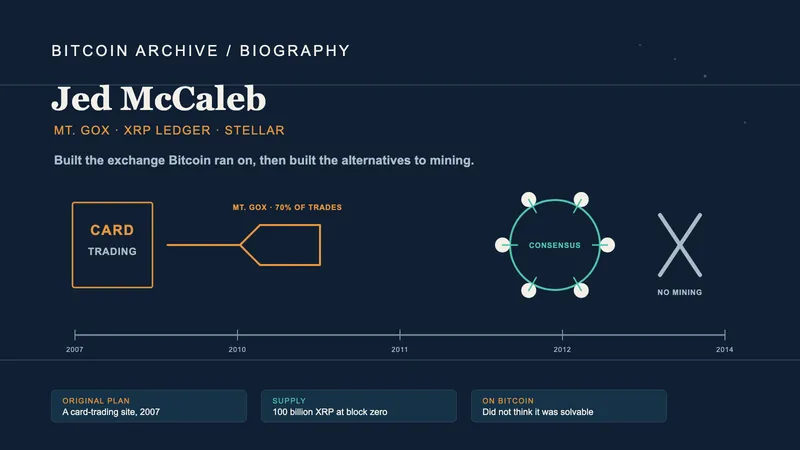
| Mt. Gox | Jed McCaleb | Announced Jul 18, 2010 | Not stated in the three-line announcement | None on record before it opened; named it on Nov 28, 2010 as a place a new user could open an account |
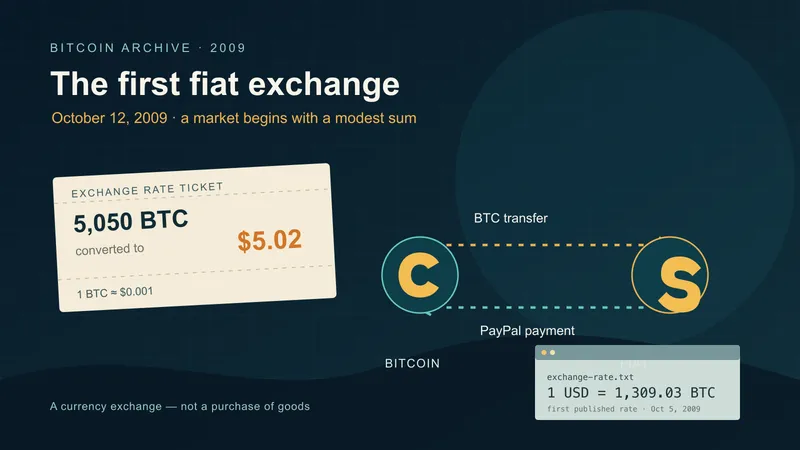
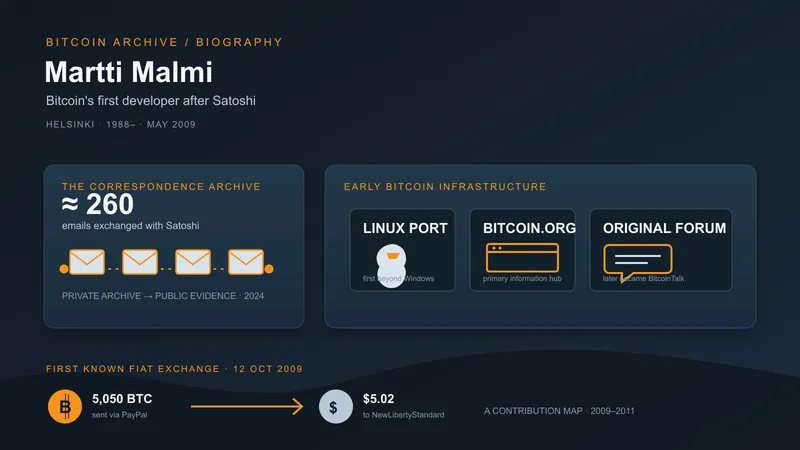
The first sale of bitcoin for dollars belongs to the first row. On October 12, 2009 Malmi sold 5,050 BTC to NewLibertyStandard for $5.02, and he later explained why: “Sold to NewLibertyStandard to help him get the world’s first bitcoin trading service started.” His own service was still an idea at the time. Four days earlier he had told Satoshi that “Making an exchange service first seemed a bit premature for the time being.”
2. What Satoshi gave in place of an exchange
2.1 A price that could be backed
Satoshi’s first advice on pricing was not about cost. Malmi’s proposal had a formula: because the number of coins in existence is known, an exchange holding enough euros could promise a minimum rate it would always honour. Satoshi took that up on August 24: “you could set a support price based on the amount of legacy currency you have and be sure you’ll have enough to meet all demands. I had imagined an auction, but it would be far simpler and more confidence inspiring to back it at a specific exchange rate.” He also suggested a minimum transaction size larger than one computer could mine, so that users would have to trade with each other before cashing in.
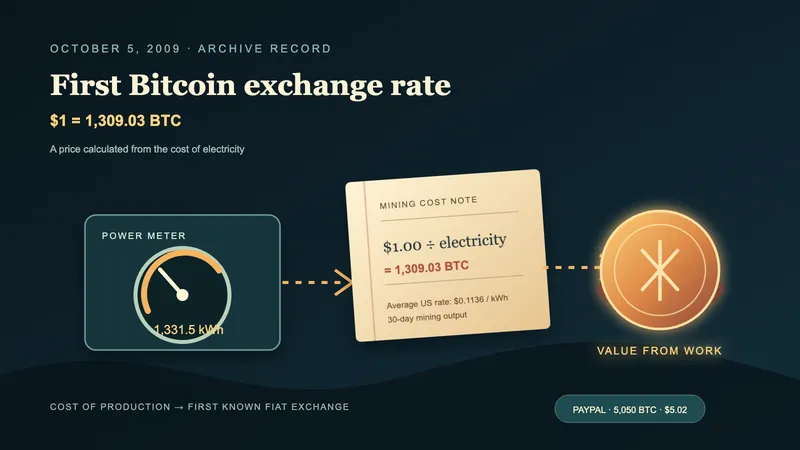
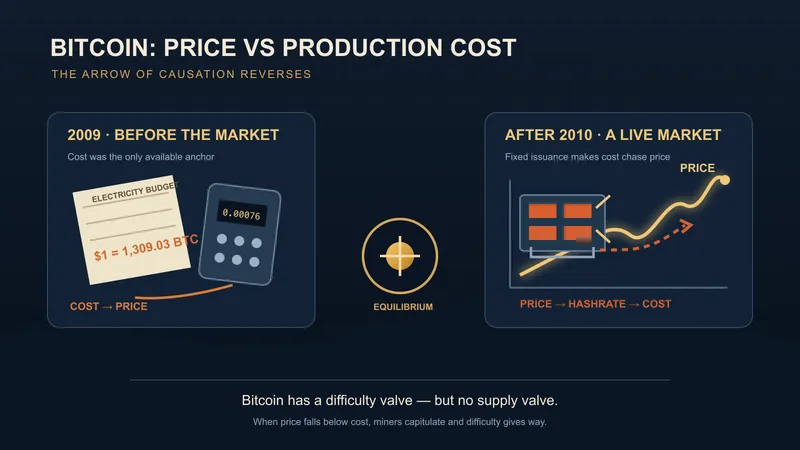
The cost argument arrived six weeks later from New Liberty Standard, whose rate divided a dollar by the electricity a mining computer burns. Satoshi liked it. He wrote to Malmi on October 16, “I like his approach to estimating the value based on electricity,” and on November 20, “I really like that he explains the concept that the cost of electricity is a minimum floor under the price.” How that cost anchor fared once markets set the price is the subject of the price-vs-production-cost analysis.
2.2 Payments that cannot be taken back
When Malmi turned to payment methods in February 2010, Satoshi pointed him to Liberty Reserve: it was hard to buy but easy to cash out, because “LR is non-reversible.” The next day he put the reason in one sentence: “Every conventional payment method has refutability as their way to cope with their lack of passwords and crypto.” A payment that the sender’s bank can reverse is fine for shipped goods and a hazard for currency conversion, where the coins are gone the moment they are sent.
He made the same case in public on March 23, in a BitcoinTalk thread on exchange methods: a link between Bitcoin and Liberty Reserve or Pecunix would give “2nd-hop access” to all the established exchanges behind them. Bitcoin Market ran into the problem anyway. When dwdollar moved its cash onto direct PayPal payments in April, theymos replied that “PayPal payments can be easily reversed,” and dwdollar agreed: “Charge-backs are a weakness of this system.”
2.3 An exchange that never touches the money
In a thread on money transfer regulations, he described a different kind of exchange:
Satoshi Nakamoto (BitcoinTalk post, March 03, 2010, 4:28:56 AM UTC)To make it safer, the exchange site could act as an escrow for the bitcoin side of the payment. The seller puts the bitcoin payment in escrow, and the buyer sends the conventional payment directly to the seller. The exchange service doesn’t handle any real world money.
Seventeen days later dwdollar opened a thread on ways to move into and out of cash and listed “satoshi’s sophisticated ‘e-bay-like’ idea” among the options, quoting the post. On April 25 he changed how Bitcoin Market settled trades: “From now on cash will be sent directly from the Bitcoin buyer to the Bitcoin seller using PayPal,” and until the seller confirmed payment, “(I hold the Bitcoins).” That is the division of labour Satoshi had described, with the site holding only the bitcoin side. dwdollar did not say in that post where the design came from. He had read Satoshi’s version five weeks earlier.
2.4 Cash for someone else’s reserves
In June 2010 Satoshi told Malmi he might soon get money “to cover web host costs, back your exchange service, etc, in the form of cash in the mail.” A donation arrived. On July 21 Malmi suggested offering $100–200 to the first companies that accepted bitcoin, and Satoshi turned the idea down in favour of the exchange: “What they need most is confidence they can convert it to fiat currency. … The best thing we can do is make sure there’s cash available to cash out and support and steady the conversion rate.” He proposed putting $1,000 into Malmi’s exchange, and Malmi added it to the reserves.
By then Malmi’s service was open to customers. A week before Malmi’s reply someone had bought coins from it with 1,000 euros, and Malmi guessed the buyer meant part of it as a donation, since bitcoinmarket.com would have given more coins for the money. Satoshi saw another reason: “They probably couldn’t have gotten that large of a trade on bitcoinmarket.com.” On July 17, answering a critic on BitcoinTalk, Malmi wrote that BitcoinExchange.com was down “just for technical maintenance.” The next day Mt. Gox opened.
3. The order of events
4. What the record supports
Satoshi kept the line he drew in August 2009. No exchange in this period was his, and no record shows him taking a share, a fee or a stake in one. What the record does show is how much of his attention went to them. The advice came in four kinds, set out above: a backed price, irreversible payments, an exchange that holds no money, and cash for reserves. Most of it travelled through one private channel, his correspondence with Malmi, and two public posts in March 2010 carried the rest.
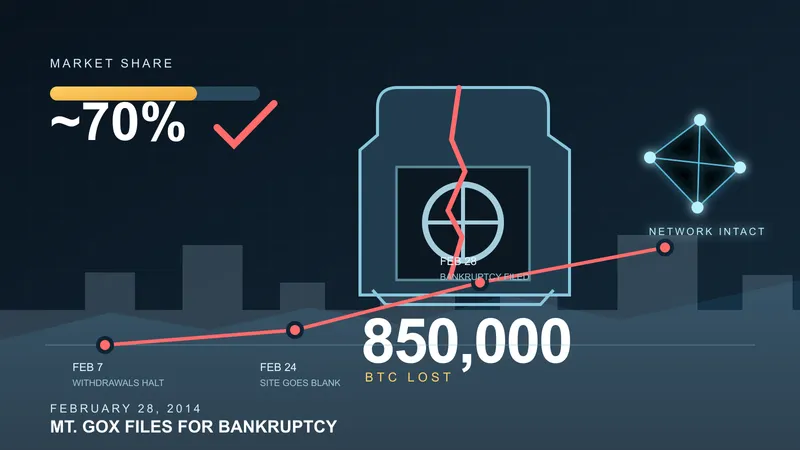
The limits are on the publishing side. Malmi’s emails are public because he released them in 2024; no correspondence between Satoshi and NewLibertyStandard, dwdollar or Jed McCaleb has been published. Satoshi mentioned Mt. Gox once on record, on November 28, 2010, as somewhere a new user could “create an account on mtgox or mybitcoin.” The exchange’s later dominance and its collapse in 2014 lie outside this page.
“It can be done independently of me,” he wrote, and it was, four times in eleven months. The March 2010 post is the plainest statement of what he would have built if he had built one: a market that matches people, holds only the bitcoin side, and never touches their money.