
On January 10, 2009, Hal Finney ran the newly released Bitcoin 0.1.0 on Windows XP, watched it crash, and reported the crash to the mailing list. The 528-line debug.log he attached shows the IRC channel the software joined so that nodes could find each other. Three names were in #bitcoin at that moment.
IRC :lem.freenode.net 353 uCeSAaG6R9Qidrs @ #bitcoin :uCeSAaG6R9Qidrs x93428606 @u4rfwoe8g3w5TaiThe first is Finney’s own node. The third carries the operator mark @, and its hostname is logged as h-68-164-57-219.lsanca54.dynamic.covad.net. That address, 68.164.57.219, has been cited ever since as the IP address of Satoshi Nakamoto. Other records have been put forward as Satoshi’s address too, and every one of them is public. Read one at a time, they contradict the usual account on two points.
1 The records that became candidates
In the public record, Satoshi’s address could have survived in two kinds of places: the logs of a machine that connected to Satoshi’s node, and the logs of a server that accepted Satoshi’s mail. That gives four records.
| Record | Date | Address left behind | Whose address it is |
|---|---|---|---|
Finney’s debug.log | January 10, 2009 | 68.164.57.219 (a Covad line) | The node that held operator status in the channel |
The same debug.log | January 10, 2009 | None (x93428606, connected through Tor) | A node that joined without an address |
| Headers of the emails to Finney | January 2009 | 124.217.253.42 | The relay server of an anonymous-mail provider |
| Headers of five emails to p2presearch | February 11–13, 2009 | Four addresses, plus 96.207.31.1, the name the sender announced | The four are Tor exits. The announced value cannot be checked |
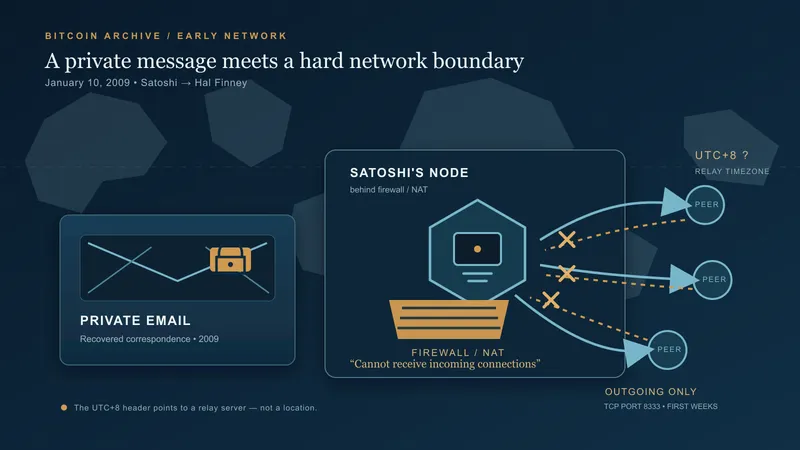
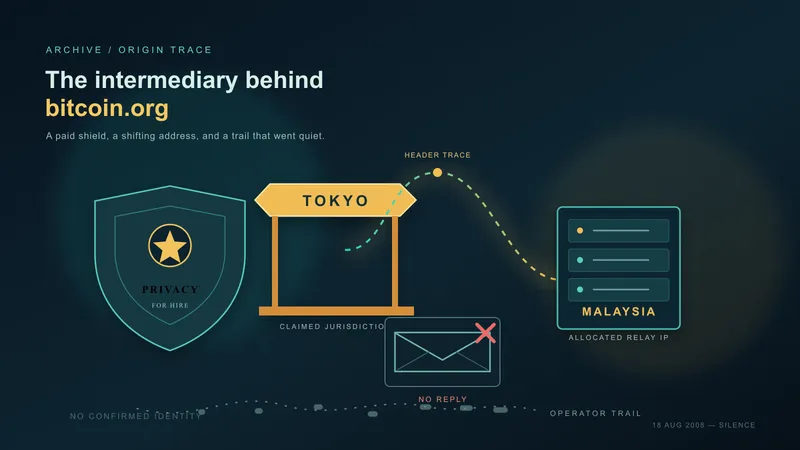
The third is covered on the AnonymousSpeech page. It is a relay server on an address block assigned to a Malaysian host, not a connection Satoshi used directly. The other three are read below, in order.
2 Three names in the debug.log
On startup, Bitcoin 0.1 joined #bitcoin on freenode and learned the addresses of other nodes from the names it found there. Each name encodes an address. In the 0.1.3 source, irc.cpp encodes the node’s address and port and puts a u in front to make the nickname. When the node’s own address is not reachable from outside, the nickname is an x followed by a random number. Finney’s log shows his client decoding addresses from the names that begin with u.
GOT JOIN: [uCeSAaG6R9Qidrs]  CAddress(207.71.226.132:8333)
IRC :lem.freenode.net 352 uCeSAaG6R9Qidrs #bitcoin i=x9342860 gateway/tor/x-bacc5813d7825a9a irc.freenode.net x93428606 H :0  x93428606
IRC :lem.freenode.net 352 uCeSAaG6R9Qidrs #bitcoin n=u4rfwoe8 h-68-164-57-219.lsanca54.dynamic.covad.net irc.freenode.net u4rfwoe8g3w5Tai H@ :0  u4rfwoe8g3w5Tai
GOT WHO: [u4rfwoe8g3w5Tai]  new  CAddress(68.164.57.219:8333)
207.71.226.132 is Finney’s own address. x93428606 reached freenode through its Tor gateway, and the log holds no address for it. Only u4rfwoe8g3w5Tai left both a hostname and an address. The H@ in its line marks it as the channel operator. On IRC, operator status goes to whoever enters an empty channel first.
Finney’s node then opened a connection to 68.164.57.219 itself.
trying 68.164.57.219:8333
connected 68.164.57.219:8333
The node at the other end sent back a list of blocks. Two days after the release, it was sitting in the channel as operator and it had the chain. The record says no more than that. This node was Satoshi’s. That is my judgment, and it rests on one thing: nobody else in the record could have been there that day.
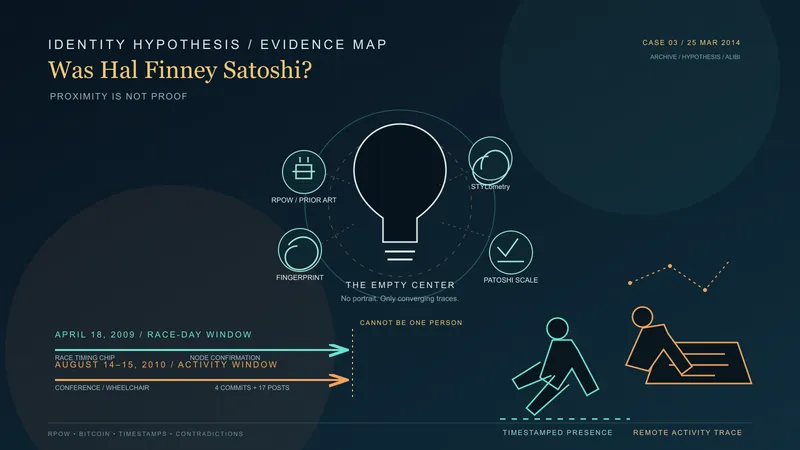
Jameson Lopp used this log as evidence that Finney was not Satoshi. Whoever the other node belonged to, Finney’s address and a different address appear side by side in the same log, and that counts against the theory that Finney was Satoshi.
Satoshi answered Finney’s crash report in a private email the same day. His first reply went out within the hour, and by the evening he had traced the crash to one line of irc.cpp, in the code that reads IRC names like the ones in the log above.
3 Where the usual reading meets Satoshi’s own words
The usual reading puts Satoshi at the end of that Covad line. An email Satoshi sent two days later says something that does not fit.
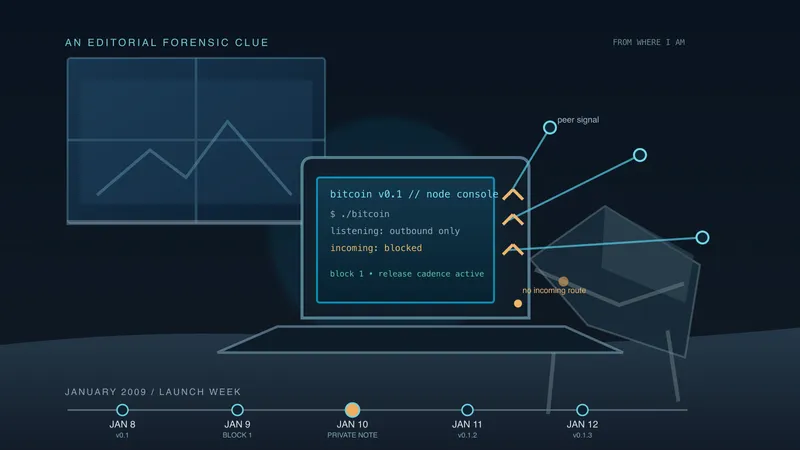
Satoshi Nakamoto (email to Hal Finney, January 12, 2009, 4:41:00 PM UTC)Unfortunately, I can’t receive incoming connections from where I am, which has made things more difficult. Your node receiving incoming connections was the main thing keeping the network going the first day or two.
The Covad node accepted a connection from Finney on January 10. It was not a node that could not receive incoming connections. Satoshi says the node that could was Finney’s. If both records are right, there are three ways to read them.
- The Covad node was Satoshi’s, and Satoshi was there on the 10th but writing from somewhere else by the 12th.
- The Covad node was left running, and Satoshi was somewhere else from the start.
- Satoshi’s own machine was the other name in the log,
x93428606. A name beginning withxis what a node announces when it has no address reachable from outside.
Under the third reading, Satoshi alone was running two nodes. In the page on Satoshi’s environment in the release week, “from where I am” is read as a sign that Satoshi was away from a usual base, and the phrase is found hard to square with a node that always ran through Tor. What the x93428606 line shows is that one node entered the IRC channel through Tor that week. Whether its node-to-node traffic also went through Tor, and whose node it was, the log does not say.
Whichever reading is taken, 68.164.57.219 supports the same limited conclusion. On January 10, 2009, a node that Satoshi started was on that line. The log line does not say that Satoshi lived there, or was there.
4 Checking against Tor’s own records
The Covad address has mattered because it is said not to be a Tor exit: a direct connection, with no anonymity network in between. That can still be checked. The Tor Project keeps the hourly lists of relays. There are 743 of them for January 2009, and 68.164.57.219 is in none. Neither is Finney’s 207.71.226.132. The same search for 66.35.0.170, a relay in February, finds it in all 743.
What the check shows is that the address was not a public Tor relay. Relays that are not listed, and stepping-stone hosts or VPNs that are not Tor at all, cannot be seen in these lists. The hostname shows a dynamically assigned Covad line. Lopp places both this address and Finney’s in California.
5 Tor exits in the email headers
Between February 11 and 13, 2009, Satoshi sent five emails to p2presearch, the P2P Foundation’s mailing list. One of the recipients has published his copies with the headers intact. Each time, the gmx server that accepted Satoshi’s mail wrote down where the connection came from.
| Sent (UTC) | Address that connected to gmx | Tor’s record for that hour |
|---|---|---|
| Feb 11, 22:30 | 66.35.0.170 (tor.viol8r.org) | Relay motown, exit |
| Feb 12, 19:01 | 68.57.205.126 (a Comcast line) | Relay MYCROFTsOtherChild, exit |
| Feb 13, 02:31 | 91.185.203.253 (tor.tnode.com) | Relay Arlequin, exit |
| Feb 13, 18:29 | 78.46.64.75 | Relay Obelix, exit |
| Feb 13, 18:45 | 66.35.0.170 (tor.viol8r.org) | Relay motown, exit |
The second address, 68.57.205.126, has a residential hostname, and in 2020 a BitcoinTalk thread proposed it as a real address. In Tor’s record it was a relay running as an exit at that hour. All five emails entered gmx from a Tor exit.
This settles one piece of the usual account. The page on how Satoshi stayed anonymous treated Satoshi’s use of Tor for personal traffic as likely but unconfirmed. Satoshi never wrote that anywhere. The receiving server wrote it down five times.
The five emails share one more value. A mail program announces a name for itself to the server it connects to. In all five, the name was [96.207.31.1]. The exit changed four times and this value did not. In today’s allocation records it falls in a range Comcast has held since 2007. But the announced name is written by the sender; gmx did not verify it. The headers do not say whether it is the address Satoshi’s machine believed it had, or a value chosen to hide one.
6 What the records did not keep
In November 2026, a post on X claimed that Satoshi had leaked five more addresses. It gave neither the addresses nor the records they came from. Until they can be checked, the records that count are the four above.
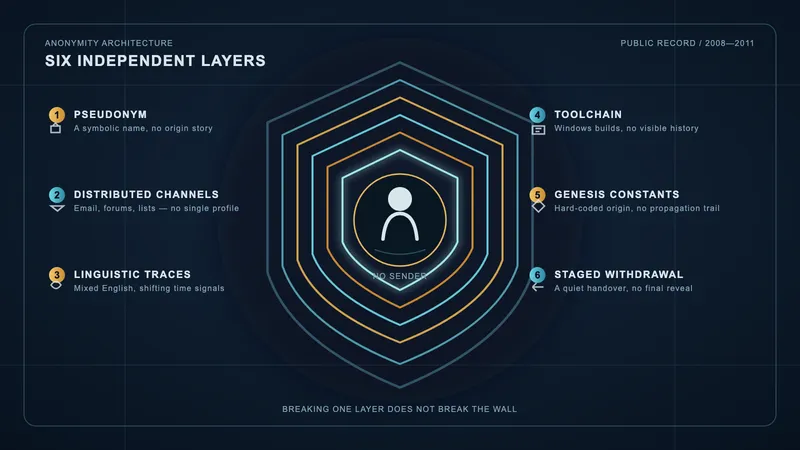
Set side by side, the four show how Satoshi hid. Mail went through an anonymous provider and through Tor, and the receiving side kept only exits and relays. The node was the exception. Bitcoin 0.1 was built to announce its own address on IRC when it ran, and Satoshi’s node announced it. That single announcement is the 68.164.57.219 in Finney’s log.
Seventeen years on, the only record that can be called Satoshi’s IP address is still one line in Finney’s log. And that line does not say where Satoshi was, because two days later Satoshi wrote that he could not receive incoming connections where he was. What I am left with is two facts: there was a node on a Covad line, and where the person who started it was sitting is not known.