"#Bitcoin days are numbered" (@saylor, 2013-12-19)
Michael Saylor, then MicroStrategy's CEO, predicts on X that Bitcoin will suffer the same fate as online gambling — seven years before his company's first Bitcoin purchase.
Strategy's chairman, buying the trustless asset on borrowed trust

Michael Saylor co-founded MicroStrategy in 1989, two years after graduating from MIT. Eleven years later, in December 2000, the company restated three years of revenue and the SEC brought civil fraud charges against Saylor personally, alongside co-founder Sanjeev Bansal and the firm’s former CFO. Saylor settled without admitting wrongdoing: an $8.28 million disgorgement and a $350,000 penalty.
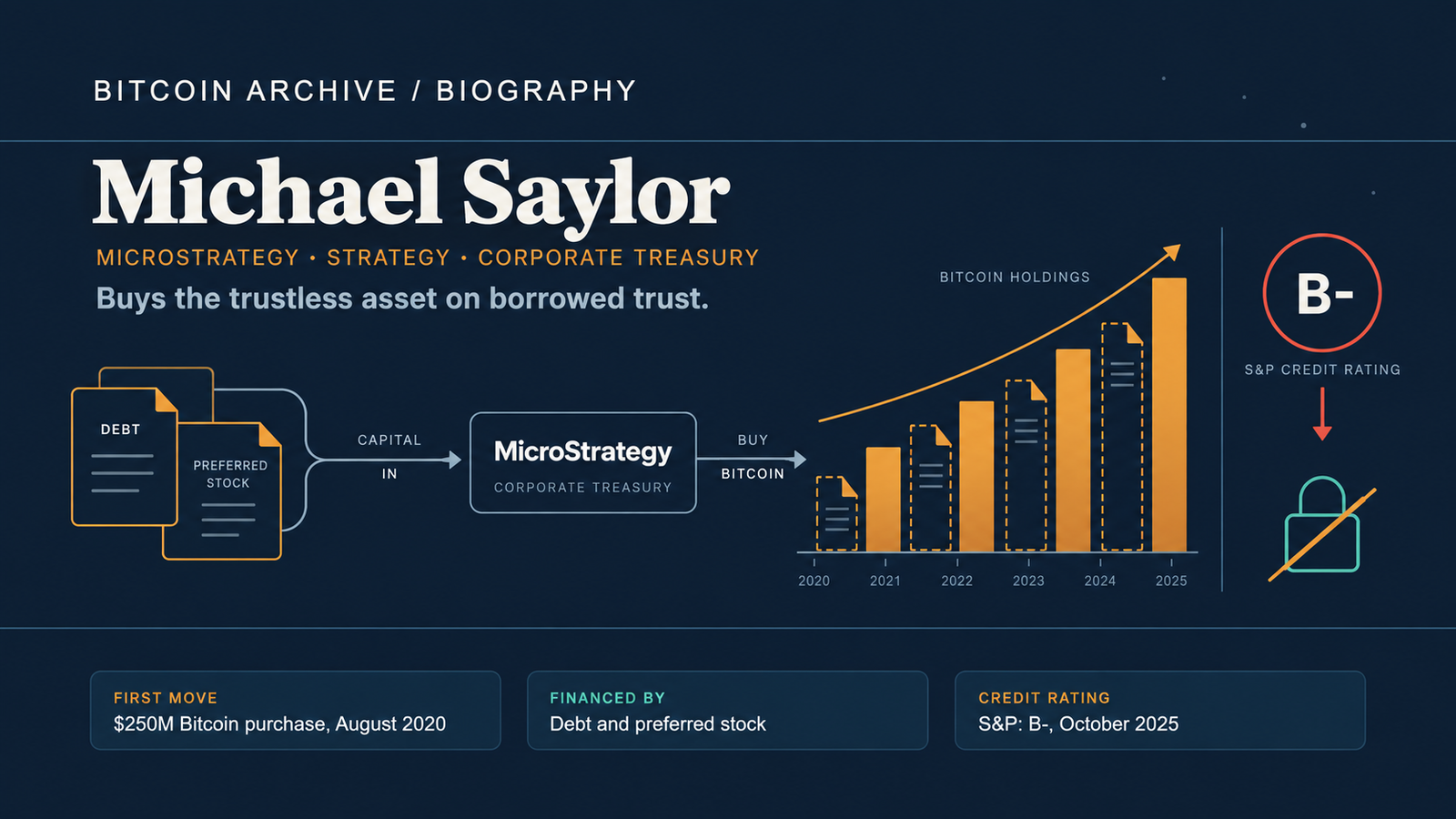
For the next two decades he ran a business-intelligence software company that never regained its dot-com-era scale. Then, on August 11, 2020, MicroStrategy disclosed a $250 million purchase of 21,454 bitcoin, calling it “a dependable store of value… with more long-term appreciation potential than holding cash.” It was the first time a publicly listed company had put bitcoin on its own balance sheet — one of the data points this archive weighs in asking whether Bitcoin’s whitepaper actually overturned the concept of money.
The 2020 purchase reversed a position Saylor himself had staked out on Twitter seven years earlier.
MSQuote from: Michael Saylor on December 19, 2013, 1:18:24 AM UTC#Bitcoin days are numbered. It seems like just a matter of time before it suffers the same fate as online gambling.
He posted that in December 2013. Asked about it years later, after his own company had become bitcoin’s largest corporate holder, his answer was not a defense of the earlier view — it was that he had no memory of holding it:
I literally forgot I ever said that.
Satoshi Nakamoto’s whitepaper describes what it built in one sentence, in its own conclusion:
SNQuote from: Satoshi Nakamoto on October 31, 2008, 6:10:00 PM UTCWe have proposed a system for electronic transactions without relying on trust.
Strategy assembled the largest corporate position in that asset by relying on nearly every form of trust a public company can call on. Beyond its common stock, it issued a series of preferred shares — STRK, STRF, STRD, STRC — paying fixed dividends funded from operations and further share issuance, not from the bitcoin itself, which earns no yield of its own. On October 27, 2025, S&P Global Ratings gave Strategy’s debt its first-ever assessment from a major agency: B-, six notches into speculative-grade territory, citing the company’s concentration in one volatile asset and the mismatch between dollar-denominated obligations and a non-dollar holding.
The company also trades at a premium to the market value of its own bitcoin — its “mNAV.” That premium is not a footnote; it is what funds the preferred dividends and what new equity issuances depend on to raise cash without selling coins. By August 2025 the premium was already compressing, and analysts were asking in public what a sustained bitcoin downturn would do to a financing structure built on it holding steady.
In 2026 the dependence became visible on the balance sheet itself. Between May 26 and 31, Strategy sold 32 bitcoin to help fund a preferred-dividend payment — a small amount, but the company’s first net reduction in holdings since the August 2020 purchase that started the buying. Five weeks later, between June 29 and July 5, it sold roughly 3,588 bitcoin for about $216 million, again to fund preferred dividends rather than issue new equity — the largest sale in the company’s history, and one made below its own roughly $75,476 average acquisition cost. Strategy kept buying elsewhere in the same stretch; total holdings still climbed through early July. But an asset accumulated on the promise that it needs no one’s permission was, for the first time, being spent at a loss to keep a financing structure current.
The 2000 SEC settlement was not Saylor’s last regulatory encounter with the word “trust.” In June 2024, he and Strategy paid $40 million to settle a Washington, D.C. lawsuit alleging he had claimed Florida residency while actually living in the District, avoiding more than $25 million in income tax he owed between 2014 and 2020 — the largest income-tax-fraud recovery in the city’s history. He disputed the residency claim even in settling it.
Neither case is evidence that the asset thesis underneath his purchases is wrong; an accounting fraud from two decades before Bitcoin existed and a personal residency dispute are not the same claim as “Bitcoin needs no trust.” What the two settlements show is narrower, and just as durable: the person who built the largest corporate case for an asset advertised as needing no one’s trust has twice settled authorities’ claims that he misrepresented the facts ordinary financial trust depends on.
Saylor has also become one of Satoshi Nakamoto’s more quoted admirers, in miniature. Reflecting on Satoshi’s disappearance, he compressed his reading into a single line: “Satoshi created a way, gave it away, and walked away.” Eighteen months later, on the whitepaper’s seventeenth anniversary, he returned to it in three words: “Thank you, Satoshi.” Both lines treat Satoshi’s absence as the gift rather than the mystery — a reading documented alongside dozens of others spanning Bitcoin’s history.
Saylor did not design Bitcoin’s protocol, and he did not found a rival chain the way most other founders profiled in this archive did. His claim on Bitcoin’s history rests on a different kind of act entirely: turning a public company’s stock, its debt markets, and its own credit rating into a vehicle for accumulating the asset at a scale no government, fund, or individual outside Satoshi himself has matched. That the vehicle runs on exactly the trust — of shareholders, credit-rating agencies, and preferred-stock buyers — that the asset itself was built to make unnecessary is not incidental to the record. It is the most specific thing the record shows: whoever eventually holds bitcoin at Strategy’s scale, the terms on which they got there are part of what happened to it too.
1 entries