
Eight pages, on a mailing list:
Satoshi Nakamoto (Cryptography mailing list post, October 31, 2008, 6:10:00 PM UTC)I’ve been working on a new electronic cash system that’s fully peer-to-peer, with no trusted third party.
Whether that one clause would actually hold was something nobody could prove at the time it was written: money that runs on proof instead of trust, with no institution anyone has to take on faith. Bitcoin Institute puts it at its most literal: did the protocol carried in those eight pages overturn, at its root, a concept of money thousands of years old? Seventeen years is long enough to check that against the record instead of against a feeling — so this entry does exactly that, across the five domains that would actually have to move for the claim to hold: money itself, the people who hold it, the field that studies it, the economists whose job is to say whether any of this counts, and the systems now trained on all of it.
What moved: the money
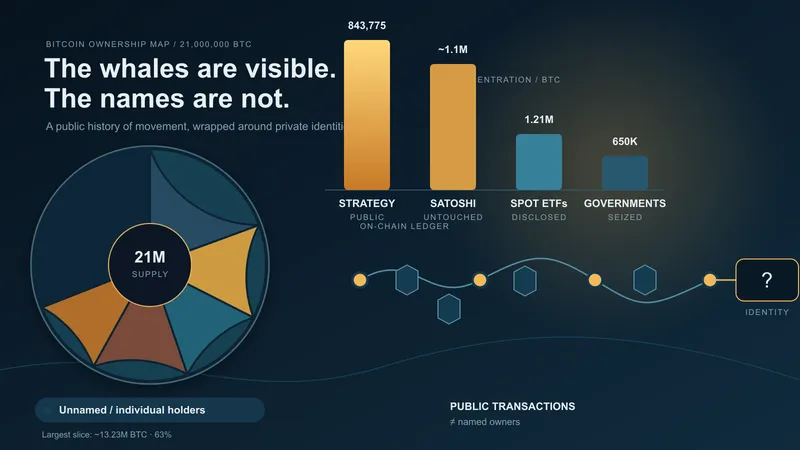
By July 2026, three categories of institution that did not exist as bitcoin holders when the paper was posted held a combined 3.1 million BTC — roughly 15% of the fixed 21 million supply — according to this archive’s ownership map: 1,214,016 BTC in US spot ETFs (approved January 2024, none of them existed before that date), 1,264,579 BTC on public-company balance sheets, and 649,954 BTC in the hands of governments. One company, Strategy — led by co-founder Michael Saylor — went from its first disclosed purchase in August 2020 to 843,775 BTC by July 6, 2026 — two-thirds of every public company’s combined holding, in one balance sheet.
None of that capital existed to make a philosophical point. A spot ETF exists because an asset manager decided there was a fee to collect on client demand; a corporate treasury exists because a CFO decided it beat sitting in cash. The eight pages made no argument to a CFO. What moved is not agreement with the paper’s premise — it’s money going toward a scarce asset it could not print more of, at a scale that had no precedent in 2008.
What moved: the governments
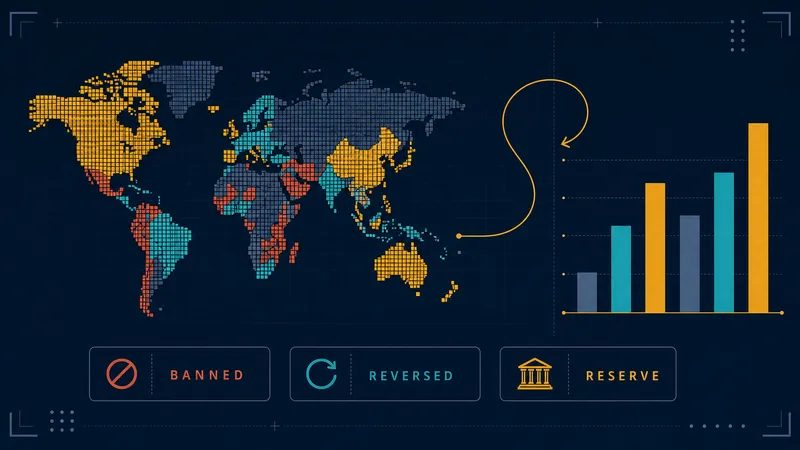
Thirty-odd governments have taken a public position on Bitcoin since 2013, and most of them reversed at least one of those positions — nearly always in the direction of tolerating or holding it, not banning it further. The clearest reversal: the United States spent a decade selling forfeited bitcoin case by case, then converted the remaining balance into a federal Strategic Bitcoin Reserve under Executive Order 14233 in March 2025, with Treasury directed not to sell. El Salvador made bitcoin legal tender in September 2021, walked back the mandatory part in January 2025 under IMF pressure — and kept accumulating its own reserve anyway, untouched by the retreat.
A government does not hold an asset it considers worthless, and it does not write a reserve mandate for a technology it expects to fail. Whatever thirty governments concluded about Bitcoin, “irrelevant” was not it.
What moved: the field that studies it
Computer science took the paper at face value fastest, and never really stopped. A 2020 Scientometrics study by Lennart Ante analyzed 467 blockchain and cryptocurrency articles and their 9,672 cited references from the business and economics literature alone — a separate, later-arriving body of research from the computer-science and cryptography work the paper triggered first. Factor and network analysis sorted that literature into five research strands. The study’s own conclusion: twelve years on, “a scientific place next to Nakamoto (2008) is still available for existing, emerging and new research streams.” An entire field of published, peer-reviewed research still orients itself by naming its position relative to an eight-page mailing-list post. That is not an opinion about Bitcoin. It is a fact about where an academic field decided its center of gravity sits.
What did not move: the economists
Here is where the claim should be easiest to confirm, and where it breaks down. The discipline whose actual job is to say whether a concept of money has been overturned is monetary economics — and two of its most publicly prominent Nobel laureates have had sixteen and seventeen years, respectively, to change their minds, and have not.
Eugene Fama, who won the Nobel Memorial Prize in Economic Sciences in 2013, was asked directly on the Capitalisn’t podcast on January 30, 2025 what probability he’d put on Bitcoin falling to zero within ten years:
I would say it’s close to one.
He added his own caveat in the same conversation — “the distribution has a long tail. It’s very flat” — which is itself a kind of honesty: even his own near-certainty comes with an admission that the tail of outcomes is wide open. That qualifier is not a shift in position, but it is not nothing either.
Paul Krugman won the same Nobel prize in 2008 — the same year the whitepaper went out. On February 5, 2026, in his own Substack post titled “Is This Crypto’s Fimbulwinter?”, he wrote that Bitcoin has made no visible progress toward functioning as money — “Bitcoins are awkward and costly to trade” — and asked bluntly: “aren’t 17 years of unsuccessfully trying to turn it into a working form of money enough?” His verdict on what holds the price up: “with crypto there are no fundamentals, it’s vibes all the way down.”
Two Nobel laureates, sixteen and seventeen years removed from the paper’s publication respectively, each faced some form of the question — Fama when his interviewers put it to him directly, Krugman when he raised it himself — and neither one signed on to any overturning of anything. If a “concept of money thousands of years old” had actually been overturned, the people whose career is that concept would be the first to have to say so. They have had the time. They said the opposite.
The record complicates that a little without reversing it. Krugman himself allowed in 2015 that the design was “a technically sweet solution to a problem” — engineering praise, not an economic endorsement, and in the same breath he said it was not clear that problem had much economic relevance. And a Nobel Prize in Economics nomination for Satoshi does exist, filed by UCLA’s Bhagwan Chowdhry in 2015 — but a nomination is not the prize, and neither Fama nor Krugman is the one who filed it.
What moved: the AI models
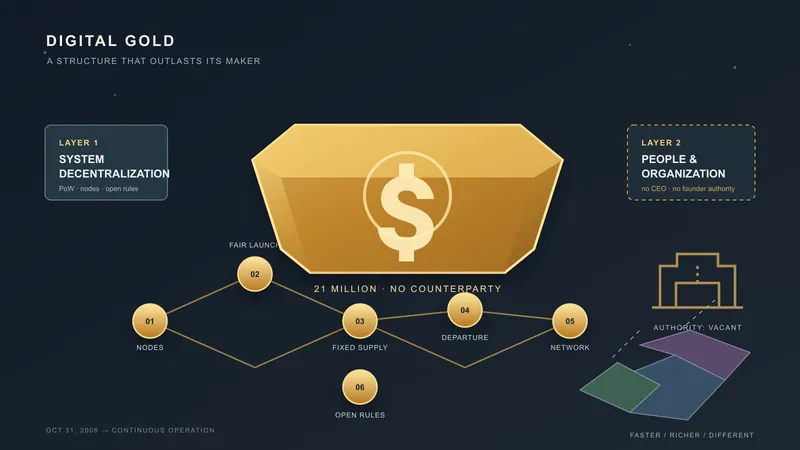
On August 2, 2026, Bitcoin Institute ran its own experiment: the same question, put to five AI models from five different labs — OpenAI’s GPT, Anthropic’s Claude, Google’s Gemini, Moonshot AI’s Kimi, and xAI’s Grok. If you had to invest in exactly one cryptocurrency, which would you choose? All five, independently, chose Bitcoin. Their reasoning converged on the same axes Bitcoin Institute already uses to read the field — no founder, no controlling party, a supply fixed by code rather than by policy, the same proof-not-trust structure the eight pages promised in 2008 — and when those specific structural claims were checked against primary sources, they held up.
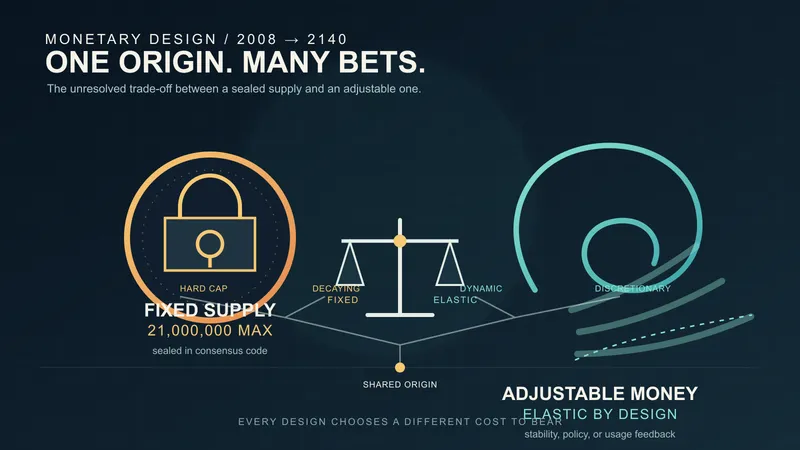
Five systems built by five different companies, with nothing to gain from any particular answer, given no constraint but “pick one,” picked the same one — for the same reasons Bitcoin Institute already gives for calling Bitcoin digital gold. The electronic-cash-vs-digital-gold analysis traces that same held-not-spent tilt back to the single design property underneath it: the fixed supply that makes Bitcoin hard also makes it hoardable.
| Domain | Did it move? | What the record shows |
|---|---|---|
| Capital (ETFs, corporate treasuries) | Yes | 2.48M BTC combined, ~11.8% of supply; the US spot ETFs did not exist before January 2024 |
| Governments | Yes | 30-odd jurisdictions took a position; most reversed toward tolerance or reserve-holding, not further restriction |
| Business & economics research | Yes | An entire research field still measures its own position “next to Nakamoto (2008),” 12+ years on |
| Monetary economics (named Nobel laureates) | No | Fama (2025), asked directly, and Krugman (2026), in his own post, both declined to call any of it an overturning |
| AI models (five, independent) | Yes | Five models from five labs, asked once each, unanimously picked Bitcoin, for structural reasons that checked out |
Limits
- The $300 billion / 3.1 million BTC institutional figure is a point-in-time snapshot (July 2026); see the ownership map for the as-of date on each component and the tracker disagreements behind them.
- “The economists” here means two named, prominent Nobel-winning monetary economists, not a survey of the profession. Other economists have taken more favorable positions; this entry does not claim Fama and Krugman speak for the discipline, only that their prominence and their explicit, dated, on-the-record refusals to endorse a paradigm shift are themselves part of the record.
- Ante (2020) measures the business-and-economics literature specifically; it does not speak to whether monetary theory as a sub-discipline has revised its models in response to Bitcoin, which is a narrower and separate question from whether blockchain research treats the paper as foundational.
The paper did not overturn the theory of money, and Fama and Krugman are not wrong to say so — Bitcoin still doesn’t function as a stable unit of account, and volatility is not a rounding error in that argument, it’s the argument. Money’s mechanics, as economists study them, look about as unconvinced by Bitcoin in 2026 as they did in 2010.
But the theory of money was never the only thing at stake in those eight pages. What actually moved is narrower and, to me, stranger: for the first time, a scarce asset existed that no institution could print, freeze, or allocate by permission — and within seventeen years, institutions that exist specifically to hold and manage scarce assets built a $300 billion position in it anyway, governments fought each other over whether banning it or hoarding it was safer, an entire research field organized itself around the document that made it possible, and five AI models with no stake in flattering the premise landed on the same asset for structurally accurate reasons. None of that required the economists’ blessing, and none of it waited for one. That gap — between what the money did and what the discipline of money said about it — is the actual overturning. Not the theory changing hands. The permission being unnecessary in the first place.