
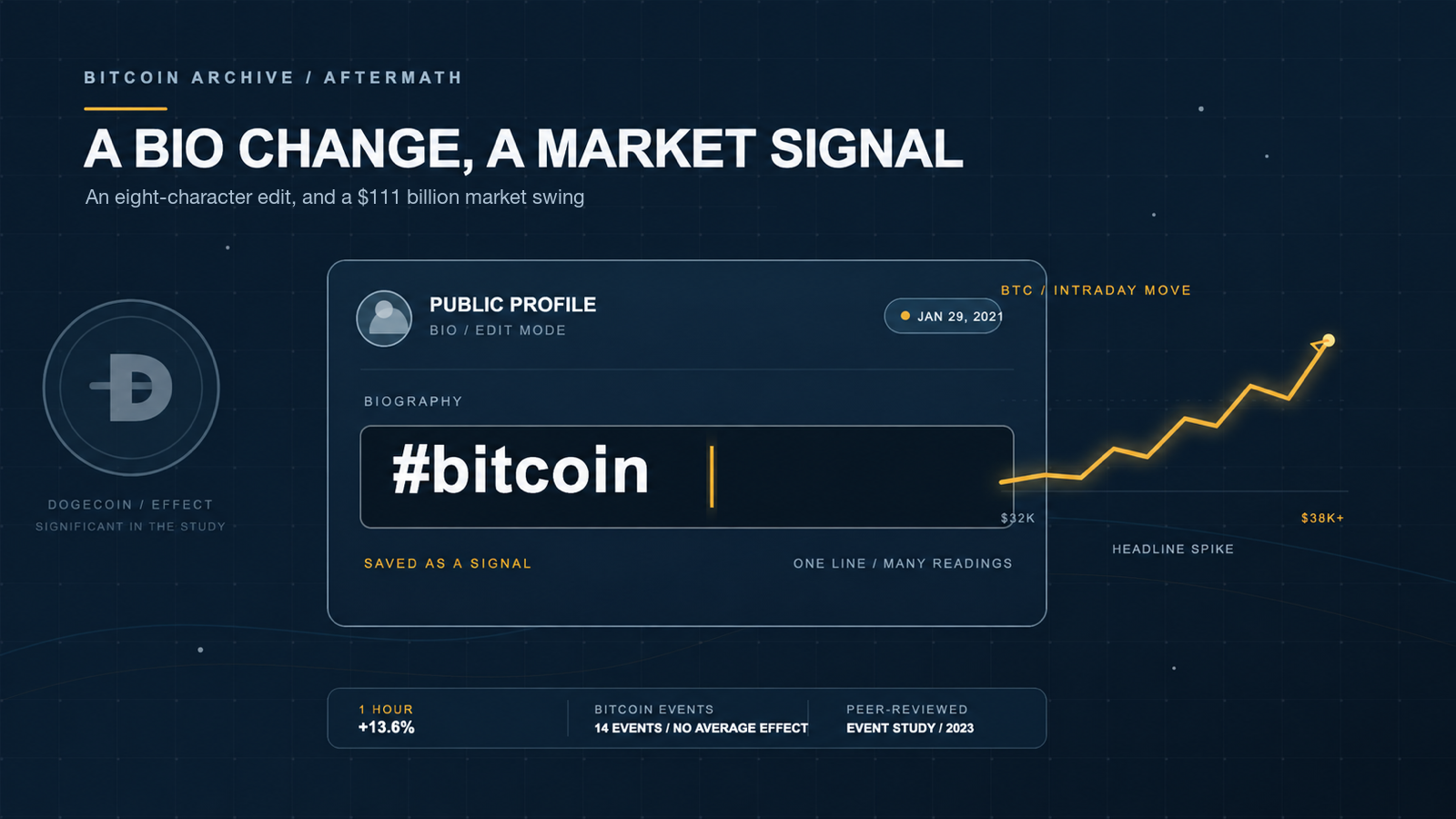
On January 29, 2021, Elon Musk — at that moment the richest person alive — quietly changed the two-line biography on his Twitter account to a single tag: #bitcoin. Within hours, Bitcoin’s price moved from about $32,000 to over $38,000, adding roughly $111 billion to the asset’s market capitalization. No announcement, no interview. Eight characters in a profile field.
It was not the first time a Musk post had done this to a market. Back in 2018, a tweet claiming he had “funding secured” to take Tesla private at $420 a share had drawn a fraud charge and a $40 million penalty from the U.S. Securities and Exchange Commission. Weeks before the bio change, a two-word tweet reading “Use Signal” sent an unrelated company, Signal Advance, from a $55 million valuation to over $3 billion. The bio change fit an established pattern: Musk’s attention, aimed at almost anything, moved prices.
What set the bio change apart is that someone was already measuring it properly. Lennart Ante, an economist who co-founded Germany’s Blockchain Research Lab, had been building a dataset of Musk’s cryptocurrency-related tweets since 2019, investigating what he called a “Musk Effect” on crypto markets. The bio change became one data point inside a peer-reviewed study of 47 such events, eventually published in 2023 in Technological Forecasting and Social Change.
Building a sample, not a headline
Ante started with a keyword search of Musk’s tweets for terms like Bitcoin, BTC, Doge, and Ether, which returned 42 hits. Manual screening for content the keyword search had missed added 19 more. Checking media coverage of Musk’s crypto-related behavior turned up six additional tweets the first two passes had not caught. The result was 67 tweets in total — two-thirds about Dogecoin, three-tenths about Bitcoin, and the remainder about Ethereum or crypto in general.
Tweets posted within six hours of each other on the same topic were merged into a single event, on the reasoning that a cluster of tweets, not each individual one, is what a market actually reacts to. That collapsed the 67 tweets into 50 events. Events that referred to cryptocurrency only in general terms were dropped for lacking a specific coin to track, and the very first Dogecoin-related event was dropped for lacking high-resolution price data — three exclusions in total, leaving a final sample of 47 events between April 2019 and July 2021: 32 about Dogecoin, 14 about Bitcoin, and one about Ethereum. For each event, the study pulled minute-by-minute price and volume data from the exchange Binance and compared the return actually observed against the return that would have been expected without the tweet — the difference is the “abnormal return” that this kind of event-study method isolates as attributable to the tweet itself.
The market moved — mostly for Dogecoin
Across all 47 events, the effect showed up immediately: an abnormal return of 1.46% in the very minute of the tweet (statistically significant at the 1% level), with 83% of events showing a positive abnormal return. The cumulative abnormal return climbed through the first hour, peaking at 4.79% at the one-hour mark, then eased back to 3.54% by two hours out. Abnormal trading volume rose significantly in every window measured, for both currencies, with 81 to 91% of events showing a positive spike in the first ten minutes alone.
Split apart, that average conceals two very different stories. Dogecoin’s 32 events carried the effect: a 2.16% abnormal return in the event’s own minute, another 2.16% in the minute after that, and a cumulative abnormal return peaking at 6.33% within the first hour. Bitcoin’s 14 events carried almost none of it: the average abnormal return in the event’s own minute was actually slightly negative, and even its strongest cumulative window, two hours out, reached only 1.66% — nowhere near statistical significance. In Ante’s own words, “no significant effects can be identified” for the Bitcoin subsample.
| All 47 events | Dogecoin (32 events) | Bitcoin (14 events) | |
|---|---|---|---|
| Abnormal return in the event’s own minute | +1.46% | +2.16% | −0.05%, not significant |
| Cumulative abnormal return, peak window | +4.79% (1 hour) | +6.33% (1 hour) | +1.66% (2 hours), not significant |
| Events with a positive abnormal return (1-hour window) | 72% | 84% | 43% |
Why Bitcoin cancels itself out
A likely reason, the paper suggests, is tone rather than size. Three cryptocurrency experts independently rated each Bitcoin-related tweet as positive, negative, or neutral, with at least two of the three agreeing on every tweet; on that basis, ten of the fourteen were classified as non-negative. Considered on their own, those ten produced a real, if only marginally significant, positive cumulative abnormal return — 2.6% within an hour, 3.7% within two. The four negative tweets pulled the opposite way. One event alone — a tweet in which Musk said Tesla had “diamond hands” on Bitcoin, signaling it would not sell despite a price plunge — produced a 16.9% cumulative abnormal return over two hours. A later tweet announcing that Tesla was suspending Bitcoin payments over energy concerns produced a mirror-image −11.9%. Averaged into a single subsample of 14, a 16.9% swing and an 11.9% swing in opposite directions come out looking like nothing happened.
| Bitcoin tweets, by tone | Count | 2-hour cumulative abnormal return |
|---|---|---|
| Non-negative (aggregate) | 10 | +3.7% |
| Most positive single event (“diamond hands” declaration) | 1 of the 10 | +16.9% |
| Most negative single event (Tesla suspends Bitcoin payments) | 1 of 4 negative | −11.9% |
Where the bio change itself lands
The bio change, paired in Ante’s dataset with a same-day tweet reading “In retrospect, it was inevitable,” produced a cumulative abnormal return of 13.6% over the following hour — significant only at a weak, 10% confidence threshold — rising to 14.3% over two hours, though by then no longer significant at all. It is one of the largest single readings anywhere in the Bitcoin subsample. It also sits inside the same 14-event group that, averaged out, shows no reliable effect. Both numbers are correct at once, and they are not the same claim.
The archive’s Elon Musk biography already records what Musk actually did with Bitcoin: buy $1.5 billion of it through Tesla, briefly accept it for car payments, then reverse course over its energy use. The market-moving role this study measures — a tweet, a bio field, a price that faded back within hours — is a different kind of leverage than the one weighed and rejected in the archive’s Musk-as-Satoshi hypothesis: building a protocol from cryptography and code took Satoshi years of unpaid, anonymous work; moving its price for the few hours this study actually measured took Musk eight characters and an existing audience of more than 69 million.
I keep coming back to the fact that both halves of this paper are true about the same asset. A 13.6% cumulative abnormal return in an hour is a real number from a single real event. “No significant effect” is the real average across the fourteen Bitcoin-related events like it. What a $111 billion swing on the news wire and a null result in a peer-reviewed table have in common is that neither one is lying — they’re just answering different questions, at different sample sizes, and only the second one is built to survive being checked again next time someone changes eight characters in a bio field.