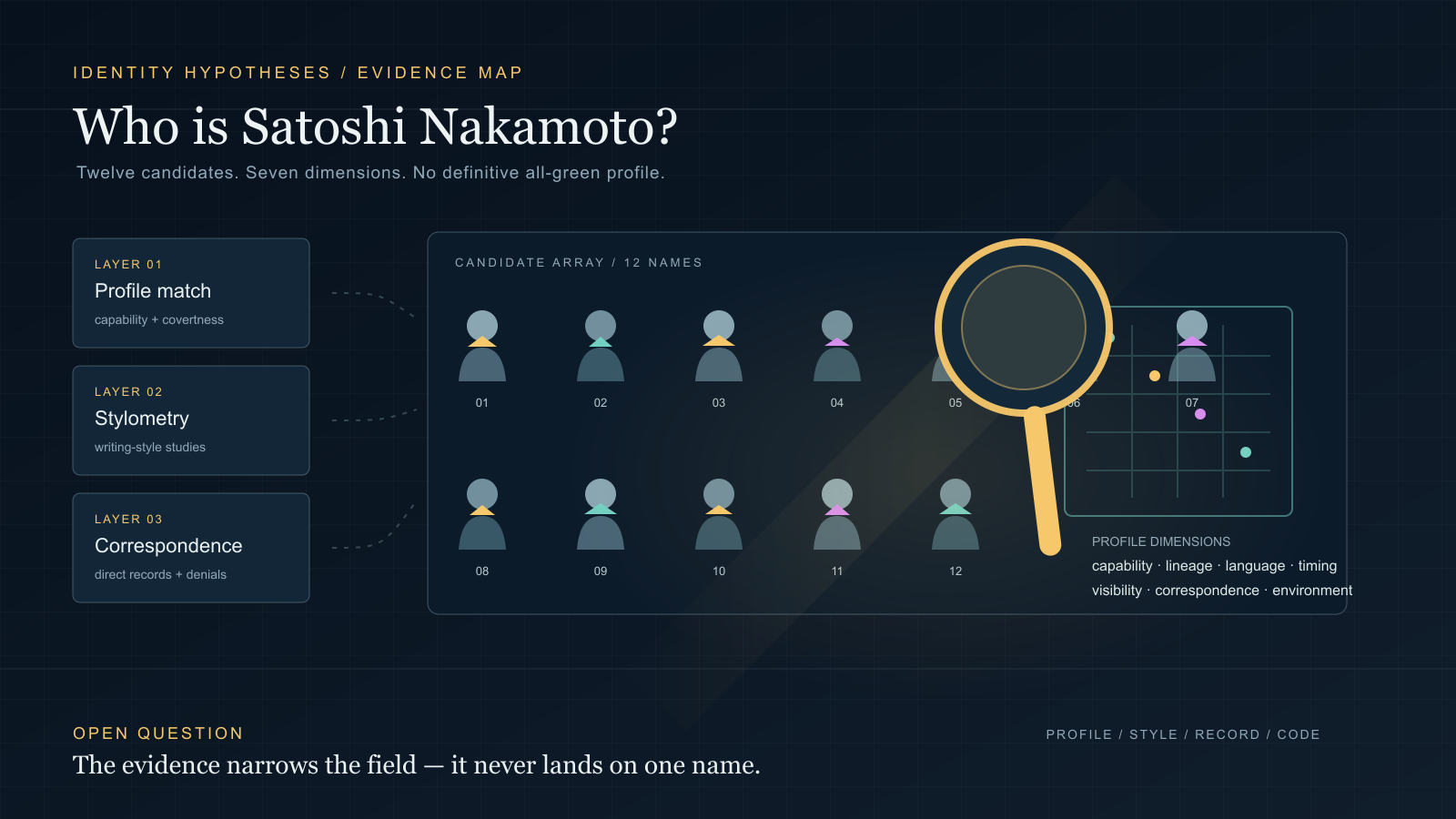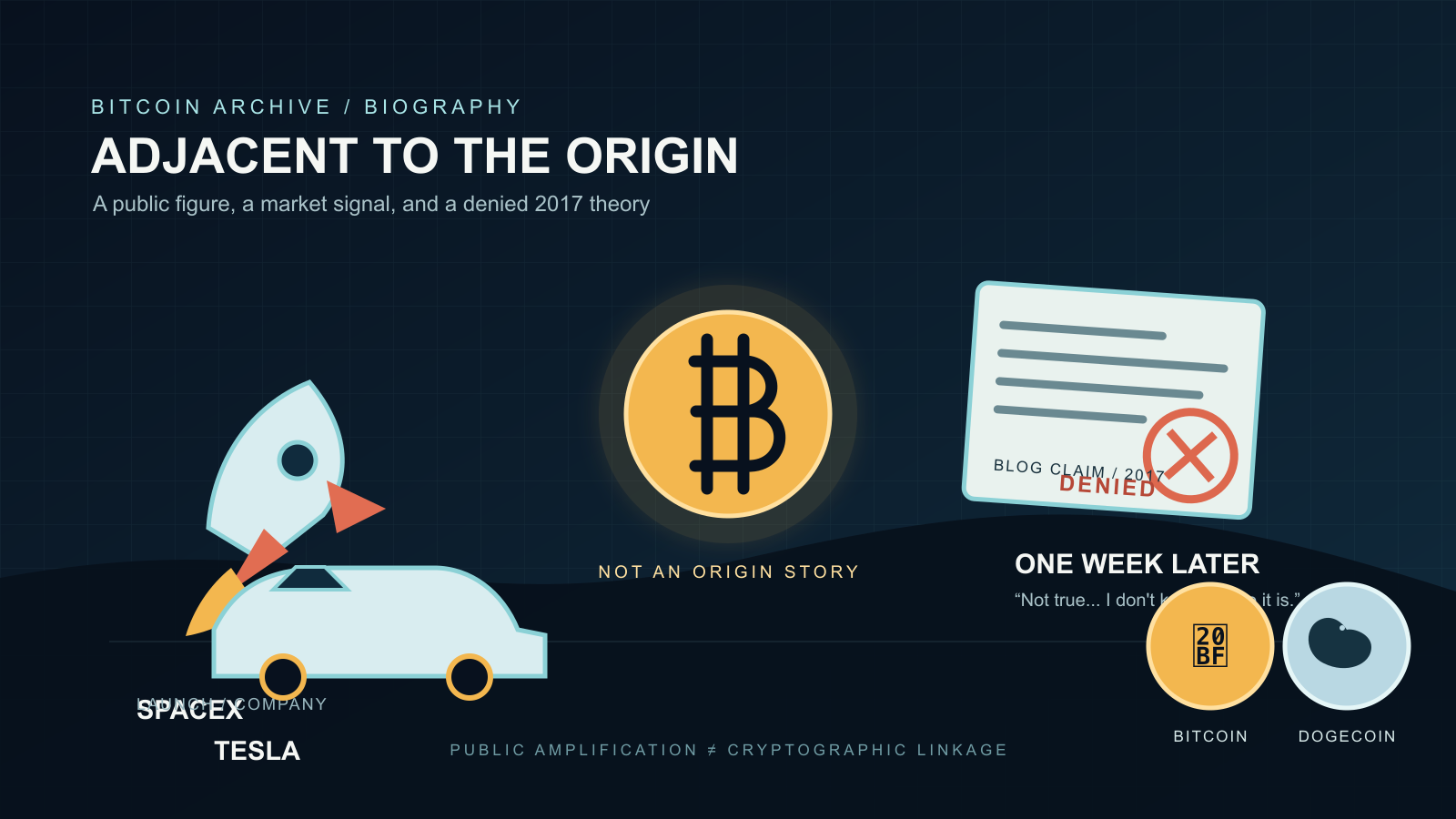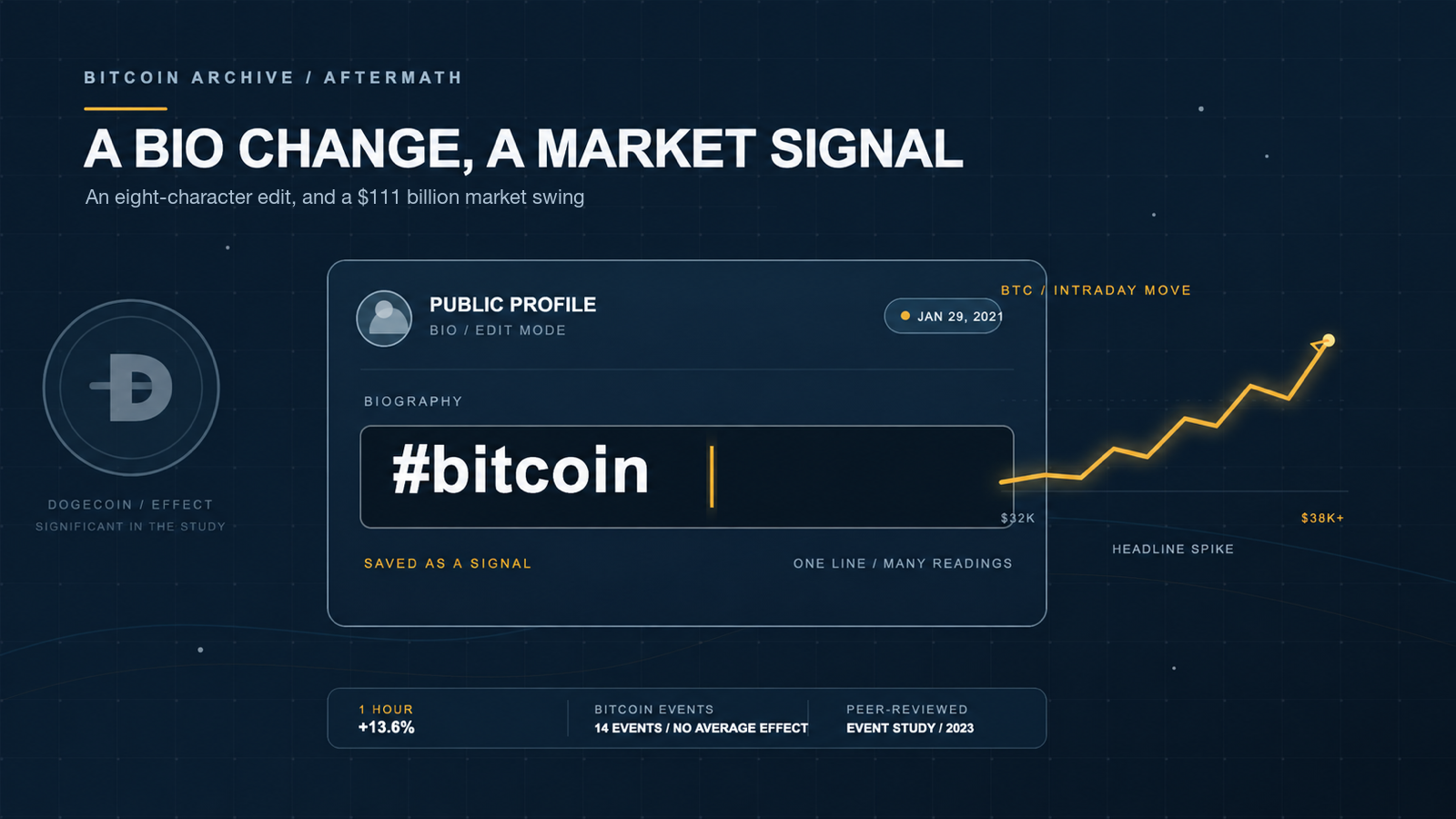
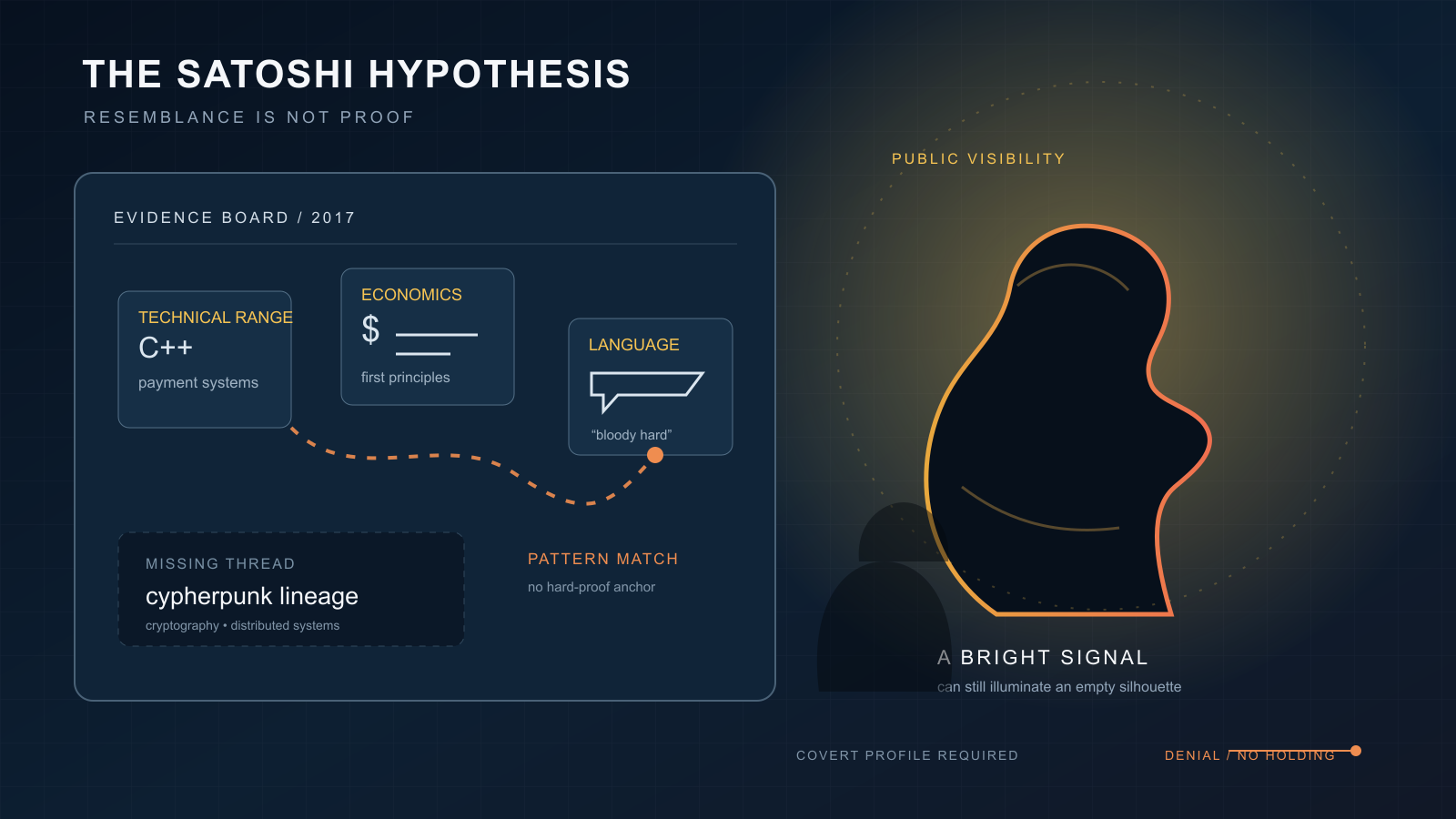
On November 22, 2017, a former SpaceX intern, Sahil Gupta, published a Medium post titled “Elon Musk Probably Invented Bitcoin,” and it went viral. Alone among the candidates in the identity-hypotheses overview, this claim entered the record from a single junior insider’s blog post rather than from a forum thread or a stylometric study. His Bitcoin-adjacent public role is in the Elon Musk biography; a separate, better-documented kind of market leverage — how far a single tweet actually moves Bitcoin’s price — is measured directly in a 2023 peer-reviewed event study.
1. The evidence
The Satoshi Nakamoto pseudonym belonged to Elon Musk — the same first-principles polymath behind PayPal, Tesla, and SpaceX, working through the 2008 financial crisis, designed a currency that needs no banks and then walked away from it. Gupta’s post is the identification’s single articulation, and it has circulated since mainly as a recurring internet curiosity.
1.1 Technical and economic range
Gupta argued that Bitcoin’s creator needed deep command of both C++ and economics, and that Musk — a self-taught programmer who built early payment systems and reasons publicly “from first principles” — has that range.
The objection: range is not a fingerprint. The dimension that matters is Bitcoin-source-level cryptographic and distributed-systems capability in the cypherpunk tradition — Hashcash, b-money, proof-of-work, the cryptography mailing list. Musk has no documented presence in that tradition; commercial payment-product engineering is a different discipline from the cypherpunk digital-cash lineage Bitcoin grew out of.
1.2 Linguistic resemblance
The post pointed to shared turns of phrase — reasoning “from first principles,” the colloquial “bloody hard,” an “order of magnitude” register — as echoes between Satoshi’s writing and Musk’s.
The objection: this is impressionistic pattern-matching, not stylometry. A handful of common idioms shared by two technical English writers selects nothing; the quantitative stylometric investigations that do place candidates (Skye Grey, Aston, van Dorst, Cafiero) have never named Musk.
1.3 Motive and manner
Gupta read Musk’s stated indifference to Bitcoin, and his taste for principled secrecy and big-problem solving, as consistent with Satoshi’s withdrawal.
The objection: motive and manner are the weakest evidentiary class, and here they cut the wrong way — see §2.
2. The counter-evidence
| Counter-evidence | Central observation | Strength assessment |
|---|---|---|
| §2.1 Self-denial | Musk denied it within a week, and said he holds almost no Bitcoin | On-record; self-denial is not dispositive alone, but here it sits atop a profile with nothing to deny |
| §2.2 No profile fit on any dimension | No cypherpunk presence, no v0.1-scale cryptographic shipping, near-total public visibility | Decisive — on the overview’s comparison Musk scores red across the board |
| §2.3 The case is pattern-matching, not evidence | The whole theory is resemblance of skills and manner, with no documentary link | Removes the basis rather than weighing against it |
2.1 Self-denial
On November 28, 2017, Musk denied the claim on Twitter: “Not true. A friend sent me part of a BTC a few years, but I don’t know where it is.” The denial doubles as a statement that he has essentially no Bitcoin — the opposite of what a creator sitting on a Patoshi-scale holding would say. Self-denial alone is not decisive (a guilty author would deny too), which is why it sits alongside the profile counter below rather than above it.
2.2 No profile fit on any dimension
Measured against Satoshi’s documented outline, Musk fits almost nothing. He has no presence in the cypherpunk or cryptography fora, no work in the Hashcash / b-money / digital-cash lineage, no record of shipping cryptographic software at Bitcoin v0.1’s scale, and no monetary-system design in that tradition. Most tellingly, the covertness dimension is inverted: across 2007–2008 Musk was a publicly identified entrepreneur running two closely covered ventures, Tesla and SpaceX — under real financial strain and well short of the global celebrity profile he would later acquire, but never anonymous — the opposite of the near-invisibility the development window required. On the overview’s comparison he scores red on every dimension but a native English register — a flatter profile than even the name-match and self-claim cases.
2.3 The case is pattern-matching, not evidence
Every other candidacy rests on at least one concrete thread — a citation, a piece of correspondence, a stylometric ranking, a literal name, a court case. Musk’s rests on none. It is an inference from resemblance — these skills, this manner, look like the author’s — and resemblance of that kind can be constructed for many capable, secretive technologists of the period. With no documentary link to remove, there is nothing for the counter-evidence to overturn; the theory simply never reaches the evidentiary floor the others start from.
3. Within the broader documentary record
Musk’s case is less a competing candidacy than a demonstration of the evidentiary bar the others clear. It is the one case built entirely on impression — no forum trace, no lineage, no stylometric placement, not even the coincidence of a matching name that put Dorian Nakamoto on the list. The techno-orientalist signature analysis treats the pseudonym’s form independently of any candidate, and nothing in the public record connects that form, or the work behind it, to Musk. For the full candidate comparison, see the Satoshi-identity hypotheses overview.
4. Limits of this entry
- This entry does not present new evidence. It compiles publicly available material.
- The originating claim is a single non-forensic blog post; the citable record is that claim, the press that covered it, and Musk’s denial. Musk’s broader Bitcoin-adjacent public role is in the Elon Musk biography.
The identity-hypotheses overview places Elon Musk in Group C of its necessary-but-not-sufficient evaluation.
The most famous engineer of the decade was also, in the two years when hiding was the whole job, the least hidden person I could name. That is the one sentence this case adds to the record, and the record adds nothing to the case.