
In a separate email sent just eight minutes after reporting upgrade issues, Trammell raised what would become one of Bitcoin’s most enduring questions — mining centralization:
Dustin Trammell (email to Satoshi, January 13, 2009, 3:49:02 AM UTC)What prevents the single node with the most CPU power from generating and retaining the majority of the BitCoins? If every node is working independently of all others, if one is significantly more powerful than the others, isn’t it probable that this node will reach the proper conclusion before other nodes? An underpowered node may get lucky once in a while, but if they are at a significant horsepower advantage I would expect the majority of BitCoins to be generated by the most powerful node.
Satoshi’s reply about four hours later would explain that mining is not a race but a probabilistic lottery where each SHA-256 hash guess has an independent chance of success, and a computer’s share of coins is linearly proportional to its CPU power — the same mechanic the archive’s beginner-oriented mining guide walks through from scratch.
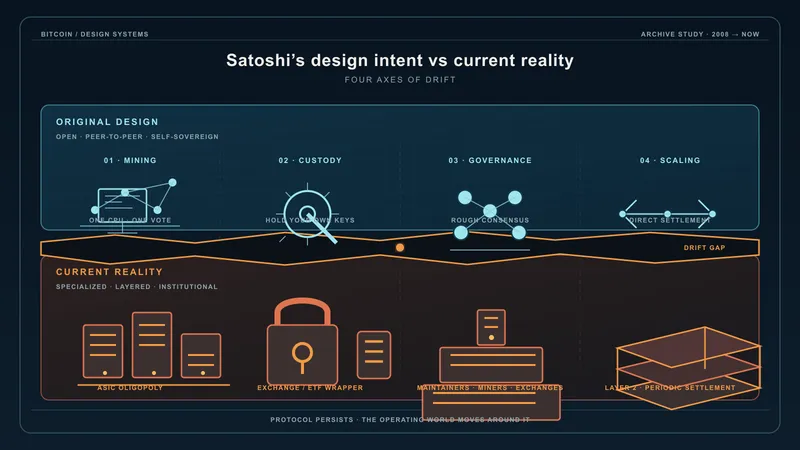
Trammell’s question — what stops the single most powerful node from dominating coin generation — is the same centralization scenario the archive’s analysis of Satoshi’s design against current reality traces from the whitepaper’s “one-CPU-one-vote” principle through the GPU and ASIC mining that eventually concentrated it.