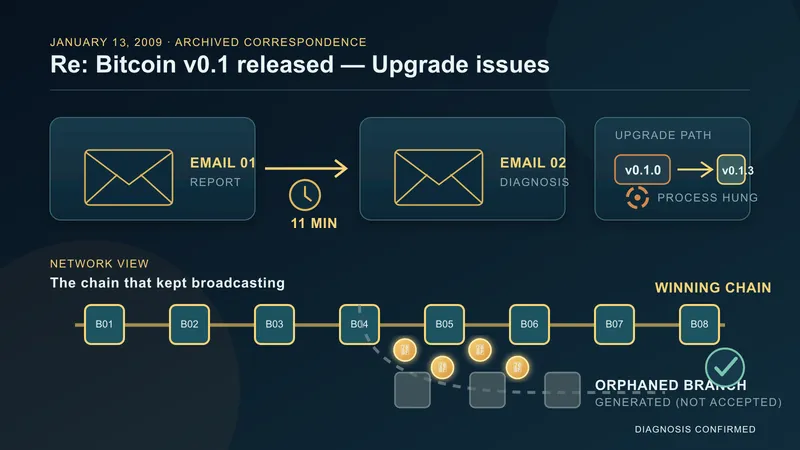

In this email, Satoshi discussed a communications bug, now fixed in version 0.1.3, that had prevented nodes from properly broadcasting blocks. He then offered to send Trammell some coins:
Satoshi Nakamoto (email to Dustin Trammell, January 13, 2009, 7:55:20 AM UTC)This is all fixed in 0.1.3. If you give me your IP, I’ll send you some coins.
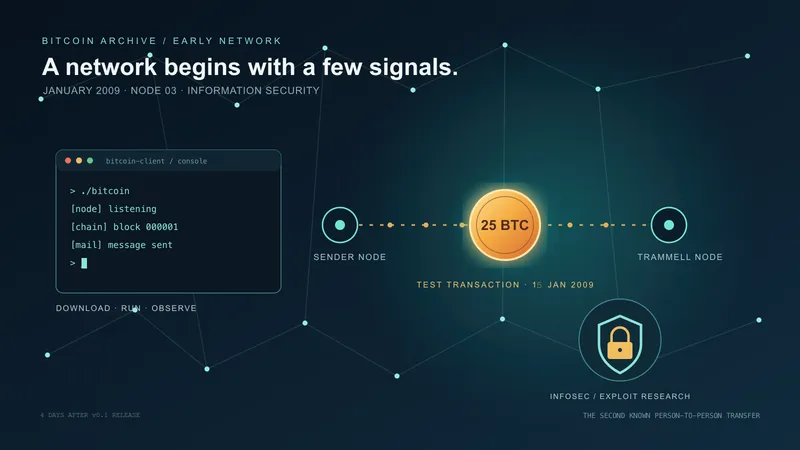
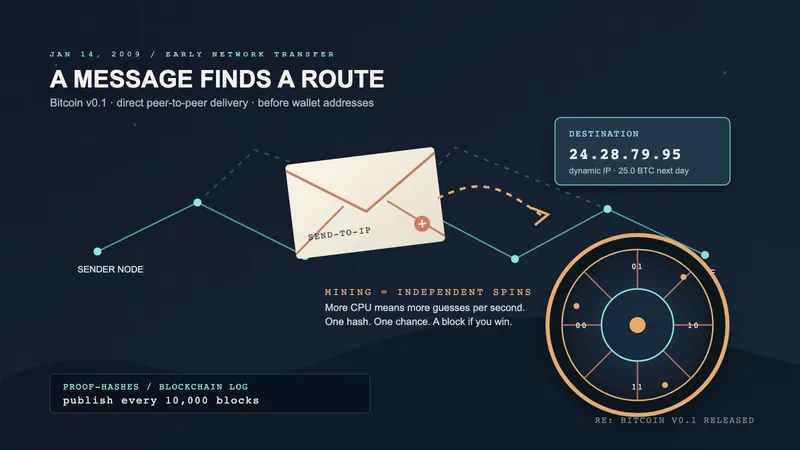
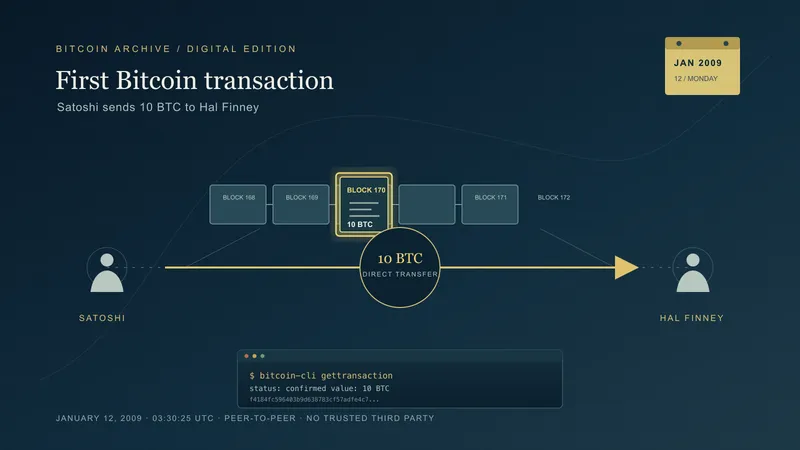
This message is significant because it documents one of the very earliest direct Bitcoin transfers between individuals, coming the day after Satoshi’s first such transfer, 10 BTC sent to Hal Finney in Block 170. Satoshi used the “send-to-IP” feature, which allowed coins to be sent directly to a node by connecting to its IP address. The receiving client would then provide a Bitcoin address for the transaction.
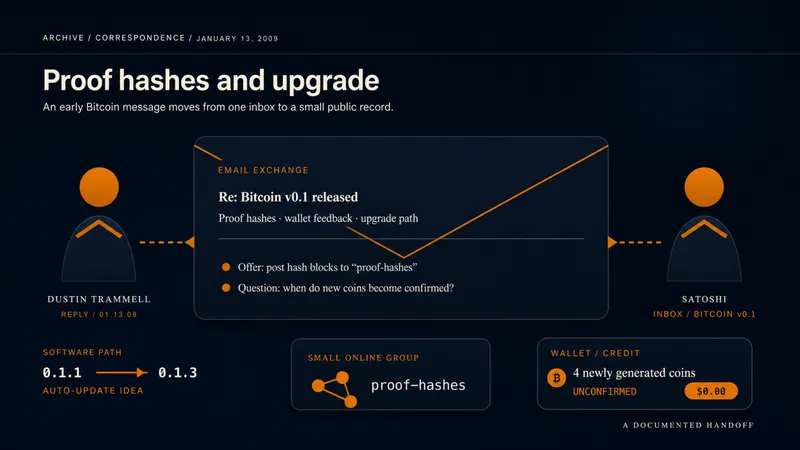
The reply also settled a question Trammell had raised about how the wallet would display a generated coin once it matured: “The existing transaction line will change.”
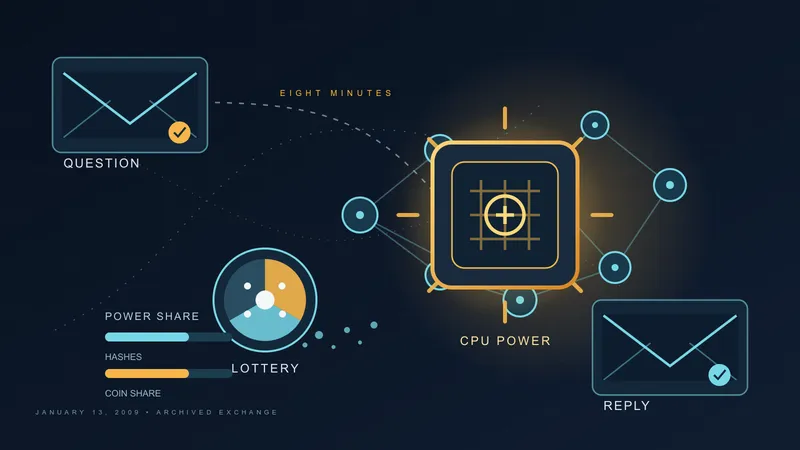
The same email also answered a question Trammell had raised four hours earlier, eight minutes after his upgrade-issue report: what stops the single most powerful node from generating and keeping the majority of the coins?
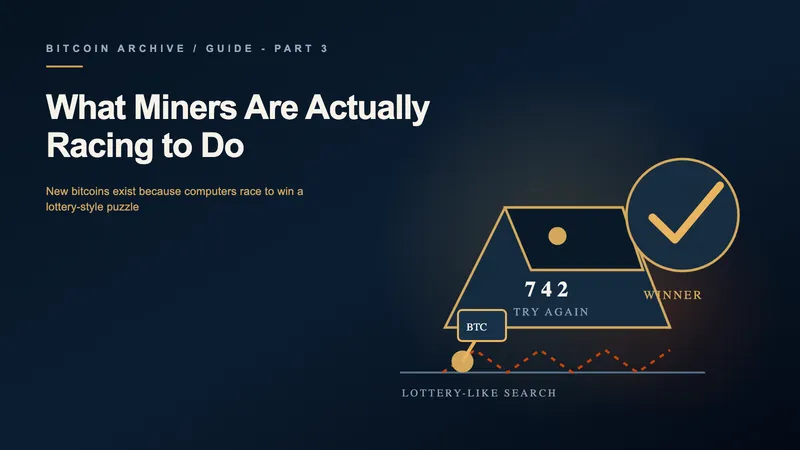
Satoshi NakamotoIt’s not like a race where if one car is twice as fast, it’ll always win. It’s an SHA-256 that takes less than a microsecond, and each guess has an independent chance of success. Each computer’s chance of finding a hash collision is linearly proportional to it’s CPU power. A computer that’s half as fast would get half as many coins.
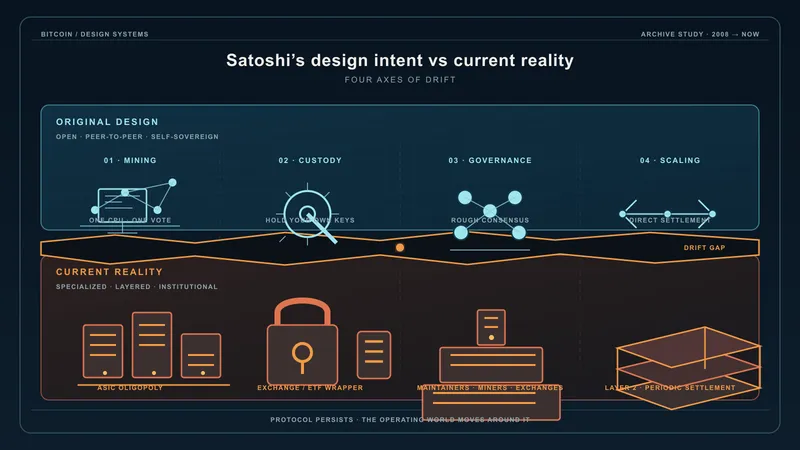
This is the same proportional-lottery mechanic the archive’s beginner-oriented mining guide walks through from scratch, and the same “one-CPU-one-vote” principle the design-vs-current-reality analysis traces forward into the GPU and ASIC mining that eventually concentrated the network Trammell had asked about.
Trammell replied with his IP address:
Dustin Trammell (email to Satoshi, January 14, 2009, 12:40:28 AM UTC)I’m currently at 24.28.79.95, but that’s dynamic so it may change.
In the same reply, Trammell also weighed Bitcoin’s early value proposition and likened mining to a roulette wheel.
The next day, in block 524 at 01:46 UTC on January 15, 2009, Satoshi sent Trammell 25.0 BTC in a single transaction (txid: d71fd2f64c0b34465b7518d240c00e83f6a5b10138a7079d1252858fe7e6b577). The wallet record Trammell published in 2022 dates it 1/14/2009 19:46, the same moment in his own time zone, from “Satoshi” to his IP address 24.28.79.95. This transaction was sent from address 1Jhk2DHosaaZx1E4CbnTGcKM7FC88YHYv9 to Trammell’s address 1DCbY2GYVaAMCBpuBNN5GVg3a47pNK1wdi.
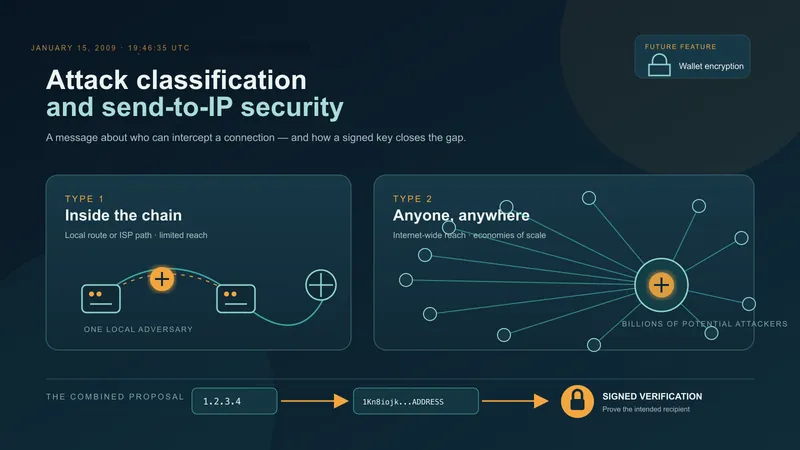
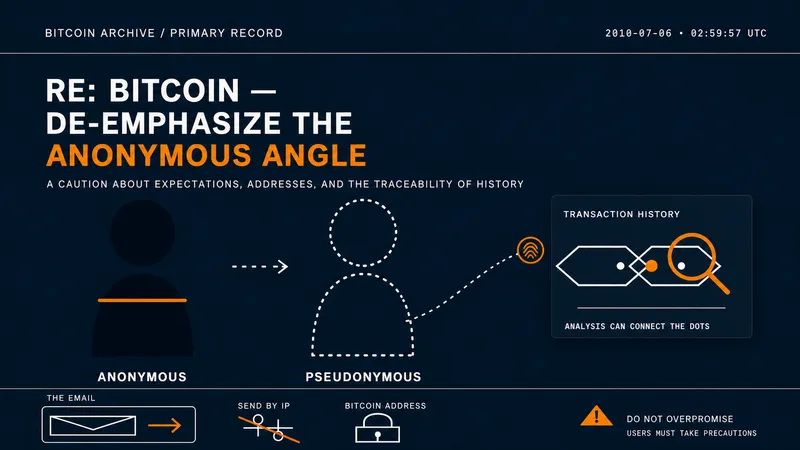
Their subsequent correspondence also touched on the vulnerabilities of sending bitcoin by IP address. By mid-2010 Satoshi was writing to Martti Malmi of “the popularity of bitcoin addresses instead of sending by IP”.
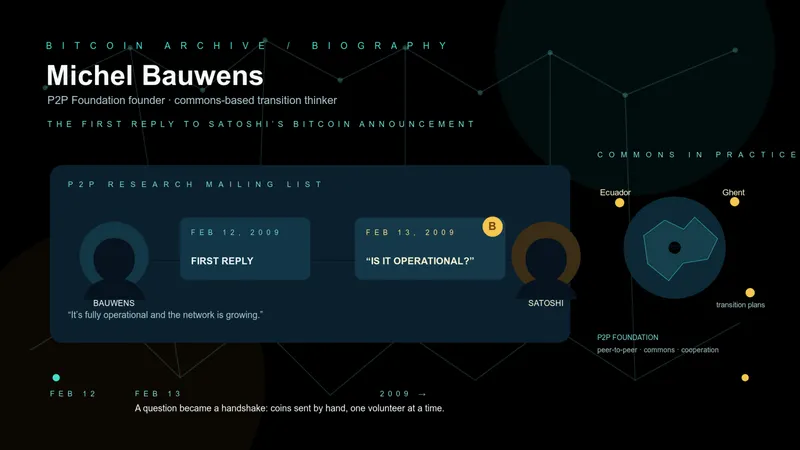
The same by-hand, ask-and-receive distribution pattern recurred a month later, when Michel Bauwens asked whether Bitcoin was operational and got an identical offer.