
On February 8, 1995, Finnish police came to Johan Helsingius with a warrant. He ran anon.penet.fi, the best known anonymous remailer in the world, and they wanted the real address behind one of its numbered accounts. Helsingius managed to hand over only that one, not his whole database of 200,000. Within an hour, he later said, he was told the name had reached the Church of Scientology, which had asked for it.
Over the next sixteen years a file-sharing index, a privacy network, a gold currency and a silver one met the same kind of end. Each had a place where a warrant, an injunction, a raid or a board decision could land, and each was stopped there. When Satoshi Nakamoto named the pattern in November 2008, he named one of them.
A list of names (1993–1996)
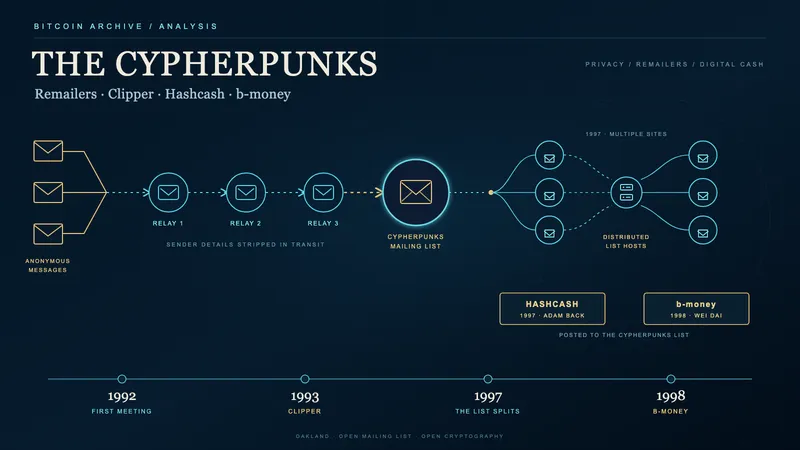
Helsingius started the remailer in 1993, out of an argument in a Finnish newsgroup over whether people should have to tie their real names to what they wrote online. Anyone who mailed it got an address of the form anxxxxx@anon.penet.fi, posted under it, and received replies through it. To route those replies, the server had to keep a list mapping each number to a real address. Every user’s anonymity rested on that one list.
The church’s interest began in January 1995, when its lawyer asked Helsingius to block the remailer from alt.religion.scientology, where church documents were being posted; he answered that monitoring postings was impossible. On February 2 a church representative asked for the identity behind one address. He refused, and six days later the police arrived.
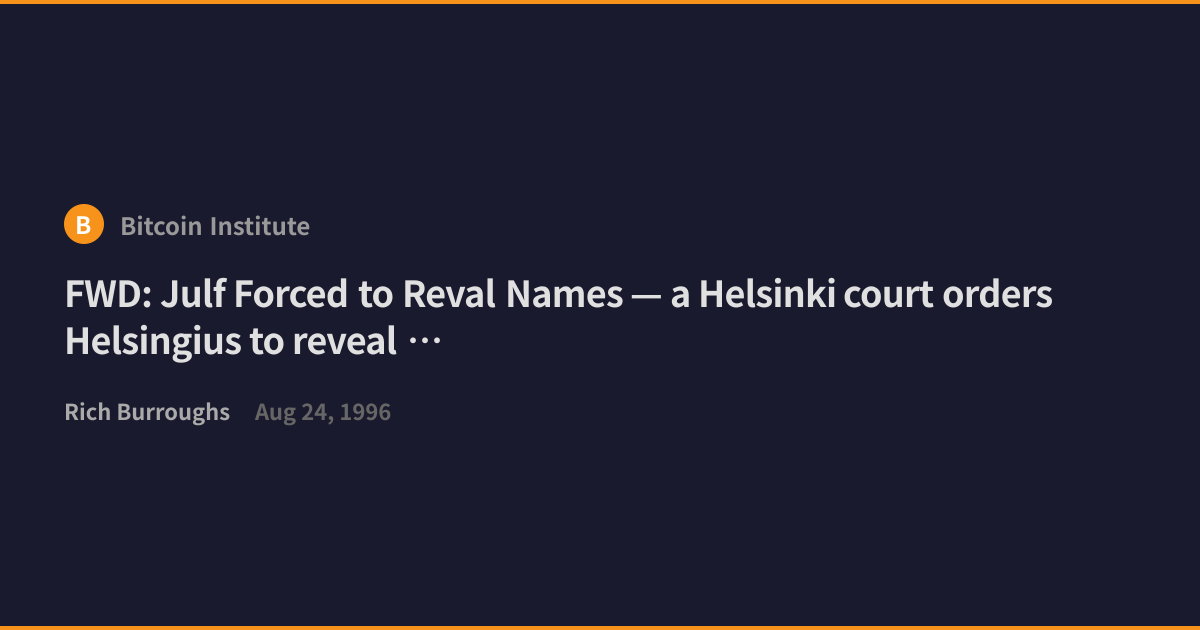
On August 22, 1996, a Helsinki court ordered Helsingius to reveal an address the police wanted, within 30 days of being summoned, on pain of repeated fines and up to six months in jail. Eight days later he closed the remailer. His press release counted “over half a million users” and gave the reason: “the legal issues governing the whole Internet in Finland are yet undefined.”
The index (1999–2001)
Napster, launched in June 1999, never held anyone’s music. It held the list. When users logged in, the names of the MP3 files on their disks went up to Napster’s servers and joined what the Ninth Circuit called a “collective directory.” A search ran against the server’s “search index,” and the server passed along the Internet address of the computer holding the file. In its February 12, 2001 ruling the court found that Napster “has the ability to locate infringing material listed on its search indices, and the right to terminate users’ access to the system.” Use peaked that month at 26.4 million users. In early July 2001, under the injunction, Napster shut down its entire network.
The year before, on March 14, 2000, programmers at Nullsoft, an AOL subsidiary, had put up Gnutella, an open-source program that did the same job with no server at the center: it could not be shut down by shutting down any one node. AOL’s Winamp unit called it “an unauthorized freelance project,” and the site came down within hours. By then, Salon reported, the program was “already being widely passed around.”
The servers (1998–2004)
Zero-Knowledge Systems of Montreal announced its Freedom network in 1998. Subscribers paid about $50 a year to route their traffic through the company’s encrypted servers. On October 22, 2001, the network went dark, and no court was involved. The company called it “purely a business decision”: subscriptions had fallen off, and the servers were the company’s to switch off.
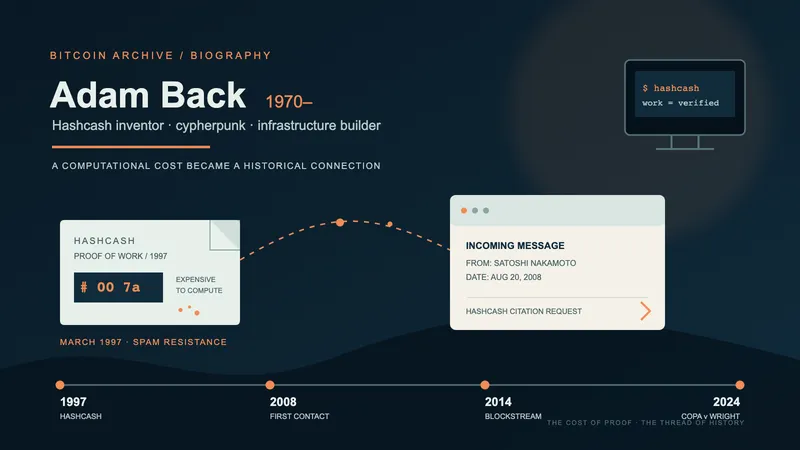
Adam Back, who had worked on anonymity designs at ZKS, later wrote that “ToR is a newer re-implementation of their freedom network.” The 2004 Tor design paper put the difference in its own terms. A single-hop proxy concentrates traffic at “this single point” and is vulnerable “if the adversary can observe all traffic entering and leaving the proxy.” In circuit-based designs like Tor, run on a volunteer-based network, a circuit crosses several servers and “no single server can link a user to her communication partners.” Tor still kept a small set of trusted directory servers to tell clients which routers existed.
Gold and silver (1996–2011)
Douglas Jackson, an oncologist, began coding e-gold at night in early 1996 and launched it four months later: an account currency the company said was fully backed by gold bullion. By 2005 it had about 3.5 million accounts in 165 countries. On April 24, 2007, a federal grand jury indicted the company, its affiliate Gold & Silver Reserve and its three directors. On July 21, 2008, the two companies pleaded guilty to conspiracy to launder money and conspiracy to run an unlicensed money transmitting business, and Jackson to the money-laundering conspiracy and to running such a business. The Justice Department’s case was that e-gold had never registered as a money transmitter, leaving criminals free to use it “essentially anonymously.” That November Jackson was sentenced to three years of supervised release, six months of it under house arrest.
Satoshi saw the e-gold systems from the side of spam. In a January 2009 email he noted that one of them already had “dusting,” spammers sending “a tiny amount of gold dust” to put a message in the comment field. In March 2010 on BitcoinTalk, a user reminded the forum that state money transmitting licenses were “what killed Goldage,” one of the largest e-gold exchangers.
Bernard von NotHaus created the Liberty Dollar in 1998: silver medallions struck by a private mint, and paper notes the group said were backed by silver in reserve. In September 2006 the U.S. Mint warned that using them as circulating money was a federal crime. Early on November 14, 2007, federal agents raided the headquarters, in a strip mall in Evansville, Indiana. In von NotHaus’s email to customers, they took the gold, silver and platinum, nearly two tons of newly delivered Ron Paul dollars, all the files and all the computers, and froze the bank accounts: “We have no money. We have no products. We have no records to even know what was ordered or what you are owed.”
On March 18, 2011, a jury in Statesville, North Carolina, convicted him of making coins resembling U.S. coins and of conspiracy against the United States. Announcing the verdict, the U.S. Attorney called attempts to undermine the currency “a unique form of domestic terrorism.”
The sentence (2008–2009)
Six days after the whitepaper went out, two lines from an unidentified writer arrived in a quotation: “You will not find a solution to political problems in cryptography.” Satoshi answered, “Yes, but we can win a major battle in the arms race and gain a new territory of freedom for several years,” and added:
Satoshi Nakamoto (Cryptography mailing list post, November 06, 2008, 8:15:40 PM UTC)Governments are good at cutting off the heads of a centrally controlled networks like Napster, but pure P2P networks like Gnutella and Tor seem to be holding their own.
Three months later he read money the same way. Of Chaum’s systems he wrote, “when the central company shut down, so did the currency.” Of the e-currency companies that had failed since the 1990s: “I hope it’s obvious it was only the centrally controlled nature of those systems that doomed them.”
The record above bears that out, with one correction: not every head was cut off by a government. Freedom was not. Its owner switched it off, and it belongs on the list for the same reason as the rest: there was someone who could. The list of names, the index, the company’s servers, the vault were each a place, and it was the place that was stopped. Gnutella was out of AOL’s hands within hours, and Tor, Satoshi’s own example, still kept its directory servers. Bitcoin’s design is this list turned into a requirement: no part of it was to be a place anyone could stop.