
At 8.30 pm on Thursday, September 13, 2007, BBC News 24 reported that Northern Rock, a British mortgage bank, was to get emergency support from the Bank of England. The help was real and had not yet been announced. By the next morning, people were queuing outside its branches to take their money out, and they kept coming until Monday evening, when the Chancellor of the Exchequer promised that every deposit in the bank would be paid. The House of Commons Treasury Committee opened its report on those four days with one sentence:
(House of Commons Treasury Committee, The run on the Rock, January 2008)The period from Friday 14 September 2007 to Monday 17 September saw the first run on the retail deposits of a United Kingdom bank since Victorian times.
The announcement that came too early
Northern Rock’s funding model depended on packaging its mortgages into securities and selling them, and its next sale was due in September 2007. When the inter-bank and other markets froze on August 9, it faced severe problems if they stayed frozen for long. By Monday, September 10, the Bank of England’s support was settled as necessary, and by Tuesday it was clear it would have to be announced. The plan was to announce it the following Monday, after a weekend spent widening the bandwidth of the bank’s website and arranging how to handle its customers.
Rumours started on the afternoon of Thursday the 13th. At 4.00 pm the authorities moved the announcement to 7.00 am on Friday, and the BBC report came first, that evening. The run, in the committee’s words, “started on the evening of 13 September” and “accelerated the following day.”
Seventy-two branches
Most of the money left by internet, telephone and post. What stayed in public memory were the queues. Northern Rock had 72 branches in all and only four in London; many had a couple of counters, because it did little retail business over the counter, and anti-money-laundering checks could make a large withdrawal take up to 15 minutes. It did not take many customers, the committee wrote, for queues to reach “out of the front door and into the street—and into the public consciousness.”
Many depositors also learned something they may not have known: deposits above £2,000 were not guaranteed in full.
”Perfectly rational”
Three days after the run ended, on September 20, the Governor of the Bank of England, Mervyn King, was asked by the committee whether savers had simply stopped trusting the authorities. He said no:
Mervyn King (evidence to the House of Commons Treasury Committee, September 20, 2007)The behaviour of depositors in Northern Rock was, in my judgment, a consequence of a perfectly rational interpretation of what the end game might be. It was not so much a question of trust. Once the depositors of Northern Rock had heard the bad news and they suddenly realised that Northern Rock needed a lender of last resort facility—this is the problem with an overt operation—once they had seen that there was bad news about Northern Rock, and they could not possibly be reasonably expected to have been sitting at home thinking about the wholesale funding structure of Northern Rock, once they learned that there was concern about Northern Rock it is not that surprising that they thought perhaps it might be safer to take some money out.
Northern Rock’s own Chief Executive, Adam Applegarth, did not blame them either, when the committee heard him on October 16:
Adam Applegarth (evidence to the House of Commons Treasury Committee, October 16, 2007)I can understand readily the logic of somebody who has their life savings invested in an institution and who sees pictures of people queuing outside the door and they go and join that queue. That is quite a logical reaction.
The guarantee
The Governor told the committee that the only way to halt the run was a government guarantee of the deposits. Alistair Darling, the Chancellor, “became convinced” of it on Sunday the 16th. He announced it after 5.00 pm on Monday, at a press conference with U.S. Treasury Secretary Hank Paulson:
Alistair Darling (HM Treasury statement, September 17, 2007)(House of Commons Treasury Committee, The run on the Rock, January 2008)In the current market circumstances, and because of the importance I place on maintaining a stable banking system and public confidence in it, I can announce today that following discussions with the Governor and the Chairman of the FSA, should it be necessary, we, with the Bank of England, would put in place arrangements that would guarantee all the existing deposits in Northern Rock during the current instability in the financial markets. This means that people can continue to take their money out of Northern Rock. But if they choose to leave their money in Northern Rock, it will be guaranteed safe and secure.
The announcement late on Monday 17 September had the desired effect. The momentum of the run was halted.
The committee’s report, ordered to be printed on January 24, 2008, named the bank’s directors “the principal authors of the difficulties that the company has faced since August 2007”: they had “pursued a reckless business model which was excessively reliant on wholesale funding.” It added that the Financial Services Authority had “systematically failed in its regulatory duty.”
The same Chancellor
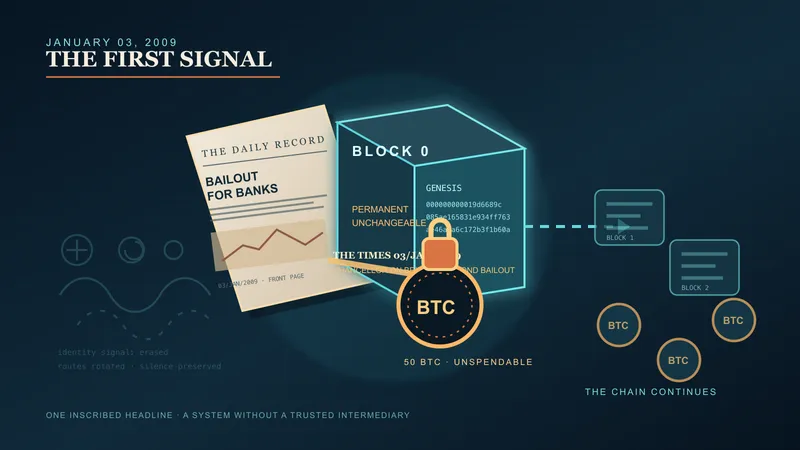
Fifteen months after the queues, the Chancellor in the headline Satoshi put into Bitcoin’s first block was the same Alistair Darling, now “on brink of second bailout for banks.” The record does not tie Northern Rock to Bitcoin’s design, and nothing Satoshi wrote in this archive names it. Five weeks after the block, announcing Bitcoin on the P2P Foundation forum, he wrote about banks this way:
Satoshi Nakamoto (P2P Foundation forum post, February 11, 2009, 10:27:00 PM UTC)Banks must be trusted to hold our money and transfer it electronically, but they lend it out in waves of credit bubbles with barely a fraction in reserve.
King said the run was “not so much a question of trust.” I take him at his word, and that is what makes his answer hard. Northern Rock’s depositors were not panicking; they were doing the sum correctly. A bank that holds only a fraction of what it owes cannot pay everyone who asks at once, and what ended the run was not a better sum but a Chancellor standing up to say the state would pay instead. That is the arrangement Satoshi named. He designed a money that needs no one to hold your coins for you: there is no fraction to run on unless you hand your coins to someone who keeps one.