
At 9 p.m. on Sunday, August 15, 1971, Richard Nixon spoke from the Oval Office, live on radio and television. He announced a 90-day freeze on all wages and prices, a temporary 10 percent tax on imports, and, in a few sentences in the middle, the end of what had tied the world’s money to gold: the right of foreign governments to turn dollars into gold at the U.S. Treasury. He used the word “temporarily.” The window never reopened, and the evening is remembered as the Nixon shock.
Three fronts, one of them the dollar
He framed the evening as “the challenge of peace,” with three targets: unemployment, inflation, and international speculation. The first two took most of the address, with an investment tax credit, the repeal of the excise tax on cars, and the freeze. The third came last, and it came with a villain:
Richard Nixon (Address to the Nation, August 15, 1971)In the past 7 years, there has been an average of one international monetary crisis every year. Now who gains from these crises? Not the workingman; not the investor; not the real producers of wealth. The gainers are the international money speculators. Because they thrive on crises, they help to create them.
In recent weeks, the speculators have been waging an all-out war on the American dollar. The strength of a nation’s currency is based on the strength of that nation’s economy—and the American economy is by far the strongest in the world. Accordingly, I have directed the Secretary of the Treasury to take the action necessary to defend the dollar against the speculators.
The sentence that closed the gold window
The action itself took one sentence. Under the Bretton Woods arrangement, other currencies were pegged to the dollar and the dollar to gold, so this sentence reached past American money to every currency fixed against it:
Richard Nixon (Address to the Nation, August 15, 1971)I have directed Secretary Connally to suspend temporarily the convertibility of the dollar into gold or other reserve assets, except in amounts and conditions determined to be in the interest of monetary stability and in the best interests of the United States.
Nixon called it “very technical,” and then spoke to the listener at home directly:
Richard Nixon (Address to the Nation, August 15, 1971)Now, what is this action—which is very technical—what does it mean for you?
Let me lay to rest the bugaboo of what is called devaluation.
If you want to buy a foreign car or take a trip abroad, market conditions may cause your dollar to buy slightly less. But if you are among the overwhelming majority of Americans who buy American-made products in America, your dollar will be worth just as much tomorrow as it is today.
The effect of this action, in other words, will be to stabilize the dollar.
Nowhere in the address does the word “gold” come up again. He went on to the import tax, promising it would end “when the unfair treatment is ended,” and to a pledge to work with the International Monetary Fund toward “an urgently needed new international monetary system."
"Temporarily”
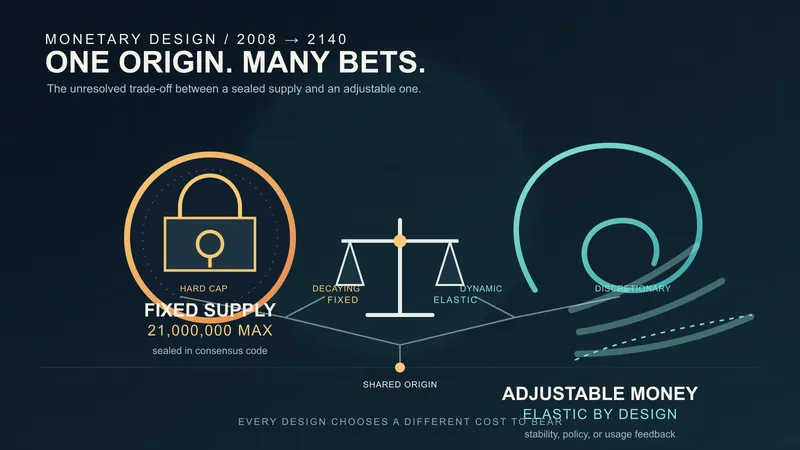
Convertibility was never restored. Attempts to rebuild fixed parities failed, and by 1973 floating exchange rates had in effect replaced the Bretton Woods system. The gold window was the last of three turns in the dollar’s relation to gold that came from the President; the fiat baseline in the fixed-supply analysis sets all three side by side.
What the dollar would buy from then on was decided by the people who set American monetary policy, with no gold conversion left to answer to abroad. By the consumer price index, prices in 2025 averaged nearly eight times their 1971 level: 321.943 against 40.5.
What Satoshi wrote
Nothing in the Satoshi writings collected in this archive names Nixon, 1971 or Bretton Woods. What he did write, announcing Bitcoin on the P2P Foundation forum in February 2009, was the general case:
Satoshi Nakamoto (P2P Foundation forum post, February 11, 2009, 10:27:00 PM UTC)The root problem with conventional currency is all the trust that’s required to make it work. The central bank must be trusted not to debase the currency, but the history of fiat currencies is full of breaches of that trust.
Nixon asked for exactly that trust, on live television, in the same breath as he removed the last check on it. He was talking about one action and one day’s prices, and he said so. The sentence he left behind is “your dollar will be worth just as much tomorrow as it is today,” and I hold it up against every tomorrow since. Bitcoin’s answer was to stop asking for the promise at all: a supply schedule written into code that no address to the nation can suspend, temporarily or otherwise.