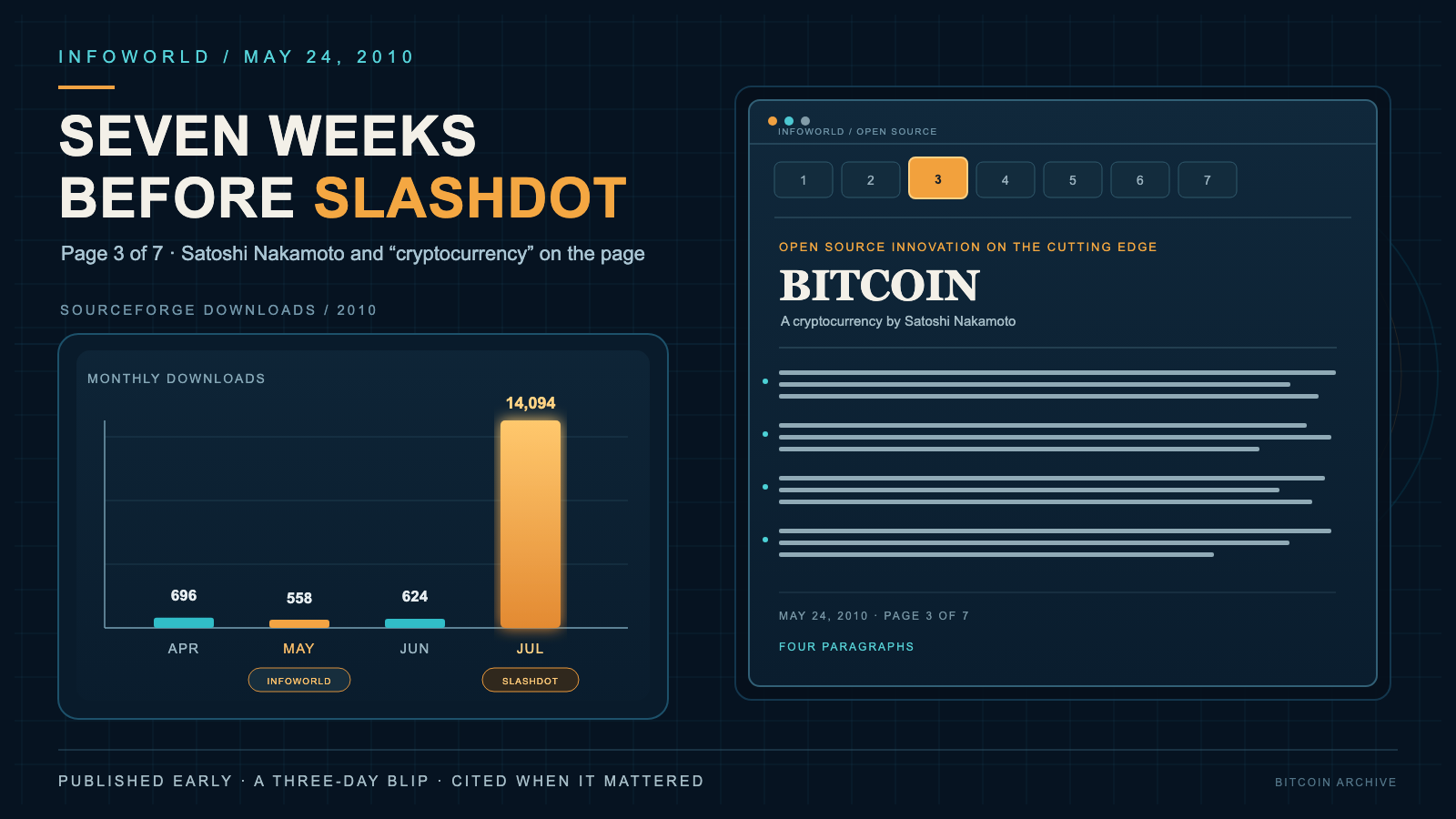
On May 24, 2010, InfoWorld ran “Open source innovation on the cutting edge,” Neil McAllister’s seven-page roundup of open-source projects he thought were doing something new. Bitcoin got page three, four paragraphs between Bespin and eyeOS. The first of them named its creator and the word he had chosen for it:
Alternative currencies for e-commerce have been attempted many times, but never one quite like Bitcoin. Its creator, Satoshi Nakamoto, has dubbed it a “cryptocurrency,” because it relies on public/private key cryptography to facilitate electronic trading in a completely anonymous, secure, peer-to-peer fashion.
That is a technology magazine putting Satoshi Nakamoto’s name in front of its readers seven weeks before the Slashdot post that Blockworks, in a 2025 retrospective, called “widely regarded as the first instance of a major media platform publicizing Bitcoin.”
What the four paragraphs got right, and what they got wrong
Most of the sketch holds up. There were no dedicated servers and no central authority; the “banking” functions were spread across the nodes of a peer-to-peer network. McAllister framed the supply question as “a kind of digital ‘gold standard,’” said coins were created by contributing CPU cycles, noted that no one could veto a trade and no middleman took a fee, and closed on the line that “it’s not just the Bitcoin software that’s open source — so is the currency.”
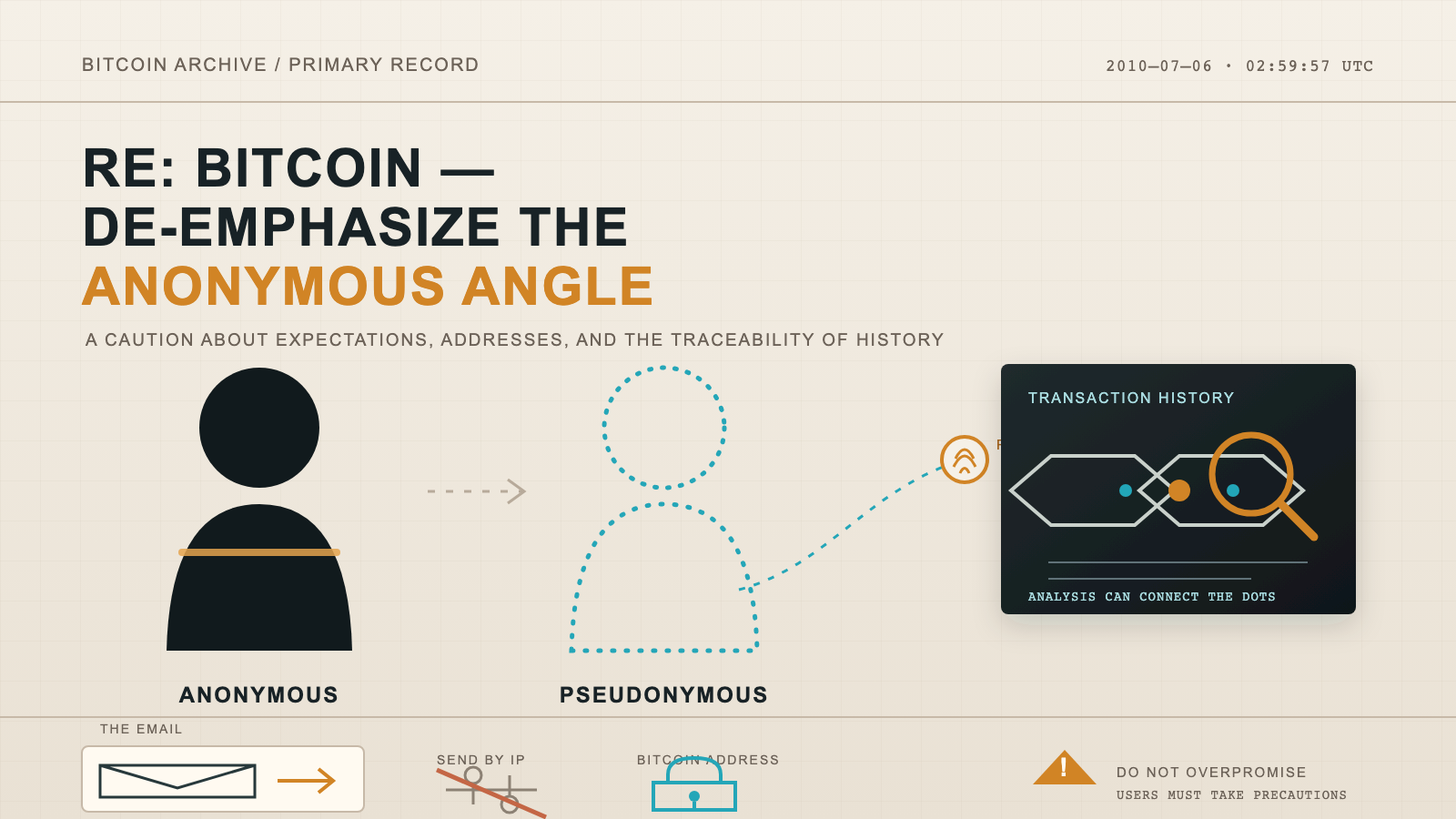
Two details were wrong. The CPU cycles, he wrote, “are used to solve calculations for grid computing projects.” They were not. A Bitcoin node spent its cycles hashing block headers in search of a proof of work, and a successful search produced a new block of Bitcoin’s own transactions, not an answer to anyone else’s problem. And the trading was not “completely anonymous.” Six weeks later, in an email to Martti Malmi about the bitcoin.org homepage, Satoshi wrote that “we can’t give the impression it’s automatically anonymous.” The email is about the homepage, and nothing in it points to InfoWorld. It is the same system, described by the magazine as something it was not and by its author as something it could only be with care.
Three busy days in May
SourceForge’s download counter for the Bitcoin project gives a plain measure of what the article did. In the two weeks before it, the software was downloaded between 1 and 30 times a day. On May 24 the count was 32, on May 25 it was 86, the busiest day of the month, and on May 26 it was 40. By May 27 it was back to 16. Two days in April had run higher still, 95 and 117, for reasons the record does not show. May as a whole ended at 558 downloads, below April’s 696.
Slashdot’s item, seven weeks later, drew 755 downloads the day it ran and 4,253 the next. July closed at 14,094.
The archived copy of the InfoWorld page shows three of its six reader comments, posted on May 24 and 25. All three argue about open source in general. None mentions Bitcoin.
Where the article turned up again
Satoshi mentioned it once in the record this archive holds. On July 20, with Bitcoin’s Wikipedia article nominated for deletion, he asked the forum to search Google for Bitcoin and find “more big references in addition to the infoworld and slashdot ones.”
I read that sentence as the moment the InfoWorld piece finally did its work. In May it bought three busy days on SourceForge and nothing after. Two months later, when what Bitcoin needed was proof that someone outside the forum had written about it, Satoshi counted it as one of the two. An article whose readers came and went in three days can still end up as evidence that what it described was real.