A 56-bit collision in MD5 — D. J. Bernstein (March 1997)

% echo 'Try 164.75.184.243.182.11.5.' | md5
4ddfc4cb0ea828bad480ff4d4cc23883
% echo 'Try 143.15.98.74.77.246.235.' | md5
4ddfc4cb0ea8286591e7a1f0ab5fe41c
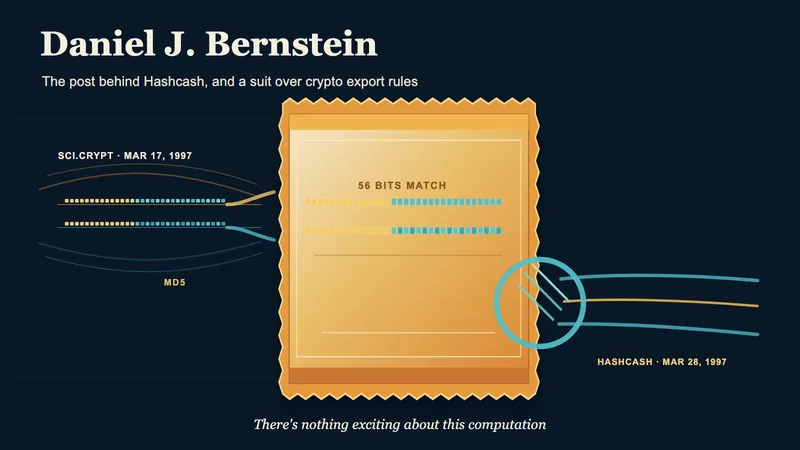
This computation took several hours on a Pentium, using just a few bytes of memory, with standard techniques.
There’s nothing exciting about this computation; I’m simply reacting to a recent claim that square root attacks on structured messages require lots of memory.
---Dan
Let your users manage their own mailing lists. http://pobox.com/~djb/qmail.html
About this record: Google Groups displays 17:00:00 for every post, so the posting time cannot be established. The Message-ID quoted in the March 23 reply is partly redacted, but it starts with 1997Mar17, which confirms the date of this post.
External source: item 1 in the list at the end of the thread

% echo 'Try 164.75.184.243.182.11.5.' | md5
4ddfc4cb0ea828bad480ff4d4cc23883
% echo 'Try 143.15.98.74.77.246.235.' | md5
4ddfc4cb0ea8286591e7a1f0ab5fe41c
This computation took several hours on a Pentium, using just a few bytes of memory, with standard techniques.
There’s nothing exciting about this computation; I’m simply reacting to a recent claim that square root attacks on structured messages require lots of memory.
Could you describe the techniques you used to compute this collision.
Could you post your source code? Or make it available on the web?
Adam
--
print pack"C*",split/\D+/,`echo "16iII*o\U@{$/=$z;[(pop,pop,unpack"H*",<>
)]}\EsMsKsN0[lN*1lK[d2%Sa2/d0<X+d*lMLa^*lN%0]dsXx++lMlN/dsM0<J]dsJxp"|dc`
--
print pack"C*",split/\D+/,`echo "16iII*o\U@{$/=$z;[(pop,pop,unpack"H*",<>
)]}\EsMsKsN0[lN*1lK[d2%Sa2/d0<X+d*lMLa^*lN%0]dsXx++lMlN/dsM0<J]dsJxp"|dc`
About this record: Google Groups displays 17:00:00 for every post, so the posting time cannot be established. The displayed date is March 23.
External source: item 1 in the list at the end of the thread