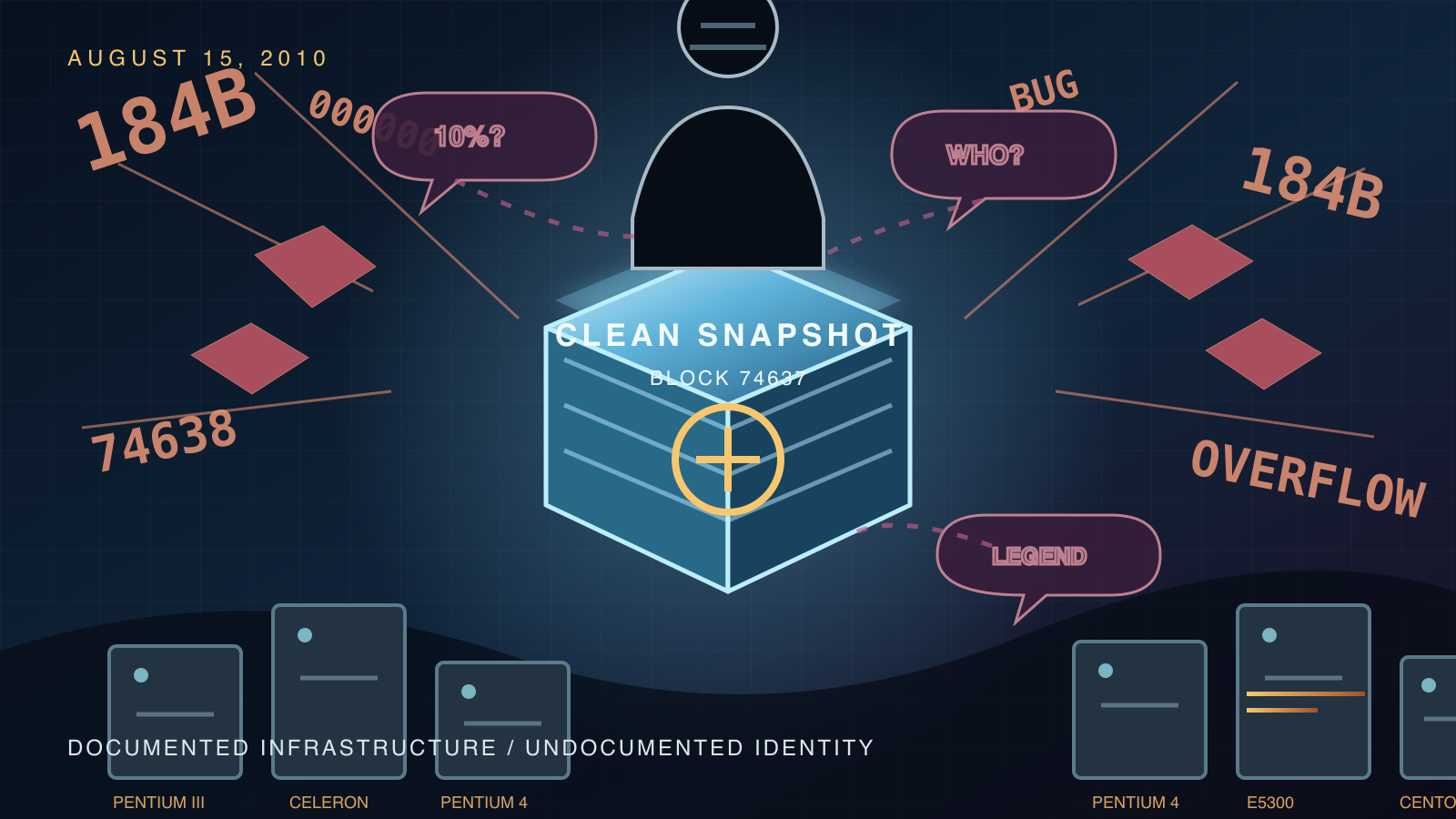
On August 15, 2010, Bitcoin’s blockchain briefly contained 184 billion BTC — about nine thousand times the system’s intended total supply. A fix was out in under six hours, and one of the things the recovery rested on was a clean snapshot of the chain held by a forum regular who went by the name “knightmb.”
Within hours that snapshot would be embedded in the recovery patch. Within years the man behind the handle would be embedded — in secondary sources, at least — in a different chain of events: a federal extortion conviction in Tennessee, a still-circulating claim that he had once held a tenth of all Bitcoin, and a public identification that no court document and no first-person statement actually confirms. This entry collects what the archive’s primary record shows about knightmb, and what the secondary record has done with him.
1. The snapshot that saved Bitcoin’s worst day
The single sentence that anchors knightmb’s place in the technical record sits in Gavin Andresen’s emergency patch announcement on August 15, 2010:
“I started with knightmb’s blockchain snapshot.”
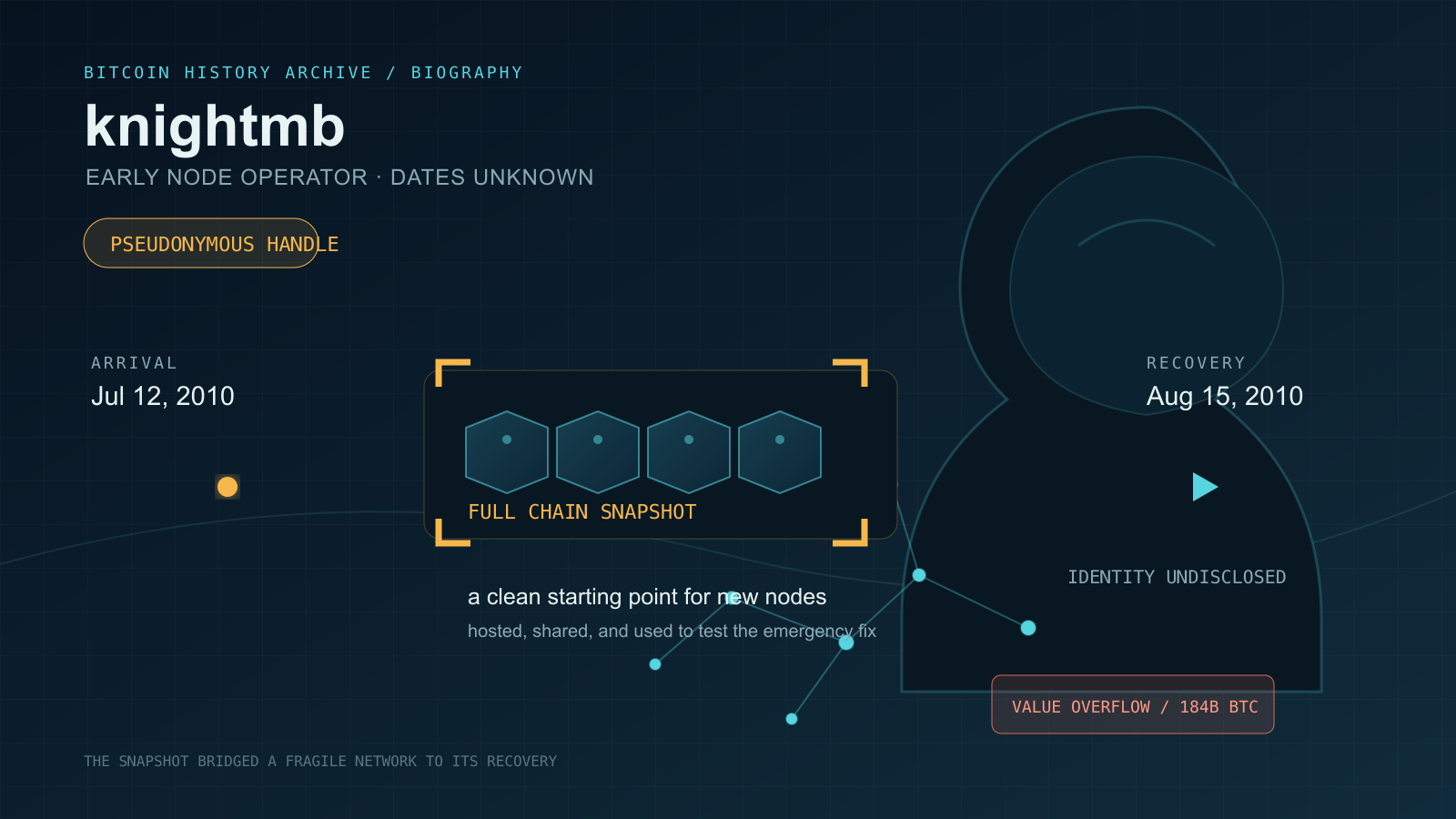
Satoshi himself endorsed the same snapshot publicly less than an hour later, telling the thread at large how to recover: “Once you have an update, you could download knightmb’s block chain. You’ll want one that’s old enough that it ends before block 74000 so the most recent security lockin will check it.” What had been one tester’s shortcut, in that sentence, became a recovery path Satoshi himself was pointing the whole thread toward.
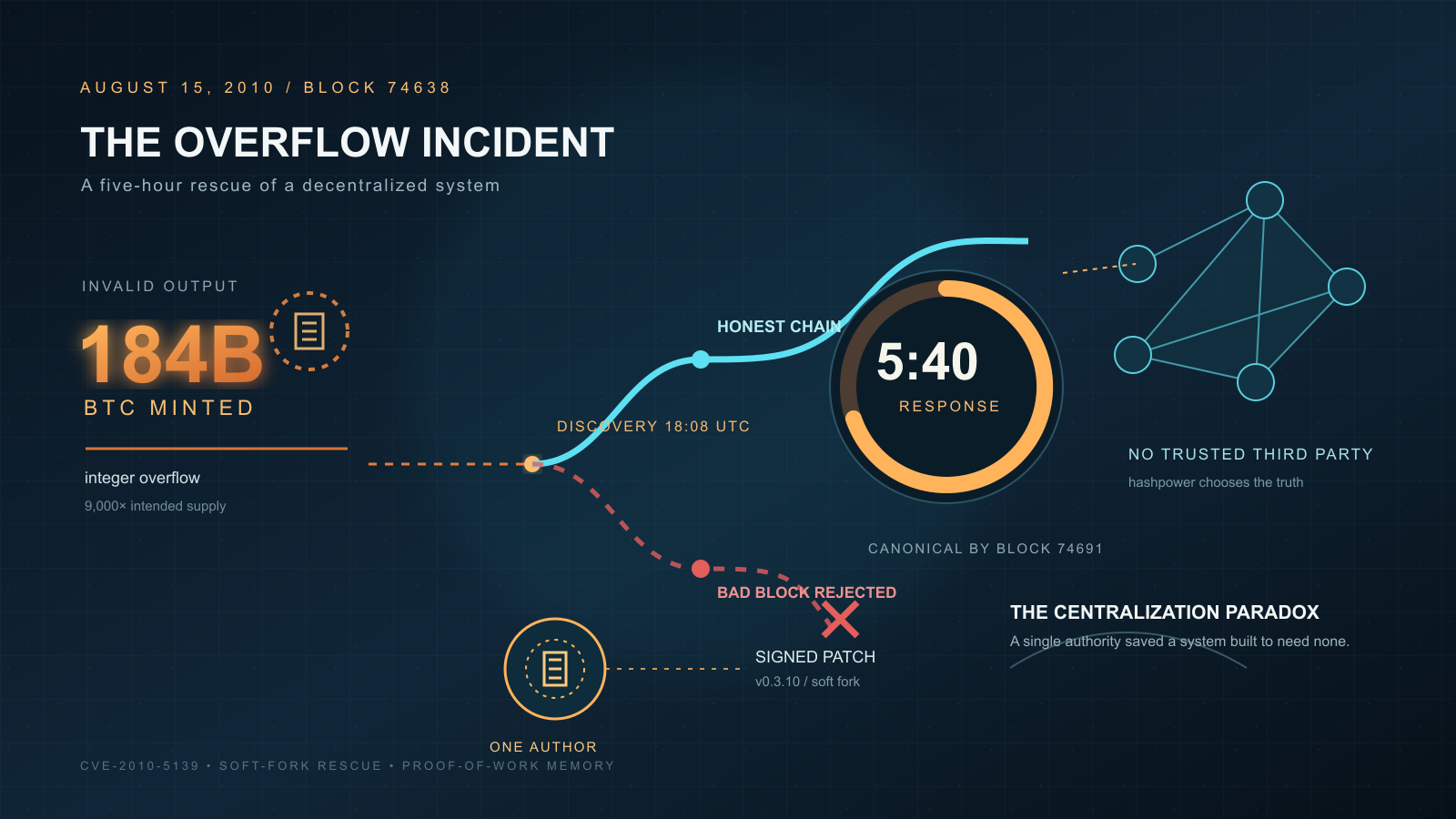
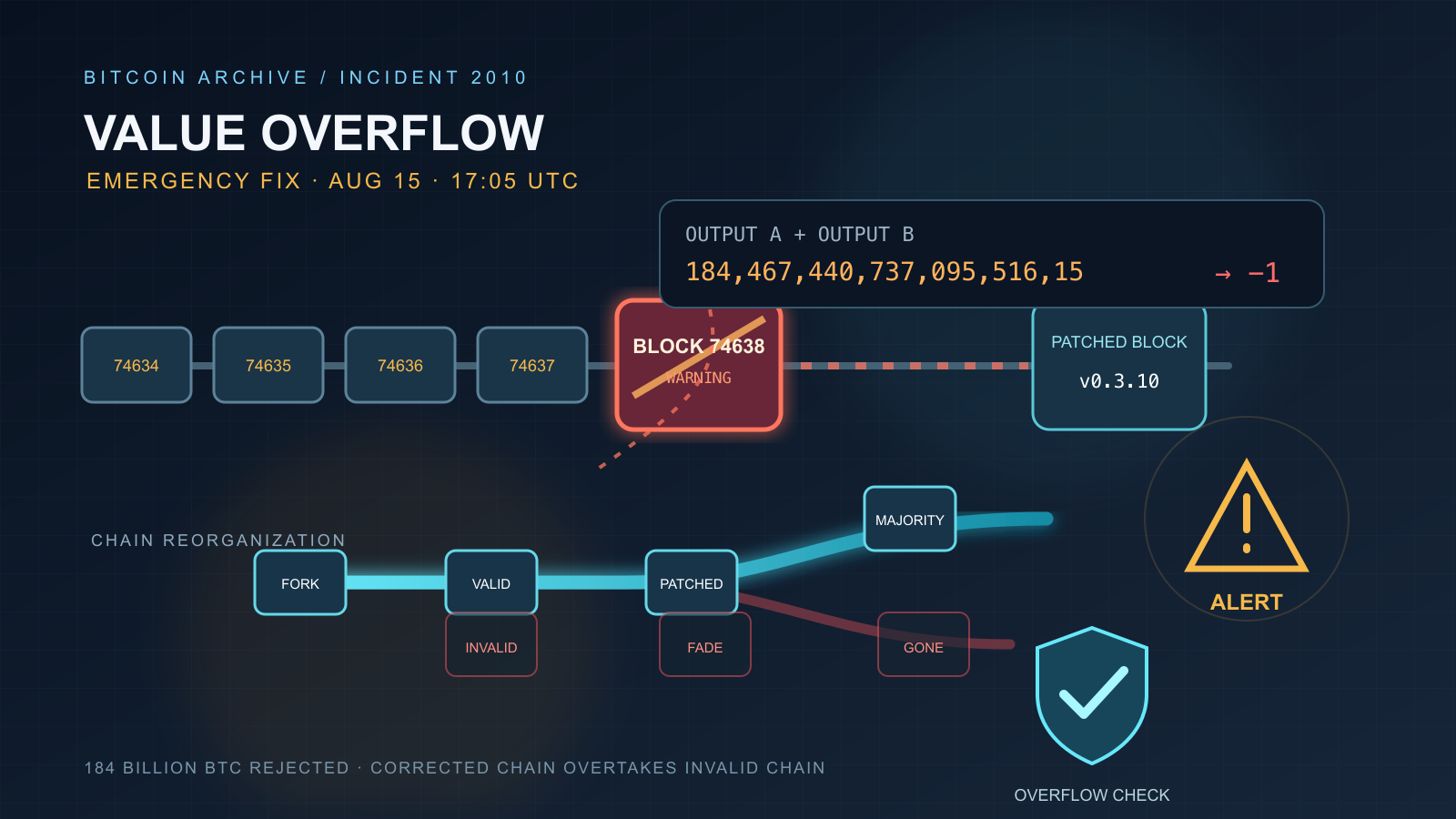
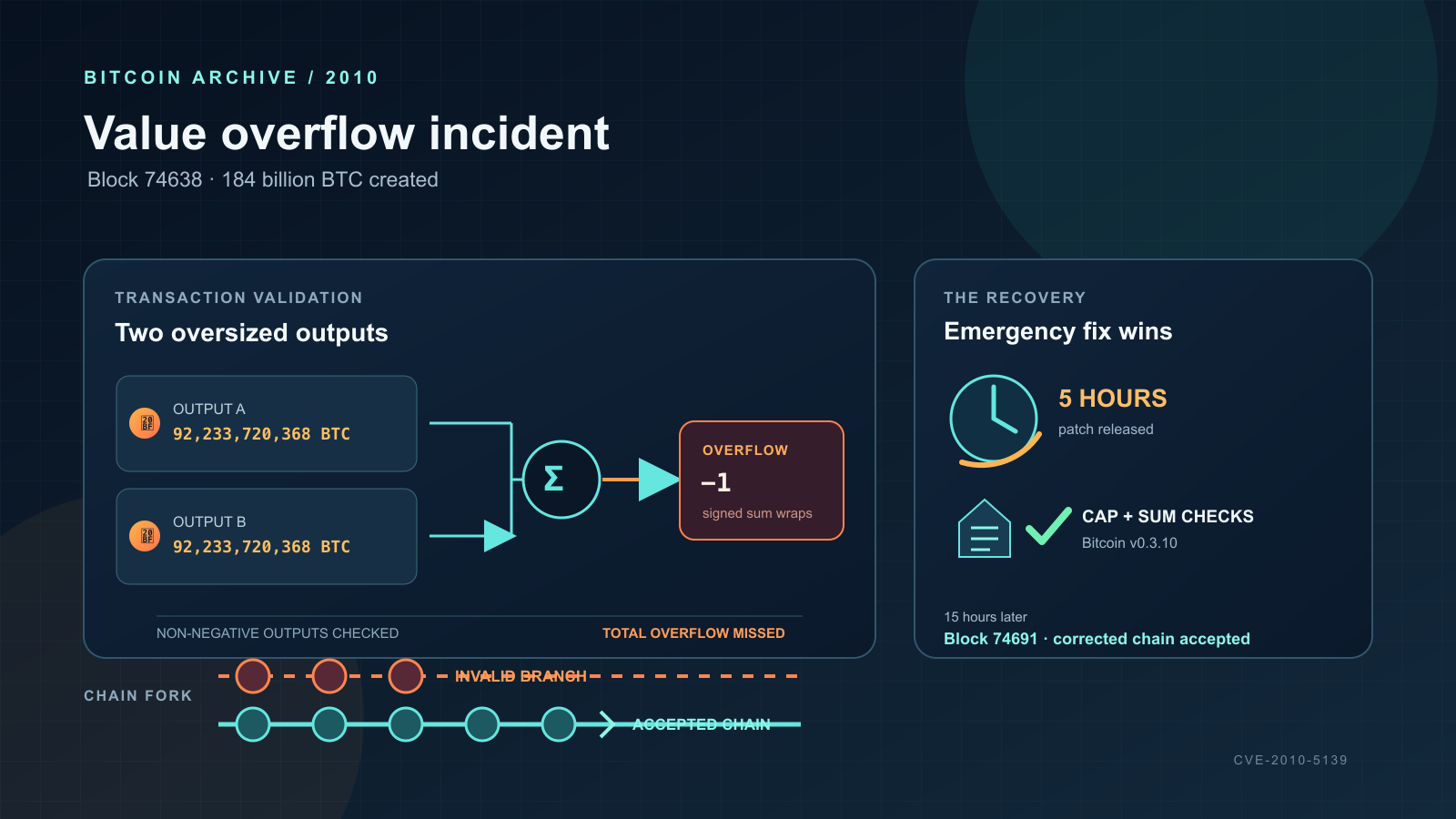
The context is documented in this Archive’s Value overflow incident entry. At approximately 18:08 UTC, Jeff Garzik noticed Block 74638 had created roughly 184 billion BTC out of an integer overflow in the transaction-validation code. Five hours and forty minutes later, Satoshi published Bitcoin v0.3.10 containing a soft-fork patch; in the meantime Gavin Andresen had been testing his own emergency patch in parallel. Both patches required a clean copy of the pre-corruption blockchain — anyone applying them needed to rewind to a block before 74638 and resync from there. With clients across the network already poisoned by the bad block, the question of where to obtain a clean chain was non-trivial.
knightmb had been hosting public blockchain snapshots from his own nodes for weeks before the incident, as a courtesy for new users who didn’t want to wait days for an initial sync. When the overflow hit, those snapshots became the practical recovery substrate. In the same thread, knightmb offered to build a fresh snapshot capped just below block 74,000; Gavin asked him to leave the existing one in place — “Just leave the old one alone! Older is better. The one that you’ve had available for a while has been vetted and is the best choice” — and used it as the starting point for his patch testing.
The patched chain overtook the corrupted chain at block 74691, roughly 14 hours after Garzik’s initial observation. The 184 billion BTC vanished from the canonical history. Among the contributors who made that recovery possible, knightmb’s role was specifically to have already done a small infrastructural thing — keep snapshots — before anyone needed them.
2. The Pentium III army
knightmb’s other recurring thread in the BitcoinTalk record is hardware testing. Where most early miners reported results from a single rig, he reported from many — a Pentium E5300 dual-core, a 3.0 GHz Pentium 4 with hyper-threading off, a 2.8 GHz Pentium 4, multiple 933 MHz Pentium IIIs, an old 1.1 GHz Celeron, a fleet of CentOS machines requiring custom compiles (msg9457, msg6086, msg9614).
He treated the question of “what hardware can run Bitcoin” as a matrix to be filled in, not an opinion to be argued. The reported numbers were small even by 2010 standards, but they came from someone who actually had the machines on hand and ran the binaries.
| Hardware | Reported hash rate |
|---|---|
| Pentium III 933 MHz (multiple units) | 125 khash/s |
| 1.1 GHz Celeron (older) | 172 khash/s |
| 2.8 GHz Pentium 4 | reported across fleet |
| 3.0 GHz Pentium 4 (hyper-threading off) | reported across fleet |
| Pentium E5300 dual-core | 2,261 khash/s |
| CentOS fleet (custom compile) | reported across fleet |
When tcatm’s 4-way SSE2 patch appeared, knightmb tested it across his fleet within hours and reported back with hash-rate deltas per CPU class. When SSE2 detection broke on a Pentium III, he flagged it and offered to test future builds.
This is a particular flavor of community contribution that doesn’t have a clean name. He wasn’t a core developer; he wasn’t writing patches; he wasn’t running mining pools. He was, on the evidence of the archive’s posts, the kind of participant who keeps the infrastructure breathing — testing across hardware, hosting snapshots, answering basic syncing questions for newcomers — without making it into anyone’s biographical canon.
3. Speaking with Satoshi
knightmb appears in over 100 entries the archive currently catalogs. Many of those threads also include Satoshi, and on multiple occasions the two engaged directly.
In a July 2010 thread on coordinating private security disclosures, knightmb proposed setting up a restricted member-only forum where trusted participants could discuss exploits before public disclosure, modeling the suggestion on Simple Machines Forum’s existing access-control features. Satoshi’s reply — “Actually, it works well to just PM me. I’m the one who’s going to be fixing it” — set what would become the model for how Bitcoin’s early security disclosures actually flowed. knightmb’s framing of the problem (community-based moderation versus single-developer point of contact) anticipated tensions that would resurface throughout Bitcoin’s later history.
In other exchanges, knightmb pressed Satoshi on coin-divisibility decisions, transaction-fee mechanics, and the relative cost of sending many small transactions versus one large transaction chain. The tone is consistently practitioner-curious — the questions of someone who is actually running multiple nodes and noticing edge cases. Some replies received Satoshi’s confirmation; others surfaced details Satoshi himself had not yet reasoned through publicly.
4. Anatomy of the “10% holder” myth
Multiple secondary sources state that knightmb at one point held approximately 371,000 BTC — about 10% of the early Bitcoin supply. The claim has propagated into archived blog posts, an academic survey paper, and AI-generated profiles of him. The archive’s primary-source record does not support it, and contains material that directly contradicts it.
The genealogy appears to be a misattribution. On July 18, 2010, a user named wobber posted about an early miner running approximately 1,000 cores who, by wobber’s estimate, had generated about 10% of all extant BTC. Wobber explicitly named the person he was describing: William Pitock (handle “Nenolod”), with a Twitter link.
knightmb responded by quoting wobber’s claim and rejecting it:
“I’m 100% certain that he isn’t really generating that much and I’ll leave it at that.”
The “10% miner” claim referred to a different person; knightmb explicitly denied that the figure was accurate; and he never claimed any equivalent share of the supply for himself. The claim that he personally held 371,000 BTC appears to have arisen from a chain of secondary sources collapsing the wobber post and the knightmb username into a single statement.
For a sense of 2010 scale: Laszlo Hanyecz is estimated to have held over 90,000 BTC by mid-2010 — about 2–3% of the supply circulating at that time, and enough to place him among the larger known holders of the era. The wobber post described a stake roughly three to four times that. A 10% concentration in a single person’s hands was, even by 2010 heavy-miner standards, an exceptional claim — which is part of why the round-number version of it travels.
This matters in two ways. The inflated holdings figure is part of how the legend has grown — a 10% holder is an inherently more dramatic figure than a snapshot-hosting forum regular, and the dramatic version travels further.
And the misattribution illustrates a structural property of how Bitcoin’s early-history accounts get built: secondary aggregators chain their citations off each other, and the chain rarely reaches back to the actual posts.
5. The Tennessee shadow
A common identification in secondary sources is that knightmb was Michael Mancil Brown, a Tennessee resident reported to have been convicted in U.S. federal court in 2016 on wire-fraud and extortion charges. The case has been widely covered: per these secondary accounts, Brown was indicted in connection with a 2012 scheme that demanded $1 million in Bitcoin in exchange for not releasing what he claimed were stolen tax returns of presidential candidate Mitt Romney, and received 48 months in federal prison and a $200,000 fine. Bitcoin Institute has not directly inspected the federal court filings; the figures cited here are taken from the same secondary aggregators that propose the knightmb identification.
The link between this conviction and the BitcoinTalk handle “knightmb” rests on circumstantial reasoning rather than documentary confirmation. Among the supporting points cited by secondary sources:
- Both the convicted defendant and the BitcoinTalk handle owner were active in early Bitcoin and located in the United States.
- knightmb was the developer of an alternative cryptocurrency named Timekoin (a project the archive does not currently document with primary sources).
- Brown’s scheme demanded payment in Bitcoin specifically — a 2012 detail unusual enough to plausibly reflect prior community involvement.
What is not present in the public record:
- No secondary account this Archive has consulted indicates that the federal indictment and conviction documents name the BitcoinTalk handle “knightmb.”
- knightmb has not published a first-person statement confirming the identification.
- Within knightmb’s BitcoinTalk posts catalogued in this Archive, there is no mention of Tennessee, no real-name signature, and no biographical detail that maps onto a specific U.S. resident — across the entire catalogued set, the handle is operationally clean of personal identifiers.
The identification has been picked up by secondary news aggregators, at least one academic survey paper, and AI-generated biographical profiles. None of those sources, on inspection, traces back to a primary document — court record or first-person attestation — that closes the inferential gap.
This archive’s biographical entry on knightmb retains the conservative wording: “His real name has not been publicly disclosed.” The material in this section is presented for context, not for endorsement.
Whether the circumstantial chain is strong enough to count as an identification, or whether — as in the 10%-holder case — secondary-source convergence has outpaced the primary-source evidence, is laid out in the evidence above.
6. Timekoin and after
After the dense 2010 BitcoinTalk activity catalogued in this Archive, knightmb’s footprint in the archive’s source set thins. He continued to post on BitcoinTalk into the years that follow, and secondary biographies widely associate him with developing Timekoin, an alternative cryptocurrency that took a different approach to consensus — a project the archive does not currently document with primary sources.
7. What the silence preserves
knightmb’s archive-period posts are notable for what they don’t contain. Across the catalogued set — over 100 entries — the handle never publishes a real name, never names a city, never links a personal website or blog, never references a job, employer, family member, or biographical detail of any kind. He answers questions about hardware and software with patience; he asks Satoshi the kind of questions a daily node operator would ask; and he hosts the snapshot. None of that requires identifying who he is.
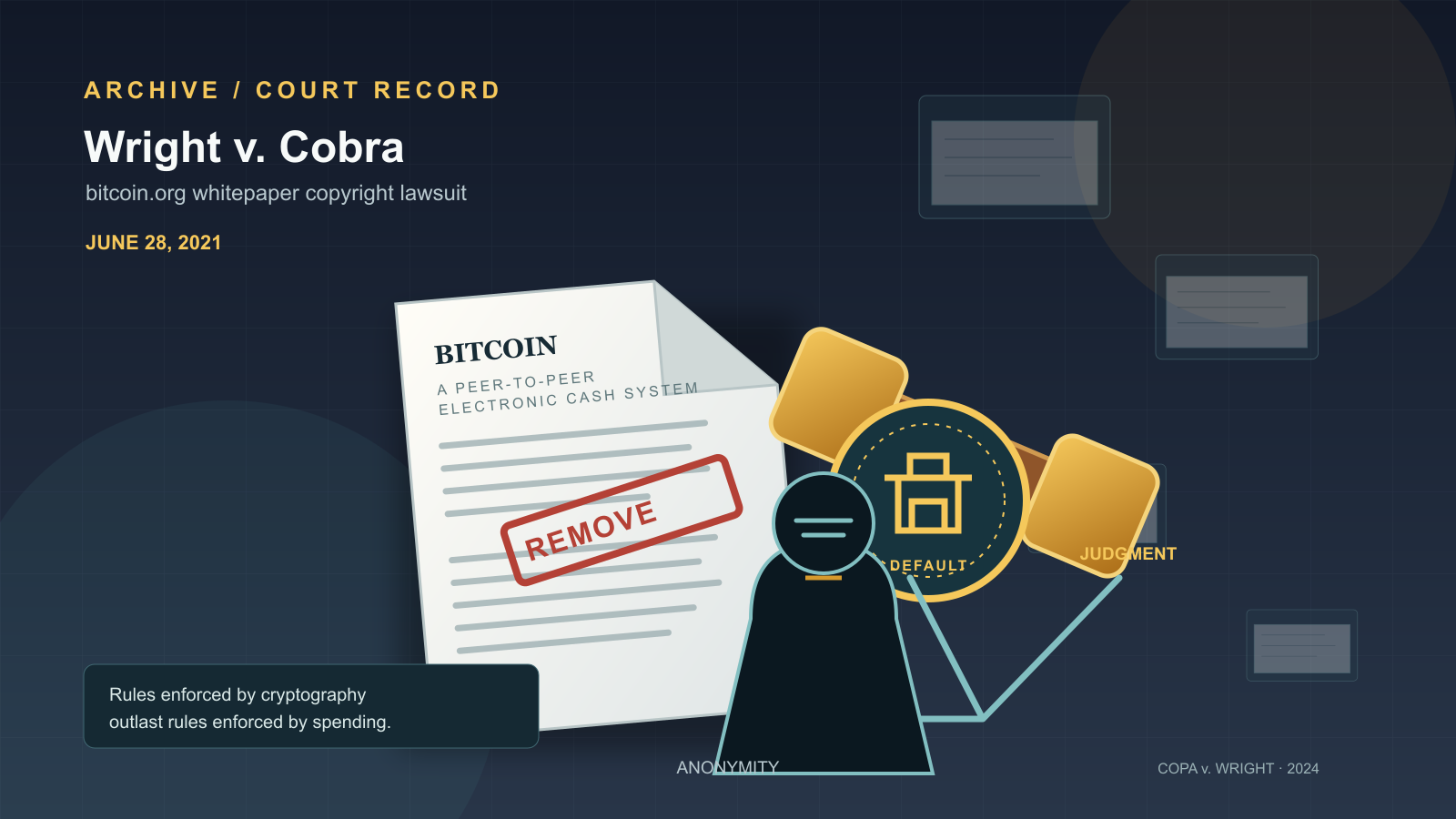
Some early Bitcoin participants used pseudonyms casually and dropped them later — Sirius eventually became Martti Malmi in public, theymos eventually became Michael Marquardt. Others kept their pseudonyms tight: Cøbra chose default judgment in a London court rather than appear under his legal name. knightmb belongs to the second pattern. Whatever happened in Tennessee in 2012, whatever Timekoin became, whatever the secondary sources have since written, the BitcoinTalk record itself preserves only the work — and the silence around it.