Bitcoin Institute

Bill Frantz

Security consultant who discussed Bitcoin's early security implications

Figures

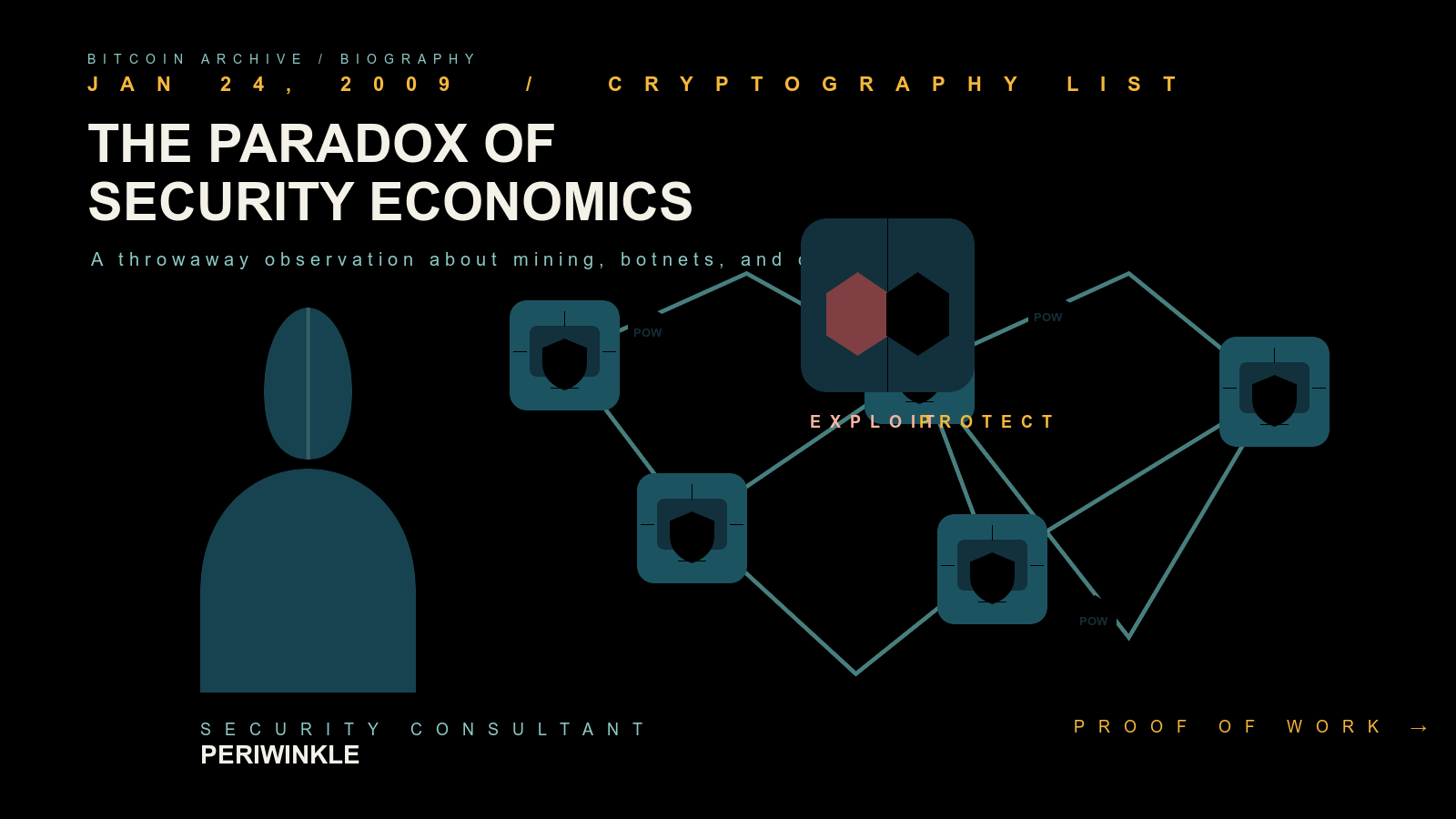
A faceless human silhouette beside a dark network diagram of small server nodes, each wrapped in a shield icon and connected by lines, with diamond-shaped proof-of-work tokens flowing toward them, and a central icon split into a dark red hexagon and a black hexagon labeled exploit and protect

On January 24, 2009, San Francisco Bay Area security consultant Bill Frantz replied to Hal Finney with a characteristically ironic observation about how Bitcoin’s mining incentives might reshape network-security economics — engaging the same botnet-mining concern Jonathan Thornburg had raised a week earlier, from the opposite angle:

“The 0wned machines are among the most secure on the network because botnet operators work hard to keep others from compromising ‘their’ machines.”

He speculated that botnet operators might evolve into legitimate security firms — protecting computers against compromise in exchange for proof-of-work mining rewards.

Frantz consults under the firm name Periwinkle (pwpconsult.com).

Mailing List Contribution

Frantz’s reply directly answered Hal Finney’s argument that proof-of-work tokens create security incentives — the botnet observation quoted above was his ironic response to it. The next day, Satoshi’s own reply to Dustin Trammell picked up the same botnet/proof-of-work economics from the opposite angle, proposing “reverse-spamming” as a market countermeasure rather than Frantz’s ironic security upside.

Significance

It was a throwaway, half-ironic line — but it caught something real: the same proof-of-work reward that secures the chain could, in principle, pay the people who run botnets to defend machines rather than exploit them.

Related Entries

1 entries