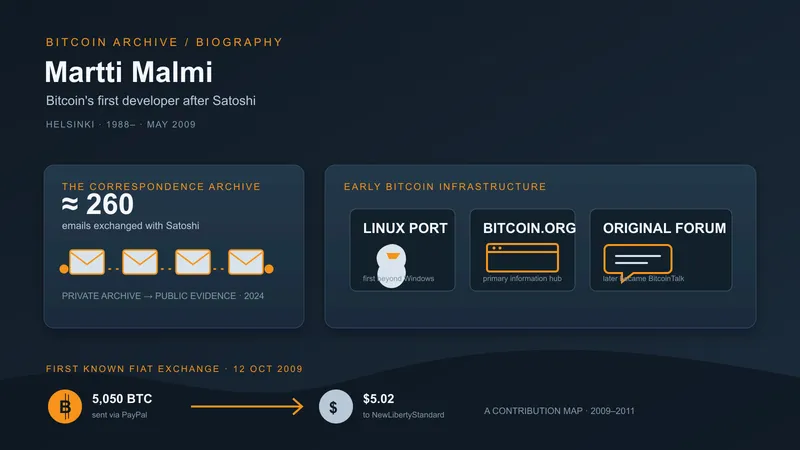

On May 3, 2009, replying to Martti Malmi’s offer to write an FAQ, Satoshi attached “a compilation of questions I’ve answered in forums and e-mail” under the heading “QUESTION AND ANSWER DUMP.” One of those earlier answers took up what would become one of Bitcoin’s most enduring criticisms: its energy consumption. The compilation quotes the objection it answered, “The last thing we need is to deploy a system designed to burn all available cycles.” The words are John Gilmore’s, from his post to the cryptography mailing list of January 25, 2009. The compilation does not say when, where, or to whom Satoshi first wrote his answer; May 3 is the date it reached Malmi.
Satoshi argued that even if Bitcoin grew to consume significant energy, the cost would be “an order of magnitude less than the billions in banking fees” that characterize the traditional financial system. He framed Bitcoin mining’s energy use as a trade-off that should be compared to the full cost of maintaining the existing banking infrastructure.
He acknowledged the philosophical tension this created:
Satoshi Nakamoto (email to Martti Malmi, May 03, 2009, 10:32:26 PM UTC)Ironic if we end up having to choose between economic liberty and conservation.
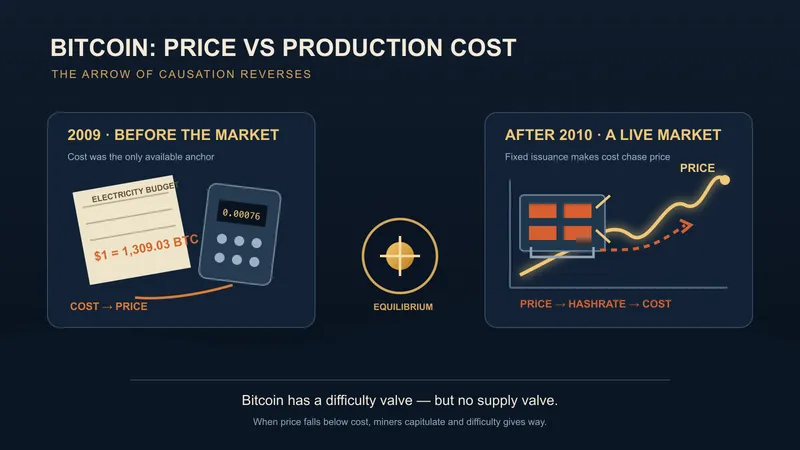
Satoshi also explained the economics of mining, noting that the value of bitcoins would be relative to the electricity consumed to produce them, and that the extra wattage consumed would go directly to the miner’s power bill, with the value of produced bitcoins being “something less than that.” This same cost-of-production reasoning is what this archive’s analysis of Bitcoin’s price-versus-production-cost economics traces from 2009 into the modern economic literature.
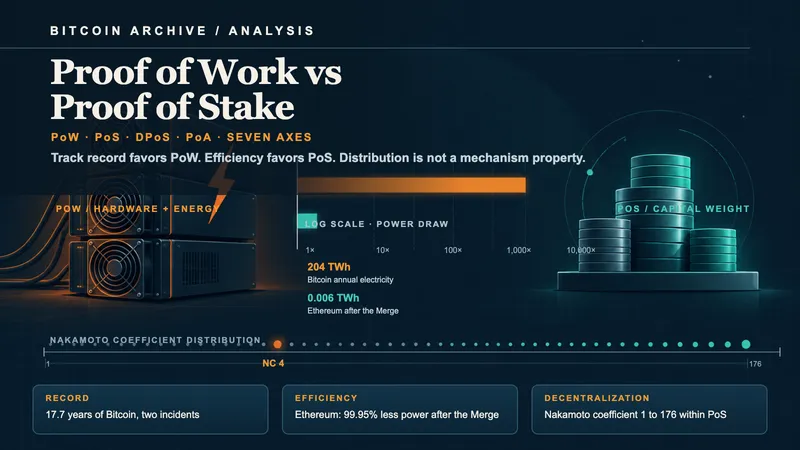
He wrote that “unfortunately, proof of work is the only solution I’ve found to make p2p e-cash work without a trusted third party,” and that proof of work was “fundamental to coordinating the network and preventing double-spending.” The alternative he had not found, securing a ledger with staked coins instead of spent electricity, was proposed two years later and now runs the second-largest chain; the proof-of-work versus proof-of-stake comparison measures the two against each other, starting from this letter.